

Guest writer: Pilgrim.
Introduction
One year after the death of Pope Francis, Edward Pentin’s interview with Peter Kwasniewski presents The Disastrous Pontificate: Pope Francis’ Rupture from the Magisterium as a sober reckoning with a troubled papacy. What it offers, in fact, is something more consequential: a nearly thousand-page forensic account of a pontificate its author regards as a catastrophe. This is, in recent Catholic publishing, a competitive category. The book is presented as a pastoral resource, a handbook for priests, parents, and seminarians trying to navigate the wreckage of twelve years of doctrinal confusion.
Kwasniewski raises real concerns. The Francis years were often genuinely difficult, and pretending otherwise would be dishonest. Anyone who followed the pontificate closely will recognise that. But there is a difference between acknowledging difficulty and constructing an indictment. And it is the indictment, its scope, its tone, and above all its implied ecclesiology that raises questions the interview does not answer and perhaps does not quite realise it needs to ask.
The central problem is not Kwasniewski’s critique of Francis. It is that his presentation serves as the public face of a project whose interior logic, when its actual author speaks freely, tends not toward fraternal correction but toward something considerably closer to institutional rupture.
The Case Being Made
Kwasniewski’s argument has three interlocking parts, each of which deserves to be understood before being questioned.
The first is doctrinal. He argues that Francis, most critically in the trilogy of Amoris Laetitia, Fiducia Supplicans, and Dignitas Infinita, systematically elevated subjective personal experience above the objective norms of revealed truth.
The most explosive claim comes via Josef Seifert’s reading of Amoris Laetitia paragraph 303, which is described as a “moral theological atomic bomb”. A passage that implicitly licenses individual conscience to override the demands of the moral law. If conscience can determine that an objectively irregular situation is “what God himself is asking,” then the Church’s entire framework of moral teaching becomes, in principle, negotiable.
The second part is institutional. Kwasniewski argues that a pathological “hyper-papalism,” a popular inflation of papal authority far beyond what Vatican I actually defined, enabled Francis to act without adequate accountability and now prevents honest reckoning with the consequences. This is a theologically well-grounded observation. Pastor Aeternus defined papal infallibility with considerable precision: the pope must “religiously guard and faithfully expound” the existing deposit of faith, and must not “make known some new doctrine.” The gap between that careful definition and the culture of near-absolute deference that grew up around it is real, and Kwasniewski is right to name it.
The third part is practical. He is not calling for schism. He is calling for what Thomas Aquinas identified as fraternal correction: a duty to challenge a superior whose errors cause genuine harm, provided the challenge is made in charity and without contempt. He cites the fourteenth-century dispute over Pope John XXII’s eschatological error as precedent. Theologians and secular rulers challenged the pope formally and publicly, and the pope eventually took remedial steps.
This is a serious argument. It should not be brushed aside by simply reasserting papal authority as if the question had never been raised.
The Book Behind the Interview
That framework looks rather different when we examine what the book’s actual author says in his own voice. The gap between the two is considerable, and the gap is the point.
In the Pentin interview, Kwasniewski presents The Disastrous Pontificate as sober theological scholarship: carefully documented, pastorally motivated, and rooted in the tradition of fraternal correction. Grigio, the anonymous author, Kwasniewski tells us, “couldn’t sleep” because of the harm being caused to souls. The book is framed as an act of conscience, a handbook for priests and parents, and a contribution to the historical record.
Fraternal correction, as Aquinas understood it, is a targeted act of charity directed at a specific harm. It is not, as a rule, 750 pages long. The scale of the project is itself a clue to its purpose. This is not a correction; it is a prosecution brief designed to be definitive.
Grigio spent five years researching and writing it. Five years of daily immersion in the errors, missteps, and provocations of a pontificate you already believe to be catastrophic is not a recipe for measured judgment. It is a recipe for the kind of cumulative outrage that produces extreme accusatory phrases. The book’s length is not evidence of its thoroughness. It is evidence of its obsession.
When Grigio speaks in his own voice in interviews to promote the book (in Rorate Caeli and Gloria.tv) the picture is different in ways that matter. He describes himself as a “guard dog” of the Church, a “hunter of wolves”. He refers to Francis’s “co-conspirators.” He calls the pontificate an act of deliberate sabotage, the barque of the Church “being deliberately steered onto the rocks.” He describes the excommunication of those who challenged Francis as “ecclesial murder.” He endorses the claim that Francis presided over “the most disastrous pontificate, from the doctrinal point of view, in the entire history of the Catholic Church,” a claim that places Francis below popes formally condemned for heresy, below the Borgias, below every catastrophe in two millennia of Church history. It is an extraordinary assertion, and nothing in the book’s promotional material comes close to the standard of proof it requires.
The personal testimony Grigio offers is at times genuinely moving. The story of a friend deserted by her husband, left to raise children alone while remaining faithful to her marriage vows, is affecting. But it is deployed to establish that Amoris Laetitia was “manipulative and devious,” which does not follow. Pastoral harm caused by ambiguity is real. It does not prove deliberate malice. The slide from one to the other is a rhetorical move, not a theological argument.
Most revealing of all is Grigio’s handling of the question of whether Francis was a legitimate pope. He does not answer directly. He offers a careful disclaimer, noting that it “took the Church 43 years to condemn Pope Honorius,” before retreating with the observation that he will “leave that to the judgment of a future pope and council.” The effect is less that of theological restraint than of legal cover; venturing as close as possible to sedevacantism without technically crossing the line. For a book presented as orthodox Catholic scholarship, it is a striking place to end up.
The question this raises about Kwasniewski is uncomfortable. He is an intelligent and theologically sophisticated man. Given the contrast between the interview and Grigio’s own statements, it is difficult to avoid the conclusion that he cannot be unaware of the register in which Grigio operates when speaking freely. Yet in the Pentin interview, he presents the book as measured fraternal correction and frames the whole project in the language of Aquinas and pastoral concern. That presentation is, at best, selective. A book whose author describes himself as a guard dog hunting wolves, speculates about whether the pope he criticises was even legitimate, and dedicates his work to a future council that will reverse Francis’s pontificate is not an exercise in fraternal correction. It is a movement edging toward a parallel authority within the Church, articulated in theological language. That Kwasniewski presents it otherwise is not incidental.
Where the Argument Overreaches
The argument has structural weaknesses that go beyond matters of tone.
The most serious is this: if an entire pontificate, not a document, not a single decision, but twelve continuous years, amounts to a sustained rupture from the deposit of faith, a much larger question surfaces. What does this imply about the Church’s claim to be a reliably guided teacher? Kwasniewski affirms, in the same breath, that the Holy Spirit protects the Church from definitive error and that the Church’s visible head spent over a decade endangering souls on a large scale. That tension is not resolved in the interview. It is displaced into appeals to future correction and grassroots renewal; a rather different thing.
The rhetorical excess of the argument also undermines its credibility. Phrases like “weaponized ambiguity,” “gaslighting,” and the claim that Francis “delighted in attacking” faithful Catholics are accusations of deliberate malice, not theological descriptions. Kwasniewski’s argument draws much of its force from the claim that Francis acted in bad faith. What he actually demonstrates looks considerably more like leadership and governance failures and pastoral recklessness. That gap matters, and it should not be papered over with emotive language.
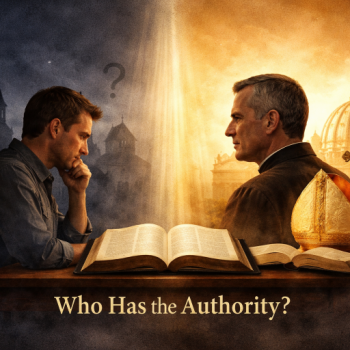
There is also the unresolved problem of interpretive authority. The call for a “groundswell at grassroots level” to correct papal error raises the obvious question of who decides what counts as an error? The answer, Scripture, Tradition, and the perennial Magisterium, does not solve the problem. It moves it somewhere else, because each of those sources has to be interpreted, and the history of Christianity is largely the history of disagreements about how to do that.
Once it is accepted that a community’s reading of tradition can override the living magisterium, interpretive authority tends to migrate, often gradually and without anyone intending it, away from the wider communion and toward those who are convinced they have read the tradition correctly. Chesterton observed that the madman is not the man who has lost his reason but the man who has lost everything except his reason. He is the person whose system is perfectly self-consistent and perfectly sealed against correction from outside. The Old Catholics, after Vatican I, did not set out to found a separate church. Sedevacantists did not begin by intending to conclude that every pope since Pius XII was illegitimate. These things happen by degrees, and each degree feels, from the inside, like fidelity.
Grigio’s interviews make that trajectory uncomfortably visible. He has not formally embraced sedevacantism. He has adopted its emotional logic: the institution is corrupt, its authorities are compromised, the faithful remnant must hold the line until a future pope and council set things right. That is not the posture of fraternal correction. It is the posture of someone who is placing himself outside the authority he is nominally correcting. That may not be Kwasniewski’s intention in publishing and promoting this book, but it is a pattern, and once it begins, it is not easy to contain.
The Honest Reckoning
None of this requires pretending that the Francis years were straightforward. They were not, and the legitimate grievances deserve to be distinguished from the catastrophist framework into which they have been absorbed.
The distinction between a difficult pontificate and a rupture is not merely tonal. It is theological. Ambiguity in a magisterial document is not the same as a formal contradiction of defined doctrine. Amoris Laetitia paragraph 303 is genuinely ambiguous; it is not a direct contradiction of Veritatis Splendor. Fiducia Supplicans entered territory the Church had previously avoided; it did not reverse a defined teaching. The cumulative weight of these documents is real, but it becomes a rupture only if the ambiguities consistently point toward a coherent alternative doctrine. The more plausible reading is that they reflect pastoral improvisation and governance failure rather than a systematic programme of doctrinal revision. That is a serious problem. It is not the same problem.
On the dubia specifically, Kwasniewski’s position is close to traditional canonical practice. The submission by the four cardinals was not an act of defiance. It was a recognised formal mechanism, and Francis’s deliberate refusal to engage with it was a governance failure of the first order. That grievance is legitimate. But a legitimate grievance absorbed into a catastrophist framework does not validate the framework. The dubia deserved an answer. Not receiving one was a serious failure of governance. It was not evidence of doctrinal rupture, and treating it as such does a disservice to the cardinals who submitted it in good faith through proper channels.
The Governance Problem
What neither the interview nor most responses on either side quite reach is that the crisis was not primarily doctrinal in the abstract. The doctrinal ambiguities were real, but the scale of the crisis they produced was not inevitable. It was amplified by how they were managed. It was a crisis of governance, more specifically of how ambiguity was managed in a communication environment that fundamentally changed its consequences.
Francis governed through deliberate ambiguity, personal gesture, and informal signals, a style that might have functioned tolerably in an earlier era, when Roman documents were read primarily by theologians and episcopal disagreements managed through private correspondence. In a world where a papal footnote is parsed by a thousand commentators within hours and a cardinal’s letter of dissent is published simultaneously across multiple continents, the tolerance for unresolved ambiguity in magisterial documents is effectively zero. Not because the Church should be governed by the demands of social media, but because the practical consequences of ambiguity are now vastly more damaging and harder to contain than they were even a generation ago. The dubia crisis illustrates the point precisely: four cardinals seeking clarification of a published document is a symptom of a process that failed before publication, not after. Francis’s refusal to respond was not an oversight. It was a choice, and it made everything that followed considerably worse.
The structural questions this raises: stronger theological vetting before documents are released, clearer formal mechanisms for post-publication clarification, and genuine channels for episcopal concerns before they become public fractures, are more pressing and considerably less glamorous than the doctrinal debates they generated. They are also, in the long run, more consequential. A Church that addresses its governance failures is less likely to produce the conditions in which catastrophist movements flourish. A Church that leaves them unaddressed should not be surprised when they do.
A Cardinal’s Warning
One document places all of this in sharper relief. In early 2022, a memorandum circulated privately among the cardinals who would elect the next pope. Its author, writing under the pseudonym Demos, was Cardinal George Pell.
The memorandum opens with a verdict that has the compression of a Latin epitaph: “Roma loquitur. Confusio augetur.” (Rome speaks. Confusion grows.) In four words, Pell identified the governance failure this essay has been diagnosing: not silence, but speech that generated disorder rather than clarity, ambiguity deployed where definition was needed. He went further, cataloguing failures that extended well beyond theology: arbitrary dismissals of Vatican staff, phone tapping, manipulation of legal processes, and the removal of external auditors getting too close to financial irregularities. These are the observations not of a traditionalist theologian disputing a footnote but of a senior institutional figure describing an organisation whose dysfunction had become systemic.
Most pointed of all is Pell’s warning about schism. Writing to his fellow cardinals, he observed that schism was unlikely to come from the left, who “sit lightly to doctrinal issues,” but that it was “more likely to come from the right and is always possible when liturgical tensions are inflamed and not dampened.”
The weight of that observation should not be missed. Pell was no liberal. He shared many of the instincts of those who found the Francis years deeply troubling, and he said so plainly. He was writing privately, before a conclave, with no audience to perform for. And his considered judgment was that the traditionalist movement, the movement in which Kwasniewski is a prominent and respected voice, and of which Grigio represents a considerably more incendiary expression, was the more serious fragmentation risk. The warning was not aimed at their enemies. It was aimed, with some precision, at their friends. That precision is worth sitting with.
Conclusion
The interview, and the book behind it, represent a serious attempt to come to terms with a pontificate that was often confusing and genuinely troubling. People felt it at the time. That should not be dismissed.
But Kwasniewski’s more carefully made case serves as the respectable public face of a project whose actual character, when Grigio speaks freely, is considerably more radical. The legitimate grievances of the Francis years, the ambiguity, the governance failures, the unanswered dubia, have been captured by a movement whose logic, followed to its conclusion, leads not to fraternal correction but to the construction of a parallel authority dressed in traditional language. That is what distinguishes Grigio’s project from the cardinals who submitted the dubia. They used a formal canonical mechanism and accepted the institution’s failure to respond as a failure to be recorded and pressed further. Grigio has adopted the emotional logic of someone who has already decided the institution cannot be trusted.
Once it becomes normal to treat an entire pontificate as a rupture from the faith and organise accordingly, the question of authority inside the Church ceases to be stable. Tradition has to be interpreted. And the community that appoints itself tradition’s guardian against the living institution has, without quite intending to, begun to stand apart from the body that has carried that tradition through twenty centuries. Ecclesiologically speaking, that is a dangerous place to end up, and Pell, who understood the danger from the inside, said so plainly to the men who would choose the next pope.
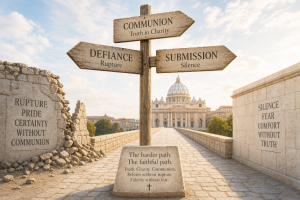
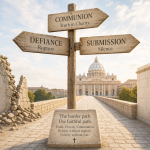
The harder task is more patient and less dramatic: pressing for clarification through legitimate channels, accepting that the arc of doctrinal resolution is measured in decades rather than news cycles, and refusing to allow genuine grievances to be weaponised in service of a rupture that would cause more damage than the confusion it claims to remedy. That is harder than either submission or defiance. It requires remaining inside a structure that has demonstrably failed to answer legitimate questions, and continuing to press through the same channels that have already been tried.
None of this yields a neat resolution, and it should not be expected to. The point is not to offer an alternative system, but to clarify the cost of prematurely abandoning existing ones. Chesterton once remarked that the Christian ideal has not been tried and found wanting; it has been found difficult and left untried. Something similar might be said about the ideal of remaining in communion while pressing hard for reform. The catastrophist finds it too difficult and reaches for more satisfying remedies. The evidence suggests that this is precisely the wrong moment to do so.
Thank you!
Read The Latin Right’s other writing here.
Please visit my Facebook page and IM your questions (and follow my page) or topics for articles you would like covered.





 Ad-Free & Subscriber Log-In