

Recently, I engaged two well-read Protestants on my Discord server devoted solely (sola) to the topic of sola scriptura. In my critique of sola scriptura, I often highlight the challenges inherent in scriptural interpretation. Here, I agree with Keith Mathison, who observes in The Shape of Sola Scriptura that “any appeal to Scripture is an appeal to an interpretation of Scripture. The only question is: whose interpretation?”
In response, I usually hear appeals to “experts” and the “magisterial Reformers” as reliable—yet still fallible and therefore corrigible—lesser authorities. But who corrects these authorities? The answer comes quickly: “God, through Scripture, corrects them.” To which I reply: “That still requires interpretation, and any appeal to Scripture is an appeal to an interpretation of Scripture.” The problem should now stand clear.
When I then present the Catholic case—which requires an authority empowered by God to settle theological and moral disputes conclusively—one interlocutor accuses me of “putting the Roman Magisterium in the place of God.” He claims that the Catholic understanding of infallibility (in defining doctrine) “makes the Magisterium equivalent to God.” In other words, while Protestants adhere to sola scriptura with its correctable authorities, Catholics supposedly adhere to an unquestionable sola ecclesia—the Church alone.
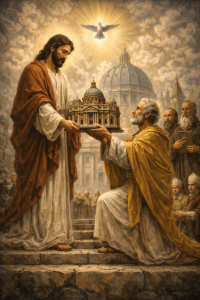
This exchange, and others like it, led me to consider the nature of Christ’s mission and what He left behind at His Ascension. Did Christ leave a book to invite endless dispute, or did He establish a visible Church to preach, teach, and govern in His name? To listen to this Church means to listen to Christ. To reject this Church means to reject Christ (Luke 10:16).
Christ did not leave a self-interpreting text. He established one visible, authoritative Church—and He commands our submission to it.
Christ Founded One Visible Church
Before pen ever met paper (or papyrus) to record His story, God’s Word entered the world in the person of Jesus of Nazareth (John 1:14; Philippians 2:7). Jesus first called disciples—twelve, and then seventy. After His death and resurrection, eleven of the Twelve became apostles (the “sent ones”).
The first appearance of the word “church” in Scripture (Matthew 16:18) coincides with Jesus renaming Simon as Peter (rock) and declaring that He would build His Church upon him.
Moreover, St. Paul, the apostle to the Gentiles—“as to one untimely born” (1 Corinthians 15:8)—calls the Ephesians to maintain unity in the Spirit: “There is one body and one Spirit—just as you were called to the one hope that belongs to your call—one Lord, one faith, one baptism, one God and Father of all” (Ephesians 4:4–6).
Notice what St. Paul does not say. He does not speak of many bodies or many kinds of baptism. He speaks of one—just as God is one.
At this point, some Protestants push back and claim that I commit a category error by equating “the Church established by Christ” with the “Roman” Catholic Church. To that, I offer this response: I see no reason to differentiate between the Church that existed in Rome in the first century and the one that exists in the twenty-first—just as I see no reason to differentiate between a man as a child and that same man as an adult. Same person, different stage of development.
Therefore, the burden does not rest on me to prove continuity, but on the Protestant to prove rupture. He must show where the Church founded by Christ ceased to exist and a different body took its place—something the historical record simply does not support.
The Apostolic Pattern: Authority That Binds
We see how the early Church understood her authority in the first major threat to ecclesial unity in Acts of the Apostles 15. There, Luke the Evangelist recounts how “some men” came down from Judea and taught that Gentile converts must receive circumcision or risk damnation. They grounded this claim in Book of Genesis 17:13, which describes circumcision as an “everlasting covenant.”
This dispute escalated, and the apostles convened the first Church council—the Council of Jerusalem. After vigorous debate and the testimony of Sts. Peter and James, the council decided not to require circumcision for Gentile converts. Despite the “everlasting” language of Genesis 17:13, the council declared in its letter: “it has seemed good to the Holy Spirit and to us” to lift this obligation.
The council did not offer advice; it issued a binding judgment for the whole Church. In doing so, the apostles established a clear pattern for resolving doctrinal disputes: the Church speaks with authority—and her judgment binds.
The Apostle’s Plan to Ensure Unity After Them
Some argue that the unique authority of the apostles—an authority that resided in them alone—gave the Council of Jerusalem its binding force. On this view, that authority ceased with the death of the last apostle, leaving only their writings, or the writings of those associated with them, as the remaining source of authority.
However, a letter from Clement of Rome to the Corinthians at the end of the first century—written during the lifetime of the last apostle, John the Apostle—reveals the apostles’ intentions before their deaths. Clement writes:
Our apostles also knew, through our Lord Jesus Christ, that there would be strife on account of the office of the episcopate. For this reason, therefore, since they had obtained perfect foreknowledge of this, they appointed those ministers already mentioned and afterward gave instructions that, when these should fall asleep, other approved men should succeed them in their ministry.
In short, the apostles anticipated future disputes and took steps to preserve unity. They appointed successors and instructed those successors to appoint others in turn. Their foresight proved necessary. The Church soon faced continued threats to her unity—first from external movements like Gnosticism, and then from within, most notably through an Alexandrian priest named Arius.
The latter crisis grew so severe that the first ecumenical council convened at Council of Nicaea (modern-day Iznik, Turkey) to resolve the dispute. As at Jerusalem, the council fathers did not offer suggestions—they issued a binding declaration for the whole Church.
The Collapse of Authority Without the Church
Let us return to sola scriptura and the problems inherent in its actual application. As Keith Mathison observes, “All appeals to Scripture are appeals to interpretations of Scripture.” Without a Church that exercises final interpretive authority, disputes multiply endlessly and unity becomes impossible. In the end, theological truth itself becomes functionally subjective when no answer exists to the question: whose interpretation should prevail?
In Gospel of Luke 10:16, Jesus states plainly: “The one who hears you hears me, and the one who rejects you rejects me, and the one who rejects me rejects him who sent me.” If we take Christ at His word, listening to His Church is not optional. It is the means He established to teach, correct, and save.
To knowingly reject the authority of the Church is not merely to disagree with men—it is to resist Christ’s own authority.
Final Thoughts… Christ’s Gift: Ecclesia Sola
Jesus Christ wrote nothing and gave no command for others to write on His behalf. Those who wrote did so for specific reasons, often to address concrete issues as they arose in real time. They did not set out to compile the twenty-seven books we now call the New Testament. In this sense, the New Testament emerged as a later development—guided by the Holy Spirit, yet still a development. Christianity existed before the New Testament and could, in principle, have continued without a fixed canon.
What Christianity requires to exist is a visible Church. It requires the Church because Christ established it. He established one Church, and those who listen to her listen to Him. Those who reject her reject Him.
Finally, one cannot affirm Christ while rejecting the means He established to teach in His name. He did not leave behind a collection of texts for endless debate; He established a Church to speak with His authority. If that Church still exists—and history affirms that it does—then the question is not whether you agree with her, but whether you will submit to Christ speaking through her.
Thank you!
Read The Latin Right’s other writing here.
Please visit my Facebook page and IM your questions (and follow my page) or topics for articles you would like covered.













 Ad-Free & Subscriber Log-In