

Guest writer: Pilgrim.
Introduction: When the President Attacks the Pope
Something remarkable has been unfolding, though perhaps only remarkable if, like me, you come from a country where faith and politics presently maintain a careful, slightly embarrassed distance from one another. I’m British. The idea that a sitting head of government would publicly attack a pope strikes me as the kind of thing that happens in a Robert Harris novel. And yet.
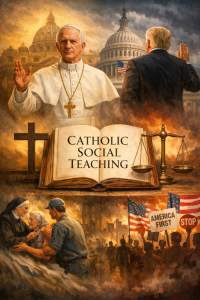
A year into Pope Leo XIV’s pontificate, the President of the United States posted a broadside against him on Truth Social that was as theologically revealing as it was politically bizarre. The post accused Leo of being “weak on crime,” suggested the College of Cardinals had elected him specifically to manage the American president, and ended with the demand that the pope “get his act together” and “stop catering to the Radical Left.” With this came an AI-generated image of the president as a glowing, messianic figure laying hands on the sick. Digital iconography so nakedly self-aggrandising that even some sympathetic commentators fell silent. There is, one notes, a long tradition of powerful men casting themselves as saviours. It has not, historically, ended especially well for the powerful men.
The immediate trigger was Iran. As the war escalated, Leo XIV became one of its most consistent critics, condemning the violence and, more pointedly, condemning the effort to dress it in religious language. He warned against what he called the “delusion of omnipotence” and insisted the Gospel cannot be conscripted into the service of political power. For that, he was attacked. One is tempted to observe that being attacked by Caesar for saying the things Jesus might say is not, theologically speaking, the worst position to be in.
The vulgarity of the attack is almost beside the point. What makes the episode worth examining is what it reveals. This wasn’t personal. It was, in a sense, doctrinal. The president wasn’t insulting a man; he was rejecting a tradition. One that’s older than any political movement currently operating in America, and more intellectually coherent than most. That tradition is Catholic Social Teaching.
What makes the collision still more revealing is that the political coalition behind the President is not theologically uniform. The Evangelical base and its growing Catholic intellectual class read Scripture differently, reason about war differently, and understand the relationship between faith and power differently. Even within the Protestant wing, dispensationalists who read current events as prophetic fulfilment and Reformed Calvinists who insist that biblical principles must govern every domain of public life occupy genuinely distinct theological ground. The coalition disagrees, sometimes sharply, about poverty, about the obligations of wealth, and about what Christian political life is for. What holds the coalition together is shared political interest, not shared doctrine. The attack on Leo XIV exposed that fault line.
This offers as good an occasion as any to examine what Catholic Social Teaching actually says, and, perhaps more importantly, what kind of thing it is. It is not a policy platform. It is a tradition of moral reasoning: a set of principles sturdy enough to think with, not a manifesto to be adopted wholesale. Which is partly why it remains so difficult to absorb into any of the frameworks currently competing in American political life, and partly why it so often gets recruited, selectively and dishonestly, to serve agendas it would not endorse.
The Foundation: Rerum Novarum and the Rejection of Both Extremes
We start with the document Rerum Novarum, issued by Pope Leo XIII in 1891. This was written in the upheavals of industrial capitalism: agrarian communities displaced, an urban working class grinding through brutal conditions for subsistence wages, and socialist movements on the rise, promising radical redistribution as the fix. Leo XIII looked at the disease and the proposed cures and rejected both.
His rejection of socialism was blunt and categorical. The “main tenet of socialism, community of goods,” he wrote, “must be utterly rejected,” not just as impractical, but as fundamentally unjust. Stripping workers of private property wouldn’t liberate them. It would harm them most directly, destroying the very means by which ordinary people build security and independence. This is worth noting, since a great many people who invoke CST against capitalism appear not to have read the first document in the tradition.
Leo XIII had no intention of baptising industrial capitalism either. Rerum Novarum insists on workers’ right to form trade unions, on genuine fair wages as an obligation of employers, and on the state’s legitimate role in protecting working conditions and providing for those who cannot provide for themselves. Private property is a right, but not an unlimited one. Capital exists to serve human beings, not the other way around.
Underlying all of this is a principle the tradition calls the “universal destination of goods”: the conviction that the goods of the earth are destined, before any legal arrangement, for the benefit of all humanity. Private ownership is legitimate and important, but it exists within and remains answerable to that prior claim. This is what distinguishes CST’s defence of property rights from a libertarian one. A distinction the tradition has always been careful to maintain, and which tends to get lost in translation when CST is recruited to serve existing political agendas.
This dual rejection, grounded in the universal destination of goods, is the permanent foundation beneath everything that follows. CST refuses the familiar left-right axis of American politics not out of desperate centrism (the politics of splitting every difference and pleasing no one) but because it’s asking a different question entirely. Not “state or market?” but something more basic: “what are human beings, and what do we owe one another?” Once you start there, neither the socialist nor the libertarian answer looks remotely adequate. It does not follow, however, that the CST tradition then supplies you with the correct answer. Instead, it supplies you with better tools for reasoning toward one.
Subsidiarity and Solidarity: The Twin Pillars
Take solidarity first, because it’s the one that gets cheapened most often, reduced to a vague feeling of niceness toward strangers, which isn’t quite what the tradition means.
In CST, solidarity carries a harder claim. Human beings aren’t isolated atoms competing for resources. Their dignity and well-being are genuinely bound up with one another. A society that permits extreme poverty alongside extreme wealth, or that abandons the elderly and disabled to destitution, has failed a fundamental moral test. How efficient its markets are is, at that point, beside the point.
Subsidiarity gives solidarity its shape and stops it from collapsing into its bureaucratic imitation. Formally introduced by Pope Pius XI in Quadragesimo Anno in 1931, the principle holds that governance and care must remain as close to the person as possible. A problem solved by a family need never reach the parish. A problem solved by a local community need never reach the federal government. The issue isn’t that government is bad (the tradition has never said that) but that large, impersonal institutions are genuinely poor substitutes for face-to-face care, however well-intentioned. A bureaucracy that loves humanity in the abstract has a poor track record with actual human beings.
Put together, you get a social vision that is not socialism, not capitalism, and not centrism. It operates from different first principles, which is why both sides of American politics can find something in it and neither can fully claim it. Conservatives recognise subsidiarity. Progressives recognise solidarity. Each tends, quietly, to drop the half that complicates their existing commitments. This is, in fairness, what most people do with traditions they find inconvenient. And CST is more inconvenient than most.
The tradition is also more honest than most political frameworks about where its own principles create genuine friction. Migration is an obvious case. Global solidarity insists that every human being possesses inviolable dignity and that wealthy nations bear real obligations toward the world’s poor, including a genuine moral right to permit migration when survival or basic dignity demands it. Subsidiarity, meanwhile, affirms the legitimate role of national communities in maintaining their own coherence, and the state’s authority to regulate its borders as a matter of practical governance.
These two commitments do not automatically resolve into a single immigration policy, and CST does not pretend otherwise. This tension is genuinely unresolved, not a flaw in the tradition, but a sign that it is engaging with a real problem rather than a tidy one. What it insists is that neither pole can be dismissed. The person crossing the border possesses full human dignity, and the community receiving them has legitimate interests. Holding both simultaneously, without collapsing into either open-borders universalism or nativist exclusion, is precisely the kind of difficult moral reasoning the tradition demands, and that contemporary political discourse finds increasingly impossible. It does not tell you where to draw the line. It tells you what considerations must be weighed when you draw it.
A Century of Development
The pattern across more than a century is consistent. Each generation takes the foundational principles of Rerum Novarum and presses them against the new problems of its era. The tradition develops. It does not wander.
Quadragesimo Anno introduced subsidiarity formally and added a warning that reads uncomfortably clearly today: unregulated capitalism, by concentrating wealth, also concentrates power, and concentrated power threatens human freedom whether it sits in the state or in private monopolies. Pius XI wrote this during the Depression. One wonders what he would make of the present situation.
Later documents extended the tradition’s reach without altering its foundations. John XXIII grounded international relations in truth, justice, and charity rather than military power, a proposal with the considerable advantage of being right, and the considerable disadvantage of being almost entirely ignored. Paul VI insisted that assistance from wealthy to poor nations is a matter of justice, not charity. He said this nearly sixty years ago. We are, as a species, still working up to it. John Paul II argued for the priority of labour over capital, and welcomed the defeat of Soviet collectivism while firmly refusing to declare liberal capitalism the winner. The free market, in his account, is a tool embedded in a moral framework: useful in that condition, destructive when treated as self-sufficient, which it increasingly is. Pope Francis extended the tradition into ecological territory, arguing that the same logic of exploitation that devastates ecosystems also devastates human communities, and that the poor reliably end up at the front of both queues. Fratelli Tutti addressed contemporary tribalism and nationalism directly. It was written five years before the current American administration gave anyone a particular reason to be enraged by it. The tradition tends to run slightly ahead of the news.
What CST Is Not: Clearing Away the Confusion
Two misreadings dominate, and both need to be named.
Catholic Social Teaching is not socialism. It never has been. Catholics who appeal to CST in support of abolishing private property or nationalising industry are not reading CST. They’re projecting their pre-existing politics onto it. When Pope Leo XIV speaks about care for the poor or the rights of migrants, he is applying principles that have been the Church’s consistent teaching since 1891. That consistency is the point, which, in the context of modern politics, is practically indistinguishable from being prophetic.
Equally, CST is not a theological endorsement of MAGA conservatism, or of any nationalism that reduces Christian identity to cultural tribalism. The tradition is universalist at its core. Every human being, regardless of nationality, possesses inviolable dignity. The “preferential option for the poor” is incompatible with economic policies that systematically favour the wealthy. And subsidiarity, while it supports local over federal solutions where genuinely appropriate, is not a philosophical licence to abandon the vulnerable to market forces and calling the result freedom. I say this as someone who finds these particular manoeuvres of dressing abandonment up as liberty or solidarity up as socialism, one of the more tiresome features of the current moment.
Nor is CST one voice in a broader Christian argument about prophecy, poverty, and political power. This is worth dwelling on because the differences are not stylistic. Some currents in American Protestant Christianity read Scripture as a predictive timeline in which contemporary conflicts carry eschatological significance and certain policy options become theologically foreclosed. Others, in the Reformed Calvinist tradition, resist that dispensationalist framework but bring their own complications. Calvinism’s theology of providence has sometimes shaded in its American expressions into a reading of material prosperity as evidence of divine favour, and of poverty as a condition that is at least partly a matter of individual moral failure. This is not a caricature. It’s a real strand of Reformed social thought, and it produces a fundamentally different moral response to destitution and poverty than CST demands. Where the tradition insists on a preferential option for the poor (a structural, communal obligation) the prosperity-inflected reading locates the problem, and therefore the remedy, primarily in the individual. These are not small differences dressed up in theological language. They reflect genuinely incompatible accounts of what poverty is, what causes it, and who bears responsibility for it. Not just different conclusions, but different questions, different starting points, a different account of what the problem is.
CST operates from different premises. It brings the just war tradition’s sober, juridical questions to the use of force: not prophetic expectation, not cultural conquest, but a disciplined moral reasoning about cause, proportion, and the prospect of genuine peace. It approaches poverty not as a spiritual symptom but as a structural condition requiring a structural response, while insisting that response must remain rooted in the human scale of genuine community rather than the impersonal machinery of the state. That’s not a minor methodological difference. It reflects a fundamentally different account of what Christian political reasoning is for.
What CST actually represents is something that dominant strands of American political culture seem constitutionally ill-equipped to receive. It takes human dignity seriously. It takes the human community just as seriously. Most current political frameworks struggle to manage both simultaneously, usually because they have already decided which one matters more. The tradition refuses to make that prior decision, not out of indecision, but out of conviction that both are non-negotiable.
CST and the Limits of the Possible
CST is not, despite the impressions of its more enthusiastic admirers, opposed to the market. It’s opposed to the market’s tendency to forget that it exists to serve people rather than the other way around. Its consistent position is that markets are powerful instruments for generating wealth and lifting people from poverty, and that this is genuinely good. What it resists is treating the market as a self-sufficient moral order, answerable to nothing beyond its own logic. Left unregulated, markets concentrate wealth, erode communities, and produce outcomes that are efficient in a narrow sense and humanly catastrophic in a broader one. The tradition has said this since 1891. It has not, on the whole, been thanked for it.
The practical implication is neither socialism nor laissez-faire capitalism, but something less dramatic and more demanding: properly regulated markets, combined with welfare provision that supports human dignity without creating the dependency culture that subsidiarity explicitly warns against. The state has a legitimate and necessary role. It is not, however, the primary or preferred actor, and solutions closer to the person, in families, communities, and civil institutions, are always to be preferred to those that require the federal machinery to grind into motion.
Within that framework, models like worker cooperatives, credit unions, and community land trusts are not alternatives to capitalism but expressions of its better possibilities: institutions that embed market logic within the social logic of community and shared stake. The Evergreen Cooperatives in Cleveland are one instructive example, worker-owned enterprises deliberately designed to anchor wealth in low-income neighbourhoods rather than extract it from them. John Paul II’s priority of labour over capital is not a medieval abstraction there. It is a payroll.
These models will not by themselves solve poverty. They are not meant to. They are what subsidiarity and the universal destination of goods look like at the scale where human beings actually live. Much of what CST recommends a Catholic ought to find congenial, whatever their political instincts. That it has instead been pressed into the service of cultural nationalism on one side and soft socialism on the other is a failure of imagination as much as anything else.
Conclusion: A Tradition for a Polarised Moment
On the surface, the confrontation between Donald Trump and Pope Leo XIV is a political spat between two powerful men with incompatible temperaments. Beneath it is a collision between a politics of power, ego, and tribal loyalty on one side and a moral tradition of genuine depth and coherence on the other. A tradition that has, with some irony, already partially formed some of the people now serving in the administration that attacks it. These things are not equally matched. The tradition will outlast the politics. It has outlasted empires, which is a more demanding test.
Catholic Social Teaching doesn’t offer America a party platform or a legislative agenda. It offers something harder to find and, in the current moment, considerably more valuable: a coherent account of what human beings are, what they owe one another, and what a society organised around genuine human flourishing might look like. That account includes the protection of private property and the freedom to create and build. It also includes robust solidarity with the poor, the sick, the migrant, and the marginalised. These aren’t in tension. They are expressions of a single, integrated vision, grounded in the conviction that the goods of the earth belong, in the end, to everyone. The apparent paradox resolves, as such paradoxes tend to, into something embarrassingly straightforward, though reasoning one’s way to that resolution requires more patience and intellectual honesty than most political discourse currently permits.
The growing number of American Catholics who find themselves politically homeless, repelled by the cruelty of one option and the incoherence of the other, might find in CST not a ready-made solution, but something more durable: a set of principles sturdy enough to think with, argue from, and build toward. When you consider what else is on offer, that’s rather a lot.
The new pope’s choice of name wasn’t accidental. In invoking Leo XIII, he reached back to the moment when the Church first tried to speak coherently to the chaos of modern industrial society, to offer something better than the false choice between revolutionary socialism and exploitative capitalism. That false choice has returned in an updated costume, with a social media account and a messiah complex. The tradition that first challenged it is still here. Still coherent. Still, with characteristic patience, waiting.
Documents of Catholic Social Teaching
- Rerum Novarum (1891), Pope Leo XIII
- Quadragesimo Anno (1931), Pope Pius XI
- Mater et Magistra (1961), Pope John XXIII
- Pacem in Terris (1963), Pope John XXIII
- Populorum Progressio (1967), Pope Paul VI
- Laborem Exercens (1981), Pope John Paul II
- Centesimus Annus (1991), Pope John Paul II
- Laudato Si’ (2015), Pope Francis
- Fratelli Tutti (2020), Pope Francis
- Laudate Deum (2023), Pope Francis
Thank you!
Read The Latin Right’s other writing here.
Please visit my Facebook page and IM your questions (and follow my page) or topics for articles you would like covered.
















 Ad-Free & Subscriber Log-In