

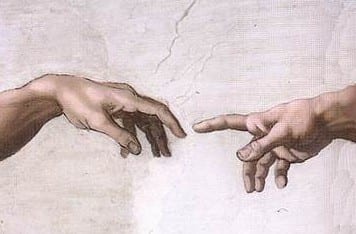
I encourage all members of the Church not to be afraid of the present challenges, but to listen to one another and firmly embrace their responsibilities in building a more humane and fraternal society. Pope Leo XIV
Chapter 3 of Magnifica Humanitas is the point where Pope Leo stops explaining the Christian and Catholic basis for what he is teaching and actually starts teaching it.
There’s more in Chapter 3 than I can cover in one post, so I’m going to break this into two, one for today and the next for tomorrow.
Pope Leo’s overall message in Magnifica Humanitas is simple. Here it is in two points:
- God made human beings in His Image and Likeness. Because of this, the human rights of all human beings are inviolate.
- All human endeavor should be ordered toward bettering the common good of all human beings.
Those 2 points are the Gospels, applied to the lived life of humanity. They’re the practical extension of the Natural Law, which we cannot break without ultimately destroying ourselves.
The absolute core of Chapter 3, and the primary call to action in Magnifica Humanitas can be summarized in three main points.
First, the Holy Father makes the straight forward assertion that the developers of AI are responsible for what they are doing, and that they should be held accountable for it.
Second, he calls for governments to exercise their responsibility to regulate AI and make sure that it is developed along lines that benefit humanity.
Third, he says that all of humanity has a stake in AI, and for that reason, all of humanity needs to have a say in its development.
Pope Leo also specifically calls all Catholics to engage with the question about how AI develops. Here’s how he says it.
I encourage all members of the Church not to be afraid of the present challenges, but to listen to one another and firmly embrace their responsibilities in building a more humane and fraternal society.
That’s you and me, boys and girls. The Pope is telling us that we need to engage. We need to work for the common good and we need to insist that our leaders and those who control our world work for the common good, as well.
There’s an old saying in politics, If you don’t have a seat at the table, you’re probably on the menu.
In this new world of government of, by and for the billionaire, ordinary people definitely do not have a seat at the table.
Our government ignores everything we say. They don’t do one thing we want. Everything they do takes things away from us that we need to survive and hurts us.
This is the opposite of Catholic subsidiarity. It is the concentration of power into the hands of a group of billionaires that is so small you can fit all of them at banquet tables in one room at Mar a Lago.
Now here in Magnifica Humanitas we have the Pope stepping up to say that people matter.
More than that, he is saying that people should be the reason for developing technologies and engaging in commerce. He’s saying that everyone, including the billionaire bros, must exercise concern for human beings and human life in the things they do and the things they create.
He’s telling a group of people who don’t appear to care about anything except money and power that money and power cannot be the only reason for what they do with their lives. He’s telling them that the betterment of human life and human beings should be the primary purpose of everything they create and everything they do.
If that was all he said, nobody would be upset about Magnifica Humanitas. But he goes further.
The Holy Father says that the people who develop AI are responsible for what they create, and that they must be held accountable for what they do.
Here’s how he phrased it:
For AI to respect human dignity and truly serve the common good, responsibility must be clearly defined at every stage: from those who design and develop these systems to those who use them and rely on them for concrete decisions. In many cases, however, the internal processes leading to a result remain opaque, making it harder to assign responsibility and correct errors. This is where accountability becomes crucial: the possibility of identifying who must “account” for decisions, justify them, monitor them, and, when necessary, challenge them and remedy any harm caused.
He is talking about the developers of AI, government and individual people all three when he says all this. He is calling the developers and investors in AI to care about something beside profit. Basically, he’s calling them to behave like moral and decent human beings who are part of the human race along with the rest of us.
He’s telling them that if they end up killing millions of people or enslaving them or reducing human beings to servants of machines, that they will be responsible for what they have done.
He doesn’t say this specifically, but the simple fact that they are responsible before God is implicit. What he is specifically calling for is that they will be held responsible in civil society. He’s saying that they are responsible, and that we — all of us, including our governments — need to hold them accountable.
In a world such as the one we have now, where billionaires and their toadies are above all law, and where money is not just more important than anything else, money has become the only thing, that’s a radical statement.
We live in a world where the idea that the law should apply to everyone, even the billionaire bros, is radical.
Second, he’s calling on governments and all people everywhere to hold those who exploit and destroy human beings accountable.
Saying that people — even billionaires — are responsible for what they do is a moral concept. Holding them accountable is a matter of law.
The Pope says we should pass regulations on the development of AI. Our governments need to regulate the development of this technology to ensure that it develops according to the common good.
In other words, our governments need to do the job that governments exist to do, which is to ensure peace, orderly commerce and the domestic tranquility by protecting all its citizens from the rapacious and the ruthless ones who would destroy them for their own gain. Governments have a moral responsibility to order the civic life of those they govern along the lines of the common good, and the pope is telling them that.
However, the responsibility for our future does not just rest with the developers of AI and governments. It is our responsibility as well.
We cannot just la-la-la our way through this like children sitting in the back seat of the car while Mama and Daddy do the driving.
We are also responsible for what we do … and what we don’t do. We have a responsibility to act according to the common good ourselves; by how we vote, what we advocate and how we spend our lives.
Caring for the common good isn’t just about politics. It’s also about visiting people in nursing homes, providing a stable home for our children, being faithful to our spouses and caring for them in sickness and in health. It’s about telling the truth, refusing to repeat slander, turning down bribes and never stealing anything. There is nothing that we do that doesn’t in some way impact the common good.
But in this instance, the Holy Father is telling us that we need to engage with the question of AI at all levels, including our politics.
Note: Chapter 3 of Magnifica Humanitas covers too much ground to unpack in a single post. I’ll finish writing about it tomorrow. “If you don’t have a seat on the table, you’re probably on the menu,” has been attributed to both Governor Anne Richards of Texas and Senator Elizabeth Warren of Massachusetts. I’ve heard it repeated so often by so many, I have no idea who said it first.












 Ad-Free & Subscriber Log-In