

When the dignity of our brothers and sisters is violated, when politics fails to address the tragedies of humanity, when the economy turns against the person, or science oversteps the limits of its competence, the Church must make her voice heard. Magnifica Humanitas
Who are the buffalo? Who are the frogs?
There’s an old saying around these parts: When the buffalo fight in the swamps, the frogs lose.
The Catholic Church, with its global reach and 1.5 billion followers, certainly qualifies as a “buffalo” in any public debate.
By the same types of measurements, AI billionaires, with their vast financial resources that make them, as individual people, more powerful than the governments they always influence and often control, are a sort of mega “buffalo.”
The leaders of government — presidents, prime ministers, kings, congresses and parliaments — who more and more serve the AI billionaires rather than the people they govern, are also “buffalos.”
That leaves us — you and me and those we love — to play the part of the hapless frogs.
Magnifico Humanitas, Chapter 2
Chapter two of Magnifico Humanitas is Pope Leo’s carefully thought out explanation for why he has to speak now about the tsunami of change that AI is bringing. Magnifico Humanitas is the Pope, telling us that when the buffalo fight in the swamp, the Church will accompany the frogs.
Pope Leo tells us quite clearly that he made the decision to write Magnifico Humanitas based on specific and long held teachings of the Church. He describes the moral basis for Magnifico Humanitas in detail.
Popes don’t just wake up one morning with itchy typing fingers and toss out a rant disguised as an encyclical.
Papal encyclicals are a response to an urgent need to establish how faithful Christians must respond to events and circumstances that are new, big, and that have the potential to be very harmful to human beings.
AI: a challenge to humanity that requires an answer.
AI fits that description exactly.
AI is a new technology that has the power to challenge the essential humanity of all human beings.
Government officials — presidents, prime ministers, congresses, courts and parliaments — are ignoring their responsibility to regulate AI for the common good. Instead, they are bowing down to the billionaires who own AI and allowing them to raid the resources and the national treasury that belong to all of us without regard for the law.
With one known notable exception, the men who are creating and controlling the power of AI appear to act with their own self-interest and greed for money and power as the only yardstick by which they measure the rightness of their actions.
These creators and controllers of the AI behemoth openly acknowledge that AI will render most human beings unnecessary. Not only will we no longer have a means of procuring our livelihoods, but we will become useless baggage to the powerful and wealthy. A few of these tech billionaires have made public statements about their intention to put the entire population under AI surveillance in order to control us.
The Church supports good government and technological advances
Pope Leo makes it clear that the Church does not intend and has no desire to control the normal functioning of healthy civil societies. The Church supports honest scientific inquiry, and it has no interest in impeding technological advances.
The Church is the repository of 2,000 years of teaching which informs Christian faith.
It provides social services, education, health care and aid all over the world. It is a purveyor of help. The Church provides generous access to the sacraments to Catholics everywhere it can. It maintains the liturgy in a consistent manner, and — this is where Magnifico Humanitas comes in — it also teaches us how to follow Christ.
When the Church teaches, it is applying the Scriptures, especially the Gospels, and 2,000 years of accumulated tradition and understanding to the real life challenges that faithful Catholics must overcome. When the Church teaches, it is equipping us to be Christ in the world.
When the Church speaks, it does so as the Good Samaritan
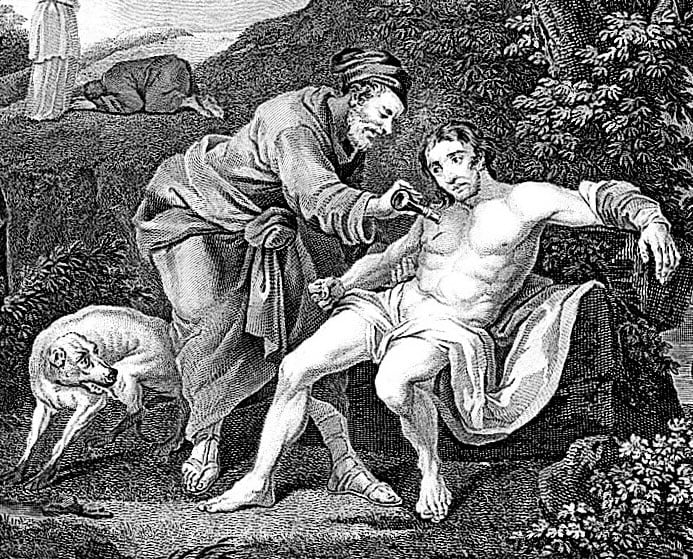
Pope Leo writes that when the Church enters into the arena of public debate, it does so in the spirit of the Good Samaritan.
The story of the Good Samaritan is a story that Jesus told to illustrate the responsibility that human beings have to care for and come to the aid of one another.
He was answering a rather condescending question from a teacher of the law who didn’t want to be obliged to help others. Jesus had said we must love God with all our hearts and that we must also love and help our neighbors to inherit eternal life. The Pharisee, wishing to justify himself, snapped back, Who is my neighbor?
Jesus replied by telling him the story of a man who was robbed, beaten and left to die on the side of the road. As this man lay there suffering, a Levite, who was a Temple official, passed him by and refused to stop and help. Then a priest also passed him by without helping.
Finally, a Samaritan, an outcast among the Israelites and someone the Pharisee almost certainly would have despised, stopped and cared for the man. He bound up his wounds, and took him to an inn, where he paid for his lodging. He left money with the inn keeper to provide for the man’s needs going forward.
Jesus asked the Pharisee, Who was this man’s neighbor? The Pharisee answered, The one who had mercy on him. And Jesus can said, You have answered correctly.
Pope Leo said that when the Church steps in as it has done with Magnifico Humanitas, it is doing it because ordinary human beings are being left beaten, destitute, with no effective help on the side of the road of life. The Church is coming to their aid, like the Good Samaritan in Jesus’ parable.
The loss of morality in government and economics.
One of the encyclicals that Pope Leo references in Chapter 2 of Magnifico Humanitas is Caritas Veritate by Pope Benedict XVI. Pope Benedict said that love and truth are at the heart of the Church’s Social Doctrine. But he noted with concern that there was an increasing tendency to dismiss morality and moral relevance precisely within social, legal, political and economic fields.
Pope Benedict wrote that in 2009. I think we can all say that the dismissal of morality and moral relevance in politics and finance is now pretty much absolute. We are living through an era in which undisguised and unashamed lies and corruption are accepted as “normal,” and even lionized by many of our so-called “christian” clergy.
The Church must speak for the common good.
When Pope Leo says that the Church has to enter the arena of public discourse by using its prophetic and moral voice to apply the Gospels to this situation, he is correct.
When he says that the Church is entering this debate with spirit of the Good Samaritan, coming to provide aid and succor to people who are injured, helpless and abandoned, he is also correct.
Pope Leo is speaks to us as our shepherd.
Pope Leo speaks to us as our shepherd. His teaching has deep roots in the rich soil of consistent Church teaching that human beings are made in the Image and Likeness of God. Insisting on moral integrity and concern for the common good from those who govern us is not only our civil right, it is our moral obligation as Christians.
If today we can speak of a corpus of shared principles and criteria, it is because this faith-based interpretation of history has never been interrupted, remaining ever open to the challenges posed by each generation, our Holy Father, Pope Leo, tells us.
Shakespeare wrote that love does not alter when it alteration finds. The same is true of Jesus Christ, Who is the same yesterday, today and forever. The same Jesus who taught us about the Good Samaritan, is speaking to us today, through our Church.
Note: You can find the parable of the Good Samaritan in Luke 10: 25-37. “Jesus Christ, the same yesterday, today and forever” is a quote form Hebrew 3:8. “Love does not alter when it alteration finds” is from Shakespeare’s Sonnet 116. “When the buffalo fight in the swamp the frogs lose” is a common saying where I grew up.













 Ad-Free & Subscriber Log-In