

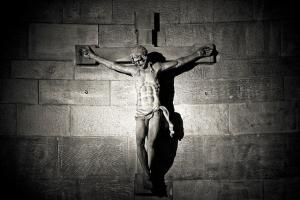
I saw that photo, of an IDF soldier smashing a crucifix in Lebanon.
I saw it several times. Everywhere I scrolled on social media, I saw it: a rather pink plaster corpus, upside down with his feet in the air, and a man slamming into it with a great big hammer.
It hurt just to look at, and as I looked, a thousand images ran through my mind– not words or sentences or morals of the story, just images and feelings. The horrible twisting in my gut that I’d felt when I heard about the October 7th attack. My gut twisting the opposite way when the bombing of Gaza began. That exact same twist as when Russia began its campaign against Ukraine. The same as the twist when I watched the policeman kneeling on George Floyd’s neck. The same as when I watched people plummeting from buildings in New York, two decades ago.
I remembered the stolen corpse that I saw lying naked on an altar in that hideous video the disgraced false priest Frank Pavone posted online, just before election day in 2016, and my stomach twisting just as it was twisting now.
I remembered my mother shaking in shock as she described the Columbine Massacre to me, while the newscaster reported it on the radio of our mini van as we drove home from band practice, twenty-five years ago. I remember shaking in shock myself, as I looked at a photo of my grandfather in a coma in the hospital just before he passed away, eleven years ago. The little jagged line on the chart shooting up and up and up, as the deaths from COVID-19 increased exponentially, in Holy Week, six years ago. Adrienne getting so horribly sick with an unknown virus that year, and the fool of a pediatrician telling me not to bring her in for a test but to take care of her at home. The feeling that I’d lose her. The unimaginable relief when she began to mend.
I remembered how it felt when my stalking neighbor really lost her mind once and for all, and I thought I was going to be killed– and then how it felt when I realized she was dead.
I remembered that story I’d heard, from some influencer I follow on social media, of a Jewish man– not Jesus but another Jewish man– walking on the Via Dolorosa.
I like to follow social media accounts of people who post videos of interesting things that they know about and I don’t. I follow former Amish people, people with disabilities I don’t have, psychologists, people who cook historic recipes, Protestant preachers, Jewish and Muslim people of various denominations. I always learn such interesting things. This gentleman talked about the time he’d gone to the Holy Land, and prayed with some Christians walking on the Via Dolorosa– because Jesus was a Jewish man, and he wanted to pray and meditate about violence against Jewish people.
I told that story to the children in my infamous after school geography club, when I showed them videos of Jerusalem. We listened to Muslims chanting the Adahn at the Dome of the Rock and looked at photos of Jewish people praying at the Western Wall. We watched Christians carry a cross on the Via Dolorosa and receive the Holy Light at the Church of the Holy Sepulcher. I showed them Jewish people dancing to “Havenu Shalom Aleichem” and Palestinian children dancing a Dabke and Christians singing the Our Father in Aramaic.
The children liked just about every one of those classes. I was surprised that the part they liked best was seeing people worshipping God in different countries. If I didn’t tell them about the religions in a country, they’d ask me to show them. We watched Syro Malabar Christians carrying icons on the backs of elephants, Peruvian Christians praying to El Señor de los Temblores, Massai Christians jumping up and down at an outdoor Catholic Mass, Japanese Christians praying at the cathedral of Urakami Tenshudo. We watched a Muslim girl praying during Ramadan, Chinese dancers performing the Lion Dance to pray for luck, Jewish families lighting a menorah, Indian children giggling as they threw dye on one another on Holi.
I told them that humans are in the image and likeness of God, and the more you learn about how interesting humans are, the less you’ll want to fight wars with them.
“The best thing you can do for world peace is to learn,” I said.
I didn’t say out loud that war, killing, hurting somebody, is smashing that Divine image.
I thought of all this, in a tangled up jumble of images, as I watched the soldier smash an image of God with a hammer.
Statues can be replaced, but what about all those other images of God? The ones made of flesh and blood? The ones in Gaza, and Lebanon, and Iran, and all over the world, that are gone forever now?
Do we understand what we do, when we do violence against one another?
What if we didn’t?
What if we all chose to stop?
Mary Pezzulo is the author of Meditations on the Way of the Cross, The Sorrows and Joys of Mary, and Stumbling into Grace: How We Meet God in Tiny Works of Mercy.









 Ad-Free & Subscriber Log-In