


I stood at the front of the after school geography class, with a great big map projected on the screen behind me.
The children sat around the classroom, some fidgeting and some paying attention. Some of the children only come to my class because they know I bring a snack, but some come because they genuinely think it’s interesting, and I welcome both kinds of children. Sometimes there’s only a handful of students, but sometimes there’s a bigger crowd. I try to speak every time as if it’s just one student and me, having a dialogue. Today, there were a lot of children.
Every geography class, I take the children on a virtual tour of a different country. Today, technically speaking, we were going to two countries. This was the class I’d been the most nervous about since I started planning my lessons in the summer.
“Today we’re going to learn about the place where Jesus grew up. It’s almost Christmas time, and you’re going to be hearing about Bethlehem, Nazareth and Jerusalem in church. Let’s look at those real life places and the beautiful people who live there!”
I gave a brief, child-friendly explanation about why there are two different countries on the same spot, and the terrible war they’d probably seen pictures of on the news. “I can’t solve wars and neither can you. Kids can’t stop wars. What kids can do, is learn. So let’s just learn about the different people who live in this part of the world today. Learning is the very best thing we can do for world peace. When you learn how interesting people are, you won’t want to hate them. We’ll start with this Israeli family, not because they’re the most important but because I comes before P in the dictionary. Remember, not all Jews live in Israel or feel the same way about Israel, but we’re just learning about this one family.”
I opened a book showing an Orthodox Jewish family who live in Israel. I started to explain about the modest clothes they were wearing, and why the little boy was not allowed to turn on the computer on a Saturday. I showed them the photo of the little boy’s school and his soccer ball, his favorite dinner, his class picture with his best friends.
I don’t think hate is inborn in anyone.
Some people are born cautious and some people are born outgoing, but caution isn’t the same thing as hate. Hate is not a personality trait but a vice a person can choose. Wherever it comes from, we are living in an era in which hate is fashionable, and that terrifies me.
I don’t think I’ve ever lived through a time which was particularly virtuous. The 90s were a hard time for women, the disabled, and LGBTQ people, among many others, and the early 2000s were scarcely better. But for most of my life, people at least had to pretend not to be bigots. They had to say “I’m not racist, but…” or substitute “inner city” for what they really meant in polite company, because being called hateful was a bad thing. That was bad enough. Nowadays, it’s considered honest and relatable to be openly hateful. People try to score points and look edgy by making cruel remarks. They stereotype entire ethnic groups and scapegoat them for the worst behavior of some of their members, and this is treated like brave truth-telling. They blurt out crass jokes about people from India or Central America. They openly express their disgust for Muslims or Jews, Palestinians, Haitians, Mexicans, Somali. And doing so is trendy. I have called out the right wing more often than I can count in all my writing, and right-wing talking heads are very guilty of normalizing this cruelty, but this is not just a right wing phenomenon. Spend any time in leftist circles and see how they talk. Get a moderate armchair liberal alone in a group of only other white people and see what they say. It’s a problem from one end of our society to another. Being a bigot is fashionable.
Growing up, I learned in my catechism that committing a sin while trying to make it look trendy was an additional sin, the sin of scandal. Scandal is a sin because it leads other people down the path of sin. Scandal turns a bad thing which ought to be looked on with revulsion, into a funny meme that other people want to imitate. Scandal makes shameful behavior into a fad.
I feel that I have to fight against this fad, or die trying.
I could lecture for half an hour that the hate we see all around isn’t cool, but who would listen?
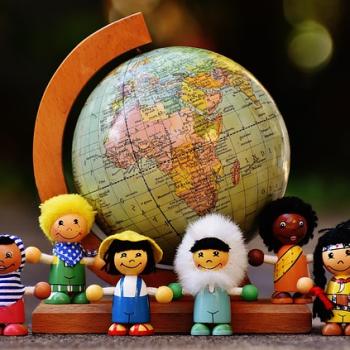
So I spend half an hour trying to show children that people who don’t look or act like them are fun and interesting.
“Now,” I said as I finished the book and opened a tab on the computer. “My favorite word in the Hebrew language is ‘Shalom.’ People who speak Hebrew will sometimes say ‘Shalom!’ for ‘hello,’ but it doesn’t just mean ‘hello.’ Often people say that ‘shalom’ means ‘peace be with you,’ but it’s not just any peace. Shalom is the peace that comes through HARMONY. Shalom is what happens when people who are different from one another respect each other and work together, instead of hating each other and forcing us all to be the same. So if someone says ‘shalom’ to you, they’re saying ‘hello’ and they’re saying ‘peace be with you,’ but most of all, they’re saying ‘please be in harmony with me.’ When Jesus appeared to the apostles after the resurrection, the first word he said was ‘shalom.’ But he wasn’t just saying hi. He was saying “harmony!”
I played a video of Jewish people singing and dancing to “Havenu Shalom Alechem.”
One of the children in the class hopped out of his seat and started singing and dancing along. “Havenu shalom, shalom, shalom alechem!”
The other children stared as if they wondered if he’d get in trouble, so I sang along too to show that it was all right.
I opened up a sticky container. “I think it’s time for a snack. This is baklava. It’s a treat children like to eat all over the Middle East, including in Palestine. You can all have two pieces of baklava while we learn about the people of Palestine.”
My students dropped crumbs on the floor and got honey all over their mouths as they enjoyed the snack. I showed them a book about Islam, with photos of a girl their age putting on her hijab and praying. I showed a video of the Adhan being prayed over a loudspeaker and told them what the Arabic words meant. Then we watched Palestinian children playing on the branches of olive trees, Palestinian adults weaving fabric and showing off their traditional clothes. I showed them a girl eating a big brown ring of Jerusalem bread. I put on a video of teenagers dancing the Dabke in front of a great big graffiti-covered wall.
The little boy who had sung along with Havenu Shalom Alechem got out of his seat and started to dance.
Again, the children looked at him and wondered if he was going to be scolded for getting up, so I started to dance.
We all danced the Dabke along with the video.
Later, I passed around a cross cared from olive wood by a Palestinian Christian. We watched a drone flight over Bethlehem and the Jordan River. We looked at photos of the Dome of the Rock and the Via Dolorosa. We saw Orthodox Christians receiving the Holy Fire on the night before Easter. We watched Syriac Orthodox priests sing in Aramaic at the House of Saint Mark.
That was just one of the places we visited in geography class. I’ve taken the children to China to see a lion dance and a drone flight through Beijing. We watched an interview with a French Holocaust survivor and went on a tour of Paris. We saw Maasai Christians jumping up and down at a Catholic Mass in Tanzania, and watched an interview with the youngest person to climb Mount Kilimanjaro. We saw a fair trade chocolate farm in Ghana. We watched Syro-Malabar Christians carry icons through New Delhi and Peruvian people carry a crucifix through Cuzco. After the Christmas break, we’re going to Hawai’i to see a hula dance. And then to Italy, and Mexico, and Brazil.
Hate is a vice. Most people say that the opposite of hate is love, but I don’t think it’s quite that simple.
Love, in a way, is the opposite of every vice. The opposite of greed is loving your neighbor through making sure their material needs are met, and that is a virtue called generosity. The opposite of pride is loving your neighbor by treating them as your equal, and that is a virtue called humility. The opposite of lust is loving your neighbor by respecting them as a sexual being, and the name of that virtue is chastity. I think that the opposite virtue to hate, is curiosity. The opposite of casually dismissing a whole group of people as garbage, is to wonder about those people and to want to learn what they’re like. The opposite of stigmatizing and othering people, is to be curious about the ways in which they’re like you.
Scandal is a serious sin. But perhaps the way to correct the sin of scandal, isn’t by yelling at people who commit it. It’s by showing the people around them that virtue is better than scandal. It is more fun to be curious than a bigot.
I didn’t start volunteering with the after school classes, because I thought it was such an important mission. I did it because I thought it would be fun and a good way to get involved in the community. But now that I’m here, it seems so much more than that.
I think that if we all begin to cultivate the virtue of curiosity, we could turn the tide of hate.
Mary Pezzulo is the author of Meditations on the Way of the Cross, The Sorrows and Joys of Mary, and Stumbling into Grace: How We Meet God in Tiny Works of Mercy.












 Ad-Free & Subscriber Log-In