

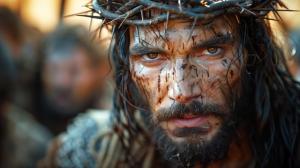
This Sunday, March 29, 2026, the Passion of Jesus Christ is the central theme on this Palm Sunday. We are about to enter Holy Week, the most sacred week in the Christian calendar. The “Good Friday” of the Passion will lead to an “Easter Morning” celebrating the Resurrection of Jesus. Let’s look at this week’s readings.
Gospel Text – The Passion of Our Lord Jesus Christ
Please click on the link to read the entire gospel reading – Matthew 26:14—27:66
From noon onward, darkness came over the whole land until three in the afternoon. And about three o’clock, Jesus cried out in a loud voice, “Eli, Eli, lema sabachthani?” which means, “My God, my God, why have you forsaken me?”
Some of the bystanders who heard it said, “This one is calling for Elijah.” Immediately, one of them ran to get a sponge; he soaked it in wine, and putting it on a reed, gave it to him to drink. But the rest said, ‘Wait, let us see if Elijah comes to save him.” But Jesus cried out again in a loud voice and gave up his spirit.
Here, all kneel and pause for a short time.
And behold, the veil of the sanctuary was torn in two from top to bottom.
The earth quaked, rocks were split, tombs were opened, and the bodies of many saints who had fallen asleep were raised. And coming forth from their tombs after his resurrection, they entered the holy city and appeared to many.
The centurion and the men with him who were keeping watch over Jesus feared greatly when they saw the earthquake and all that was happening, and they said, “Truly, this was the Son of God!”
First Reading – Isaiah 50:4-7 – The Obedient Servant Who Will Not Turn Back
Isaiah presents the “Suffering Servant” who:
- Receives a disciple’s tongue to speak encouragement to the weary.
- Listens to God every morning.
- Offers his back to those who strike him.
- Sets his face “like flint,” trusting God despite humiliation.
This is a portrait of faithful obedience. The Servant suffers not because he is weak, but because he is faithful. His confidence is rooted in God’s vindication, not in avoiding pain. The Church sees this as a prophetic window into Christ’s Passion—His willing, conscious embrace of suffering for the sake of the mission.
Responsorial Psalm –Psalm 22:8-9, 17-18, 19-20, 23-24
The psalmist experiences abandonment yet refuses despair. He cries out honestly, but he also trusts that God will act. Jesus quotes this psalm on the cross. It becomes the soundtrack of the Passion—lament that turns into victory.
Second Reading – Philippians 2:6-11 – Jesus Empties Himself on the Cross
Paul gives one of the earliest Christian hymns praising Jesus:
- Christ, though divine, emptied himself
- Took the form of a slave
- Became obedient unto death—even death on a cross
- Therefore God highly exalted him
This is the pattern of Christian life: humility leads to obedience, which leads to sacrificial love, and ultimately exaltation. Christ’s downward movement becomes the path of our salvation.
Gospel Reading – Matthew 26:14—27:66 – The Passion of Our Lord Jesus Christ
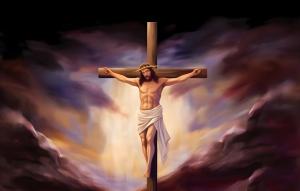
This is not just a story of suffering—it is the decisive moment of salvation history. Matthew’s Passion includes:
- Judas’ betrayal.
- The Last Supper.
- The Agony in the Garden of Gethsemane.
- Jesus’ arrest, trial, and Peter’s denial.
- The crowd’s rejection of Jesus.
- The crucifixion, death, and burial.
Matthew emphasizes:
- Jesus’ kingship (the irony of the crown of thorns).
- The fulfillment of Scripture.
- The innocence of Jesus contrasted with humanity’s guilt.
- The significance of His death (earthquake, torn veil).
The Catholic View
We stand at the threshold of the holiest week of the year, and the Scriptures place us directly in the mystery of Christ’s suffering love. Each reading gives us a different angle on the same truth: Jesus does not stumble into the Passion—He walks into it with a heart formed by obedience, humility, and love. These readings reveal the mystery of Christ’s Passion: the obedient Servant who suffers willingly, is mocked and rejected, yet remains faithful, and through that faithfulness becomes the source of salvation and the revelation of God’s glory.
The Readings Show Us:
Isaiah shows us the Servant who listens every morning for God’s voice. He is not a victim of circumstance; he is a disciple whose ears and heart are open.
Psalm 22 gives voice to the raw human experience of suffering. It is the cry of the righteous one who feels abandoned, mocked, pierced, stripped.
Paul, in the letter to the Philippians, pulls back the veil and shows us the dimension of what is happening. Christ, though equal with God, empties himself. He descends into our flesh, our weakness, our death. And because He goes all the way down, the Father lifts Him all the way up. The cross is not the collapse of His mission; it is the doorway to His exaltation.
And then Matthew brings us into the Passion itself. We watch betrayal unfold, see the disciples scatter, and hear the false accusations, the shouts of the crowd, the hammer striking the nails. Matthew wants us to see that Jesus is the true King even when He is crowned with thorns. He is the faithful Son, even when He is condemned as a criminal. He is the Savior even when He hangs in silence. The earth quakes, the veil tears, and the centurion—an outsider—utters the truth: “Truly, this was the Son of God.”
Please share your thoughts about this article in the “Comments” section.
Peace
If you like this article, you might enjoy:
A Tale of Two Horses
Church and State: Protecting Religious Freedom
Social Media Policies: Should the U.S. Follow Suit?













 Ad-Free & Subscriber Log-In