

This past year, there has been a lot of media buzz surrounding a religious revival among Gen Z in the US. Bible sales are up, contemporary Christian music (CCM) is booming, and there are reports of Gen Z coming back to church.
If this revival is really happening, it is extremely significant. Religiosity in the US has been decreasing with each generation. Thus, a resurgence of religiosity among the youngest adult generation would mark a change in a decades-long trend among Americans. However, this claim is also highly contested. In this article, we review the evidence supporting a Gen Z religious revival and compare it with the evidence against.
Data Indicating a Gen Z Revival
Here, we will only focus on the US. Although it must be noted that initial reports of a Gen Z religious revival came not from America, but from the UK and Wales. The report, published by the Bible Society, showed a huge surge in church attendance among Gen Z. The Bible Society’s data, sourced from YouGov, was criticized for contradicting trends in official denominational statistics.
However, in the American context, the major data showing a surge in religiosity has been published by the Barna Group, an evangelical research organization.
Barna’s “State of the Church” Study
Their annual “State of the Church” report shows a couple of indicators that Gen Z are becoming significantly more religious. Barna found that from 2019 to 2025, Gen Z and Millennial men and women are becoming increasingly likely to report having a personal commitment to Jesus.

Barna also found that Gen Z adults attend church nearly twice per month, compared to the average US adult who attends around 1.6 weekends per month.

Lastly, Barna found that from 2020 to 2025, Gen Z and Millennial churchgoers increased their church attendance. In 2020, both cohorts attended church around once a month. In 2025, they attend 1.9 and 1.8 times a month, respectively.

A Revival?
So, does this data show a religious revival among US young adults? That depends on one’s definition. Revival can either be a mass conversion to Christianity, or a recommitment amongst those who are already Christian.
Let us address the first definition. More young adults in Barna’s sample report having a personal relationship with Jesus from 2019 to 2025. This is certainly an indication of a rise in people identifying with Christianity. But as we will see, this conflicts with better statistics and more established trends.
The second definition of revival seems to be better supported. The average Gen Z and Millennial churchgoer (who is already attending church) now attends church nearly twice a month instead of once a month. But is this a revival? Or is it more aptly described as an increase in church attendance among younger churchgoers?
The Bigger Picture
Now let’s look at data that does not indicate a revival. Ryan Burge has done phenomenal work on looking at different data sets to address this question. He pulls mostly from the General Social Survey (GSS).
The General Social Survey
First, let’s take a look around church attendance, which seems to be the metric that’s most cited when people talk about a Gen Z religious revival. Burge compares four different generations to see how often they attended church when they were 18-29 years old.

In the GSS, Gen Z are the most likely to never attend church (38% compared to 25.75% on average). Fewer Gen Z adults attend church at least once a year, once a month, and once a week than older generations.
Pew’s Religious Landscape Study
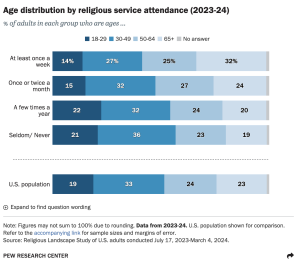
When we look at the Pew Research Center’s sweeping Religious Landscape Study, we see that from 2007 to 2024, 18 to 29 year olds are the least likely to attend church weekly. And furthermore, as of 2023 and 2024, 18 to 29 year olds are also the least likely group to attend church once or twice a month. Adults aged 18 to 49 years old are the most likely to attend church never, seldom, or only a few times a year.
Survey Center on American Life
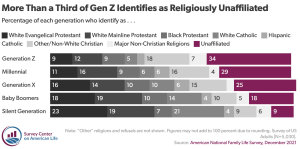
The Survey Center on American Life released data in 2022 showing that Gen Z had the highest rate of religious disaffiliation (34%) compared to Americans as a whole, among whom 23% were unaffiliated on average. This is a different metric than church attendance. But it is also pertinent to Barna’s data that shows that more young adults are reporting a personal commitment to Jesus. If there was a young adult revival, one would expect Gen Z adults to be less likely to be religiously unaffiliated.
The Public Religion Research Institute
Finally, the Public Religion Research Institute’s 2024 Census of American Religion shows that Gen Z are the least likely group to identify with religion. 38% of adults aged 18 to 29 are religiously unaffiliated, compared to 34% of 30-49 year olds, 22% of 50-64 year olds, and 18% of 65+ year olds. While 55% of 18-29 year olds identify with some form of Christianity, this is much lower than 60% of 30-49 year olds, 72% of 50-64 year olds, and 76% of 65+ year olds.
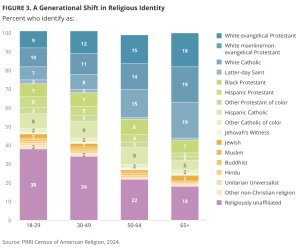
These past few graphs mostly address points in time rather than change over time. But PRRI also has data on how prior young adults disaffiliated from religion in past decades.
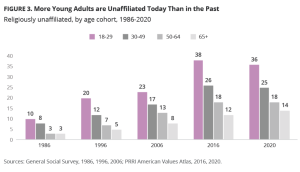
According to their data, 10% of 18-29 year olds were religiously unaffiliated in 1986. This number rose to 20% in 1996 among 18-29 year olds, 23% in 2006, 38% in 2016, and dropped to 36% in 2020. As of 2024, that number, as mentioned above, rose back up to 38%.
Conclusion
We have learned a couple of things in this survey of the data regarding the question of a Gen Z revival. First, it seems that revival in the first sense of a numerical growth of people who identify as Christian or attend church is not happening. While Barna’s sample shows young adults increasingly expressing a commitment to Jesus, Gen Z is increasingly likely to not identify with any religion at all.
This makes sense, of course, since young adults may be turning to modes of spirituality that still acknowledge Jesus as an important spiritual figure, but without the Christian label. The “Christ consciousness” movement is a good example of this. And as I have written about before for BeliefNet, just because people are becoming disaffiliated with religion does not mean that they are not spiritual.
Broader trends shown by larger datasets also allow us to see that compared with prior generations of young adults, Gen Z today are the least religious by both measures of identification and church attendance. This is seen especially in the GSS and PRRI data.
However, it might be the case that there is a Gen Z revival, just among those who are already Christian. Bible sales are going up, and these sales are famously most common among those who already own a Bible. CCM plays are up, which just as well might be due to Christian consumers utilizing streaming services more. And lastly, Barna has shown one thing in their sample, that young churchgoers who already go to church are attending more frequently. Even if this frequency is a little below twice a month.














 Ad-Free & Subscriber Log-In