

Today is Ash Wednesday, which for a hardcore Protestant such as I presents several issues. One Wednesday, the student in front of me in line at the little on-campus coffee shop in the building next to mine plopped what looked like a pre-packaged chicken Caesar salad on the counter. While fumbling for her card to pay, the cashier said “that isn’t chicken, you know. It’s tofu.” “WHAT?” the student cried. “It’s Ash Wednesday. We aren’t allowed to serve meat on Ash Wednesday or Fridays during Lent.” The exasperated student left her no-longer-wanted tofu Caesar salad on the counter, muttering “this is f—king bullshit” as she walked by. 
As I stood in line at the campus Dunkin’ Donuts several years earlier, I was truly thanking God that it was 9:15 on Friday morning. Not because of the usual TGIF thing, although Fridays are generally fine. In my life at the time, 9:15 on Friday morning was great because it meant that I was finished with my weekly 8:00 appointment at the Concannon Fitness Center, where my personal trainer, Kevin the Red-Haired Nazi, put me through experiences I could not have survived fifteen years earlier.
“The usual coffee (medium black with a shot of caramel—a shot, mind you, not a swirl) and a turkey sausage sandwich on an English muffin,” I said to the young lady behind the counter. “No meat today! It’s Friday!” some disembodied voice shouts from the little office on the side. “Shit!” I thought. That shouldn’t include turkeys—as a friend and colleague of mine once said, chickens and turkeys are just plants with weak root systems. “Then I’ll have a veggie egg white flat” (although I didn’t really want one). “It really sucks to be a non-Catholic on a Catholic campus,” I commented to the young lady as she swiped my card. “Tell me about it,” she replied without making eye contact.
I guess it must not suck that badly, since I’ve been doing it, first as a PhD student then as a professor, for close to four decades. No one could have guessed, given my background, that I would spend my professional life with Catholics. I grew up in northeastern Vermont—we called it “the Northeast Kingdom.” Although my town was only forty miles or so south of Quebec, and there was undoubtedly a French-Canadian (hence Catholic) presence all around me, I did not meet a Catholic, or at least anyone presenting themselves publicly as such, until my early adult years. My world was hard-core Baptist, fundamentalist-the-Bible-is-the-inerrant-Word-of-God-evangelical-everyone-who-isn’t-like-us-is-going-to-hell Protestant to the core.
I was a preacher’s kid; my Dad was an itinerant Baptist preacher as well as the co-founder and President of a small Bible school. I knew there were Catholics around—they had a stone church across town that was much more impressive than the community center my church met in. I had no more idea of what went on in that stone church on a weekly basis than the ancient Romans knew about the secret meetings of the early Christians.
But I knew that whatever it was, it wasn’t good. It wasn’t anything like what was going on in my church, so they were all going to hell. Actually, it seemed that just about everyone other than my nuclear family, my extended family in upstate New York and in western Pennsylvania, and the fifty or so people who came to my church was going to hell. The God I believed in was pretty picky.
Once I met and married Jeanne, a Catholic from the cradle who had grown away from the Catholic Church in her early adult years, I learned a great deal more about Catholicism than I really wanted to know. Down the street from our apartment in Milwaukee where we lived while I was in my doctoral program at Marquette University, was 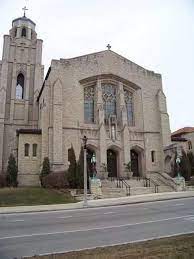 Saint Sebastian’s Catholic Church, where we made friends first with the organist, then the priests.
Before long Jeanne was cantor once in a while on Sunday morning, sang the occasional funeral, I subbed a few times on the organ, and I began thinking that this Catholic stuff was kind of cool. I had fallen in love with liturgical worship through being exposed to, then joining, the Episcopal church several years earlier and didn’t really see that much that was different here. The Dean of the cathedral where I was confirmed Episcopalian had said several years earlier that he became a priest because he liked to play “dress up” and called the Episcopal Church “Catholic Lite.”
Saint Sebastian’s, along with the intelligence and earthiness of my Jesuit professors at Marquette University, led me to believe that Catholics were pretty normal after all. I knew that, technically speaking, it was against the rules for a non-Catholic barbarian to receive communion in a Catholic service, but I had become used to the Episcopalian attitude that everyone with a pulse is invited to communion. The priests at Saint Sebastian’s made a point of letting me know that I was welcome at communion, even though they knew I am not Catholic.
I had no idea at the time just how “out of the box” this actually was. My first teaching position after graduation from Marquette was at a small Catholic university in Memphis, where I innocently and ignorantly went with my sort-of-Catholic spouse to communion on occasion. In truth, my internal resonance with liturgy probably made me more in tune with things Catholic than Jeanne’s years of working past her Catholic upbringing made her, but as the scriptures say, God looks on the heart and we look on outward appearance.
The outward appearance of a known non-Catholic receiving Catholic communion was too much for one of my colleagues to take. Soon I received an anonymous note in my campus mailbox consisting of a Xeroxed page from a local Catholic parish Sunday bulletin which, in pious and sympathetic words, essentially said that “if you are non-Catholic, we don’t want to share our communion with you.” “F–k you, Bob,” I thought in my best non-Catholic language (I knew exactly who had dropped the “anonymous” note in my mailbox). “I don’t want to go to communion if you are there anyways.”
But I learned my lesson. When a couple of years later I was hired at Providence College and we managed to escape from Memphis, I asked the chair of the department that had just hired me, a Dominican sister, about what would happen if I as a non-Catholic went for communion at the chapel on campus. She replied with what I have come to recognize as a typical Catholic response on this matter: “I would have no trouble with it, but there are some on campus who probably would.” Given that those “some” probably included a few of the geezer Dominican priests in my new philosophy department, I decided that discretion was the greater part of valor and chose not to try it out. I never have received communion on campus in thirty-two years.
And that’s been fine. I’ve even made a point of attending mass once in a while and being one of the handful of people among hundreds not to go to communion. Given that many students are unaware that there are such things as non-Catholic Christians, it’s a good “show-and-tell” and learning moment. But the issue arose once again unexpectedly fifteen years ago when, while on sabbatical for four months, 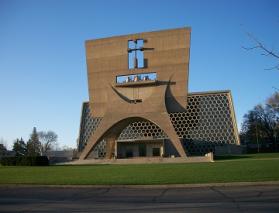 I found myself at daily prayers several times a day with a bunch of Benedictine monks.
During those months I was experiencing a great deal of internal spring cleaning and scouring; my spirit was reviving, and I was discovering inner resources I had been unaware of my whole life. As I gradually awakened to a new perspective, I realized that not sharing communion—something that had been hit or miss with me for years—with these new Benedictine friends was becoming a problem.
One Saturday at dinner I asked one of the older monks, a physicist who had taught at the university attached to the Abbey for decades before his retirement a few years earlier in his middle seventies, what I should do. “Wilfred, I would like to receive communion at the Abbey,” I said, “but I’m not Catholic and I know that it’s against the rules for me to receive. What do you think?” “I’ll tell you what Kilian (an even older monk at the next table) always says,” Wilfred replied. “Our policy is ‘don’t ask, don’t tell.’” “But I just told you.” “And I forgot what you said.”
The next day I queued up to receive communion after several weeks of sitting in the pew while others went to the front. “The body of Christ,” the Abbot said to me with a huge smile as he held the host in front of me. “Welcome.” Over the succeeding years I have returned to the Abbey on many occasions, usually unannounced. Each time after the first morning, noon, or evening prayer I attend, Kilian seeks me out and gives me a big hug. “Welcome home.” That’s exactly how it felt. Things have changed over the years. The Abbot has been replaced by a new Abbot, Wilfred died five years or so ago, and Kilian died last September a few days short of his 104th birthday, as I reflected on a few months ago. But their influence last far beyond their years.
In the middle of the sixteenth century, as his French countrymen and women were swept up into the violent storm of the Wars of Religion that followed in the wake of the Protestant Reformation, Michel de Montaigne had a simple observation to make about our ludicrous human pretensions to know the mind of God. As Protestants and Catholics regularly killed each other in the name of orthodoxy and right worship,  Montaigne wrote that
Nothing is so firmly believed as whatever we know least about . . . For a Christian it suffices to believe that all things come from God, to accept them with an acknowledgement of His holy unsearchable wisdom and so to take them in good part, under whatever guise they are sent. . . . It is hard to bring matters divine down to human scale without their being trivialized.
Good to remember, every time we get worked up about who may or may not be part of our group or about those who get worked up about such things. I’m reminded of a song I heard many years ago in church, a song with an annoying tune but an important text: “The kingdom of God is not meat and drink, but righteousness, peace, and joy.”









 Ad-Free & Subscriber Log-In