We live in an era oblivious to moral reality, we assume, in which people are relativists, at best, and complacently immoral at worst. And yet our social media and political discourse is rife with virtue signalling, righteous indignation, and politically-correct moralism. This suggests that the moral realm retains its force, despite the efforts to alter its content.
But now a LifeWay study has found that two-thirds of Americans (67%) admit that they are out-and-out sinners. Only 5% say that they are fine with that.
Just over a third (34%) say they are working on being less sinful. Just over a fourth (28%) say they rely on Jesus to overcome their sin.
Only one in ten Americans (10%) believe that sin doesn’t exist. That is slightly more than the percentage who deny that they are sinners (8%).
“Nones”–those who claim they have no religion–are more likely to say that sin does not exist (32%). Among Americans aged 18 to 44 , 14% deny that sin exists.
Confirming the Reformation, 48% of Roman Catholics say that they work at being less of a sinner, with only 19% saying that they rely on Jesus. Of Protestants, 31% claim to be working on their sins, with 49% saying that depend on Jesus.
See the article on the study in Christianity Today. For the original LifeWay findings go here.
I wonder how much of this belief in one’s own personal sin is really just a version of the humility signalling excuse that “nobody is perfect.” Is this true conviction of sin, as in the devastating complacency-destroying hammer of the Law? Are people living in guilt, shame, and fear of God’s eternal judgment? I somehow don’t think so.
But the study is evidence that the moral nerves are still firing at some level. And that not only moral categories are still alive, but so is the religiously-tinged notion of “sin.”
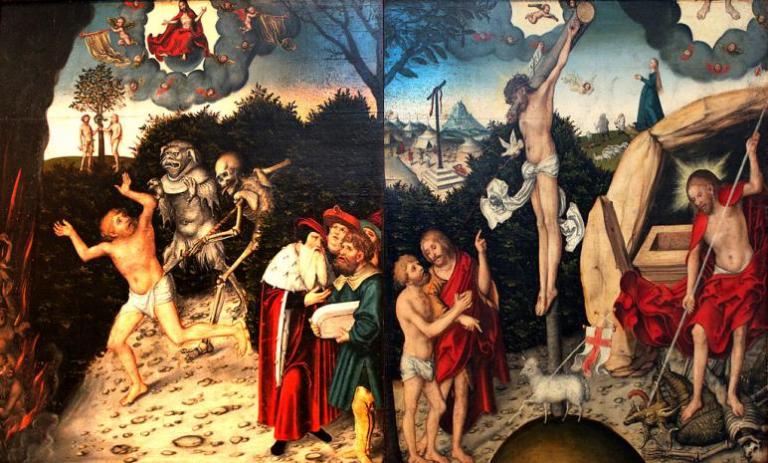
Painting by Lucas Cranach the Elder, “Allegory of Law and Grace” (1529), [Public domain], via Wikimedia Commons

















 Ad-Free & Subscriber Log-In