


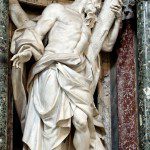
Today, we remember St. Andrew the Apostle. While tradition tells us some things about him, including the way he died, we should not neglect what we can learn about him from Scripture. He was the brother of Peter, and, even when Peter was married, it seems as if they lived in the same house (cf. Mk. 1:29). They were fishermen by trade, though they also appear to be religious, with Andrew having become a disciple of St. John the Baptist until John pointed him towards Jesus:
The next day again John was standing with two of his disciples; and he looked at Jesus as he walked, and said, “Behold, the Lamb of God!” The two disciples heard him say this, and they followed Jesus. Jesus turned, and saw them following, and said to them, “What do you seek?” And they said to him, “Rabbi” (which means Teacher), “where are you staying?” He said to them, “Come and see.” They came and saw where he was staying; and they stayed with him that day, for it was about the tenth hour. One of the two who heard John speak, and followed him, was Andrew, Simon Peter’s brother (Jn. 1:35-40 RSV).
We only get a glimpse of Andrew’s first encounter with Christ. He was one of two of John’s disciples who went to talk to Jesus. They spent the day with him. What they talked about and saw we do not know, but it was significant because it had Andrew believe had met the messiah. He went back home, told Peter, and had Peter come with him to meet Christ:
He first found his brother Simon, and said to him, “We have found the Messiah” (which means Christ). He brought him to Jesus. Jesus looked at him, and said, “So you are Simon the son of John? You shall be called Cephas” (which means Peter). (Jn. 1:41 -42 RSV).
Many think this story contradicts the way Andrew and Peter were called by Christ in the Synoptic Gospels:
And passing along by the Sea of Galilee, he saw Simon and Andrew the brother of Simon casting a net in the sea; for they were fishermen. And Jesus said to them, “Follow me and I will make you become fishers of men.” And immediately they left their nets and followed him. And going on a little farther, he saw James the son of Zebedee and John his brother, who were in their boat mending the nets. And immediately he called them; and they left their father Zebedee in the boat with the hired servants, and followed him (Mk. 1:16-20 RSV).
While it is possible these represent two separate traditions, two different ways Andrew and Peter were believed to have been called by Christ, it would not be difficult for someone to harmonize the accounts. What the Gospel of John indicates is their first encounter with Jesus. What the Synoptics give us does not have to be seen in the same way. They could have been engaging Christ for sometime, and then, when Jesus was ready to begin his itinerant preaching, he went to Andrew and Peter, telling them to come with him on his journey.
During Christ’s ministry, Andrew was connected to one of Christ’s most important (and symbolic) miracles, the multiplication of the loaves and fish:
One of his disciples, Andrew, Simon Peter’s brother, said to him, “There is a lad here who has five barley loaves and two fish; but what are they among so many?” Jesus said, “Make the people sit down.” Now there was much grass in the place; so the men sat down, in number about five thousand. Jesus then took the loaves, and when he had given thanks, he distributed them to those who were seated; so also the fish, as much as they wanted. And when they had eaten their fill, he told his disciples, “Gather up the fragments left over, that nothing may be lost.” So they gathered them up and filled twelve baskets with fragments from the five barley loaves, left by those who had eaten. When the people saw the sign which he had done, they said, “This is indeed the prophet who is to come into the world!” (Jn. 6:8- 14 RSV).
Andrew, therefore, had a part in the miracle which showed the way Christ can and would work to transcend the expectations of his followers; Christ can take what is given to him in love and multiply it, such as we see in the way the loaves and fish were given to him so that they could be multiplied and shared by all. We are meant to have this in mind when, soon after, the writer of John gives us Jesus’ description of himself as the bread from heaven, the bread which we must eat to participate in eternal life, so as to let us know that Christ can therefore take what is given to him at the eucharistic table and transform it into something greater, that is, himself, so that his followers can partake of the bread of life.
Finally, for our survey here, knowing that he was also with the other apostles in many other events of Christ’s ministry, we find Andrew, with Philip, telling Jesus about the way some Gentiles (Greeks) had come seeking an audience with him. For Jesus, this was the sign that his earthly ministry was nearing its end:
Now among those who went up to worship at the feast were some Greeks. So these came to Philip, who was from Bethsaida in Galilee, and said to him, “Sir, we wish to see Jesus.” Philip went and told Andrew; Andrew went with Philip and they told Jesus. And Jesus answered them, “The hour has come for the Son of man to be glorified. Truly, truly, I say to you, unless a grain of wheat falls into the earth and dies, it remains alone; but if it dies, it bears much fruit. He who loves his life loses it, and he who hates his life in this world will keep it for eternal life. If any one serves me, he must follow me; and where I am, there shall my servant be also; if any one serves me, the Father will honor him (Jn. 12:20 -26 RSV).
When Godfearing Gentiles started coming to him, Jesus realized his work was almost done. His ministry began with the Jews, but it was not where it was to end. His work was for everyone. He knew he going to have all humanity come together as one, overcoming the distinction between Jew and Gentile, but for that to happen, he would have to complete his mission, the mission that began with the Jews. Only in his death and resurrection would he restore humanity, allowing the divisions which sin created come to and end. And it would be after his ascension that Peter would learn it was time for the church to be open to all, and people could come following their own cultural norms so long as those norms did not go against Christ’s teachings.
Thus, after the death and resurrection of Christ, Andrew was with the rest of the apostles at Pentecost. He joined in with them in their search to find someone to replace the role Judas had among them. While he might have encountered Jesus before his brother, his seniority in faith did not give him a greater position in the church than his brother, for it was Peter who was chosen to lead the apostles, and with them, the church. Let us learn from this that we all have our calling in and with Christ. Some who come after us, some who we might initially have taught, might be called to a ministry which would eventually have them become our teacher. However odd that might seem, we need to accept it. That is, we need humility, and like Andrew, not be concerned with our rank in the church and the Christian community. What we should be concerned about is following Christ in the way Christ has called us. Andrew did that, and as such, he journeyed far and wide teaching other what God had given him to preach, reaching, we are told, into Byzantium, where he established the beginnings of a Christian community. And then, he was, like most of the apostles, executed for his faith, glorifying God in the process, showing that he might have lost his life for the sake of Christ, but he did so only to gain it for eternity, the reality of which we celebrate today as we remember Andrew and eternity with Christ.
Stay in touch! Like A Little Bit of Nothing on Facebook.
If you liked what you read, please consider sharing it with your friends and family!
N.B.: While I read comments to moderate them, I rarely respond to them. If I don’t respond to your comment directly, don’t assume I am unthankful for it. I appreciate it. But I want readers to feel free to ask questions, and hopefully, dialogue with each other. I have shared what I wanted to say, though some responses will get a brief reply by me, or, if I find it interesting and something I can engage fully, as the foundation for another post. I have had many posts inspired or improved upon thanks to my readers.










 Ad-Free & Subscriber Log-In