

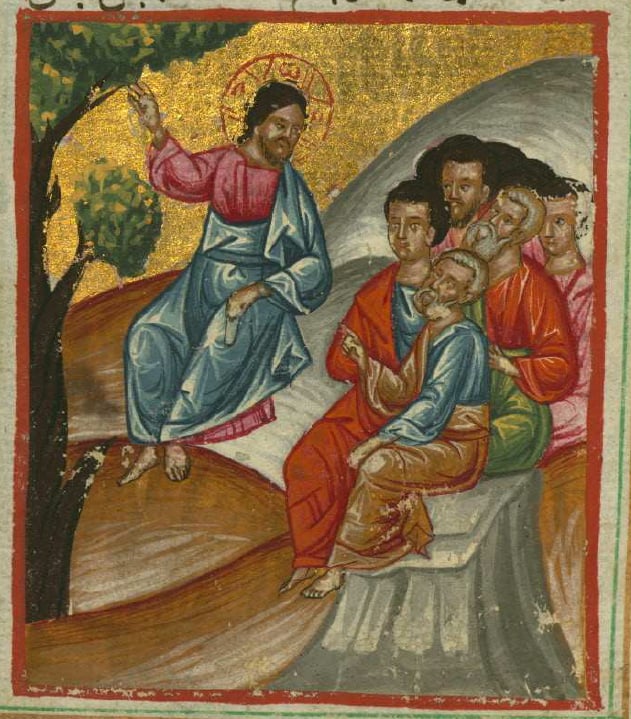
Jesus was very concerned by the way many were exploiting the Jewish faith in his day. He was not against religion, nor religious authority, indeed, he defended that authority, but he was against those who used their authority to abuse or explain the faithful. We see this in the Gospels in the way he engaged various Pharisees, Sadducees, Scribes, and Lawyers (those interested in the Law of Moses). Much of what he said which was critical of them, were critical only of those who used their positions for their own personal gain. To help the people, he sought to purify the way the Jewish tradition had developed, encouraging them to remove any abusive teaching or practice which had entered into tradition (purposefully or not). What he did not want us to do is look to Jewish traditions, nor even Jewish religious authorities, and assume they are all bad. He didn’t want us to believe they were always wrong, that what they taught, and the theological developments which came from them, should all be dismissed. He followed the way of the prophets who came before him, as earlier prophets confronted the religious and secular authorities of their time, showing how they had gone astray from the covenant. Jewish tradition was respected by him, including its developments, and many of his followers came from the Pharisees because they knew that Jesus was not fighting against them, but rather, he was promoting a necessary corrective, one which they also wanted, one which made sure religious abuse was rejected so that the faithful can live out their faith without fear. Such a corrective, to be sure, is not to be seen as true only for the Jewish tradition in Jesus’ time, but for all religious traditions, where tradition itself can be good, even if it can be infected with bad ideas and practices from time to time.
Christos Yannaras suggests we what Jesus was especially concerned about was a particularly bad legalistic turn which happened in his time, a turn which not everyone followed, and a turn which is certainly not exclusive to the Jewish religious tradition (as it is quite common in Christian history). This is why, the issue was not Judaism, but the problem of turning religious truth into a legalistic enterprise. That is, we should understand Jesus was critical of all who would push for and create various rigid rules in the name of the faith (especially by those who are hypocrites and excuse themselves from the rules they create):
The history of the fall continues even in the structures of moral and religious life. Indeed, the structures of morality and religion are more successful than any other aspect of life in camouflaging and concealing the reality of the fall, the real corruption of man. Taking social utility as their frame of reference, they define sin merely as an objective transgression and virtue merely as a necessary and useful individual quality, thus definitely closing the way to repentance. Here we see why the harshest language in the Gospels is reserved for religious people and their rigid forms. [1]
It is important for us to read Jesus’ encounters with various religious authorities of his time and consider what it would mean if he were alive today, having his ministry primarily focused with Christians. Instead of Pharisees, Sadducees, Scribes, or Lawyers, he would be looking at and deconstructing what is being promoted by various theologians, bishops, academics, and politicians. If we are to follow him, to be his continuous presence in the world, we should do so as well, of course, in the way he did, which was critical but not dismissive.
While this was obvious to many, if not most, of Christ’s earliest followers, as they were themselves Jews trying to relate what Christ taught with their own Jewish background, over time, as Gentiles became prominent in the church, many would wrongly read Jesus’ criticism of various religious authorities as Jesus attacking Judaism as a whole. Antisemitism in the Christian tradition developed, in part, because of this misunderstanding. Christians began to assume the bad examples found in Scripture represented Judaism as a whole, all the while ignoring the positive examples and ways Jesus reinforced Jewish traditions.
It is a shame that this is how the Christian tradition developed. Christians lost a valuable collaboration partner, one which they should have respected and treated as elders in the faith. They ignored and lost much of the wisdom and insight of the Jewish tradition, and when they did this, when they believed they had nothing to gain from Judaism, they stopped studying it, stopped trying to understand it. While, to be sure, Christians held interpretations of the Torah and the prophets that were never going to be the same as with the Jews, they still had much in common, and that commonality should have had Christians realize there was much they could learn from the Jews. Instead, save for a few rare examples to the contrary, Christian theologians cut themselves off from the wisdom of the Jews. Instead, many saw the Jews were an “other” who should be hated, and with that hate, destroyed; the fruit of this, of course, was the Holocaust, which was meant to be the “final solution” for the “problem of the Jews.” The real problem were the Christians, and the Holocaust merely served as a distillation and reflection of one of the worst ideologies Christians have ever embraced throughout history. And it was not just the Jews that would feel Christian hatred: what was justified against the Jews was used against many other around he world, from aboriginal peoples, the Romani, to people whose sexual orientation were different than the norm. Today, it is making itself known in the United States with Christian nationalism and the way so many Christians justify cruelty to whoever is currently seen as the “greatest threat” of the day, be it “the gays” or “Muslims” or “Mexicans.” Thus the cruelty Christians engaged against others, the cruelty which they continue to engage against others, represents a tradition which must be rejected and purged from Christianity. To be sure, while many Christians hold on to this tradition, many others see it for what it is, and, following Christ and Christ’s ways, desire to change things for the better, fixing what has become corrupt within the Christian tradition:
The horrors of the century – form the Holocaust to Rwanada – point to a level of moral perversity that is unimaginable. There is widespread recognition by all but the most indifferent and cynical that these evils amount to something more than a violation of mere social custom, aesthetic taste or sentiment. These horrors have led governments, religious institutions and humanitarian organisations to call for a level of philosophical backing for human rights that carries stronger moral authority than conventional treaties.[2]
The horrors of the Holocaust have shaken many people throughout the world. It made everyone, Christians and non-Christian alike, see the need to promote a humanism that affirms the inherent goodness and dignity of everyone, a humanism which also rejects any ideology that suggests Christians should embrace hate and return to the inhumane brutality many Christians used in the past. Sadly, as religion holds much power and sway in the world, people who have evil plans seek to use religion for their own end, which is one reason why religion is always ripe for abuse. When such abuse arises, there will be the need for some to heed the prophetic call, to follow in the footsteps not only of Jesus, but of the prophets who came before him, taking on the abuse, the legalism which is used to support such abuse, and point out again and again how God is always on the side of the abused. With the rise of Christian nationalism, it is especially important for Christian leaders to take on the corruption of the faith, and denounce those authorities, secular and religious, who are seeking to use religion for their own evil ends. This is one of the many ways the Christian faith (as with any faith) needs to be purified; it is a challenge Christians will have to face until the end of time, as generation after generation, there will arise new evils, new forms of corruption, seeking to take on and add to the evil of the past. And just as such evil, though it comes from Christians, and has been found throughout Christian history, does not properly represent the teachings of Christ, so Christians must recognize people of other faiths have similar challenges, so not to assume the worst from other religious traditions merely because they see some use their faith for a bad end. It is especially important to prop up and defend anyone, from any religious faith (or lack of it), who supports and promotes the common good. They should be shown as representations of their faiths, showing how those who do bad do not need to be seen as representing the whole of their faith tradition (lest Christians become judged by the evils done by Christians throughout history, having them represent the faith, and not the good which Christ taught).
[1] Christos Yannaras, The Freedom of Morality. Trans. Elizabeth Briere (Crestwood, NY: St. Vladimir’s Seminary Press, 1984), 63-4.
[2] Stephen J. Pope, “Natural law and Christian ethics” in The Cambridge Companion to Christian Ethics. Ed. Robin Gill (Cambridge: Cambridge University Press, 2001), 92.
Stay in touch! Like A Little Bit of Nothing on Facebook.
If you liked what you read, please consider sharing it with your friends and family!
N.B.: While I read comments to moderate them, I rarely respond to them. If I don’t respond to your comment directly, don’t assume I am unthankful for it. I appreciate it. But I want readers to feel free to ask questions, and hopefully, dialogue with each other. I have shared what I wanted to say, though some responses will get a brief reply by me, or, if I find it interesting and something I can engage fully, as the foundation for another post. I have had many posts inspired or improved upon thanks to my readers.















 Ad-Free & Subscriber Log-In