

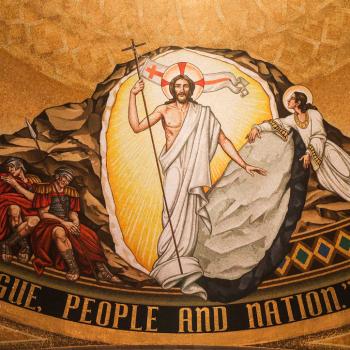
Humanity is restored to its integral unity in Christ. In baptism, we join ourselves with him, and through him, with everyone else. For we all share the same human nature. While sin has caused us to lose our connections with everyone else, we find it in Christ, who took on human nature and now brings us all together as one in himself. In him, we share with each other the glory of the kingdom of God, the glory revealed to us by his resurrection from the dead. This is why Paul said that in Christ, there is neither male nor female, Jew or Gentile, but the same humanity, the same Christ, which is shared by all. Christ lives in us and we live in Christ. The divisions which sin created in humanity are based upon relative distinctions that exist between human persons. That is, they are based upon real distinctions, but sin abuses those distinctions, having us treat them as absolute instead of relative distinctions, for if they are absolute, then the unity of human nature is not absolute, but a construct which can be taken apart. That is, humanity no longer is one, but rather, is a composition which is made of many unequal parts. Sin, therefore would have us act against our own nature, our unity with each other, would is one of the many ways it wounds humanity. Christ came into the world, in part, to heal that wound, to help us become one, seeing that our unity can and should exist alongside our relative differences. Christ also shows us something else: just as humanity is one, so creation is one. Christ brings all creation together as one, so that in and through him, it is all brought into the kingdom of God. In the eschaton, all things, all creation, find themselves together as one, not in a monistic sense, but rather, by forming an interdependent (or integrated) unity. But, as Christ is the immanent eschaton, and the glory of the eschaton has been revealed to us in his resurrection from the dead, we can experience that eschatological glory in our temporal life. As much as we do so, we are to live it out, share its grace with the rest of the world, hoping to help make the world reflect a little more the eschatological kingdom of God as it will be realized in eternity. That is, Christians are called to live out the reality of the eschatological kingdom in their lives, letting it shine through them, even as Jesus lived it out and presented it to the world throughout his earthly ministry.
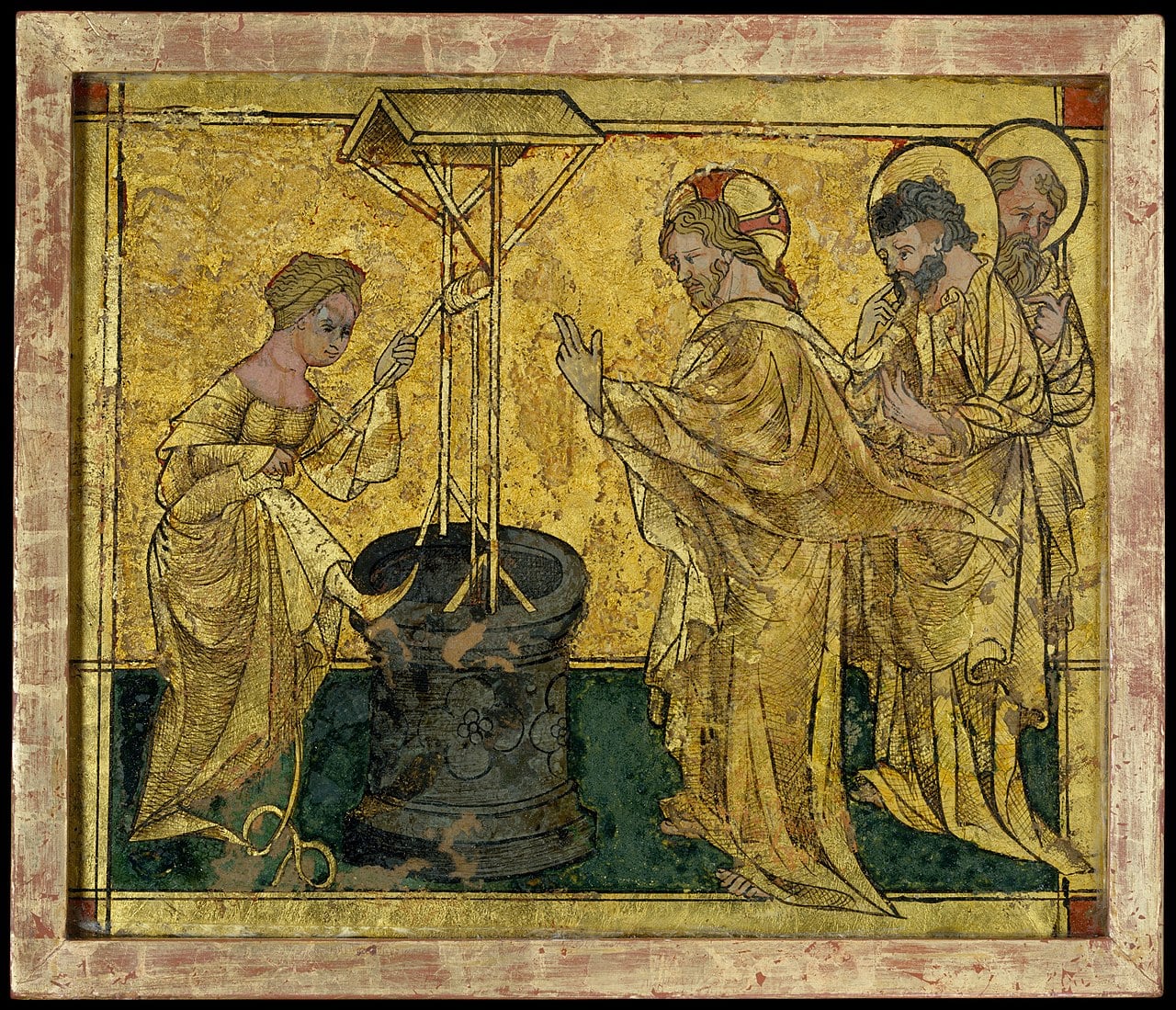
This is why the story of the Samaritan woman at Jacob’s well, St. Photina, is important. She was not a Jew, but a Samaritan, and she was a woman, so it was a surprise to her, as well as Jesus’ followers, that he not only talked to her, but that he offered her a share in the glory of the kingdom of God, that is, a share in the Holy Spirit:
There came a woman of Samaria to draw water. Jesus said to her, “Give me a drink.” For his disciples had gone away into the city to buy food. The Samaritan woman said to him, “How is it that you, a Jew, ask a drink of me, a woman of Samaria?” For Jews have no dealings with Samaritans. Jesus answered her, “If you knew the gift of God, and who it is that is saying to you, `Give me a drink,’ you would have asked him, and he would have given you living water” (Jn. 4:7-10 RSV).
Through his actions, and also through his words, Jesus showed Photina that he was not ruled by the divisions sin imposed upon the world. He did not reject her for being a Samaritan. He did not reject her for being a woman. He did not reject her for her sins. He was willing to take from her what she had to offer, her earthly drink, her water. He was not polluted by his contact with her. He was not changed by the encounter, rather, it was Photina who was changed. He said that if she asked, she could receive from him the living water, that is, the gift of the Holy Spirit, and, eventually, that is what she did. Her status as a Samaritan, and as a woman, did not make her inferior to anyone else; she was called, like everyone else, to the kingdom of God. The realization of this was important for her, but it should be even more important for Christians, because they are meant to learn from this and live out this revelation, a revelation of the eschatological kingdom of God, throughout history. Over time, it seems that they have either forgotten, ignored, or not understood this lesson. They did not see how Jesus showed them the absolutization of social distinctions do not fit the kingdom of God. This is why it is important for us to keep looking back to this story and reflect on it, especially in light of Christ’s resurrection from the dead. When we do so, we will find it is a story which continues throughout history. Christ continues to call to us, asking us to give of ourselves and our water, our own earthly goods, so that we can receive in return the living water which he sends to us, the living water of the Holy Spirit.
No one, man or woman, Jew, Gentile, or Samaritan (so hated by many Jews), will be left outside of God’s kingdom. “God is spirit, and those who worship him must worship in spirit and truth” (Jn. 4:24 RSV). The truth of the kingdom of God is the truth of our unity, and if we are going to worship God in spirit and in truth, we will do so by making sure our relative distinctions do not become a source of division in the world. The more we live out this truth, the more we fulfill what Jesus said will happen in the eschaton. We will come together and worship God in love, and our different cultural heritages will not get in the way of the bond of love which has formed between us: “Woman, believe me, the hour is coming when neither on this mountain nor in Jerusalem will you worship the Father” (Jn. 4:21b RSV). For it is not where we are from, but where we are going, the kingdom of God, the kingdom revealed to us in Jesus, which is important.
It is all too easy to find ourselves questioning the meaning of Paul, that is, to wonder what it means to say that in Christ there is neither male nor female, because that claim seems to ignore or reject the reality of the world. Looking around us, we find those who are male, those who are female, indeed, those who are intersex. We are also told, in the resurrection, we will have the same bodies as we do now, even if they are transformed and glorified; does that not mean, we will have the same gender as we did during our temporal existence? Yes. Paul was not denying empirical reality, he was not denying the differences in humanity, but rather, he was pointing out how those differences are not absolutes, and the only true absolute is found in Christ Jesus. A man or a woman is equal in Christ; he offers everyone the same Holy Spirit, and with the Holy Spirit, the same gifts. Their distinction does not make one or the other superior, which should make us wonder why Christians have long treated women as inferiors, when Christ offered St Photina the same Spirit he offered Peter and the other apostles. When will we take Paul seriously, and with it, the sign of the kingdom revealed to us in Christ’s meeting with St. Photina?
Stay in touch! Like A Little Bit of Nothing on Facebook.
If you liked what you read, please consider sharing it with your friends and family!
N.B.: While I read comments to moderate them, I rarely respond to them. If I don’t respond to your comment directly, don’t assume I am unthankful for it. I appreciate it. But I want readers to feel free to ask questions, and hopefully, dialogue with each other. I have shared what I wanted to say, though some responses will get a brief reply by me, or, if I find it interesting and something I can engage fully, as the foundation for another post. I have had many posts inspired or improved upon thanks to my readers.








 Ad-Free & Subscriber Log-In