

One of the dogmatic teachings of the Catholic Church, a teaching which was officially defined at the Fifth Lateran Council (1512-1517), but believed before then, is the immortality of the soul. We told told that when we die, we do not cease to exist; there is a “part” of us, named the soul, which continues to “live on.” Thanks to the way death is influenced by sin, when we die, our soul finds itself in an imperfect situation, as it is no longer united with the body it was intended to be joined with throughout all eternity. What the soul experiences after death, the kind of existence it has before the general resurrection, is rather nebulous; there are various elements of it which we have been told, but how those elements work together, we are not told. Theologians have debated with each other what the our intermediate state of existence, the existence we experience between our death and the resurrection, will be like. There are a large variety of opinions. To be orthodox, their views must not contradict what the church teaches, but beyond that, there is a large number of views which one can have. What, then, must be included in our considerations? That there will be a particular judgment after death, one which affects our experience of the “time” between death and the resurrection, that some might be judged to perdition, some might be judged and called to “paradise,” and the rest of us will find ourselves in a state between perdition and bliss, in a state where we find ourselves being purified from all the corruption our sins have had on us. We are also told that at the end of history, everyone will be brought back life, sharing in the general resurrection from the dead, whereupon they will experience the final or universal judgment which determine our eternal fate. After the general resurrection, we will never die, that is, our soul will never be separated from our body ever again.
I have extensively studied the theology of death. I have read through a great variety of theological and dogmatic sources, and through them, I have seen a great variety of descriptions concerning what our intermediate state is like. I have learned how Scripture itself contains a diversity of thought on the matter, with the immortality of the soul being very nebulous in the pre-Christian era, while in the New Testament, we find confirmation of the idea, even if what it means for those who are dead is not expressly stated. That is, I have seen even in the New Testament, there is enough ambiguity on what happens after death that Christians have come to many diverse conclusions, as can be seen in the way many have come to believe in the false notion of soul sleep due to Paul’s euphemism for death. Catholic teaching, however, affirms that there is a conscious element to our experience after death, one which allows us to connect, in some way, to those who are among the living. I have, thanks to all that I have learned, formed various opinions of my own, some which are peculiar to myself. I am especially influenced from my Eastern Christian traditions, some which are controversial, such as the notion of the “toll houses”; but I do so recognizing that the descriptions used to explain the toll houses as stations one goes through in one’s ascent into heaven as being metaphorical, serving a similar role as the “fires of purgatory.” Both the toll houses and the fires of purgatory are used to explain the kinds of experiences the soul undergoes as it is being purified and made ready for its entry into heaven.
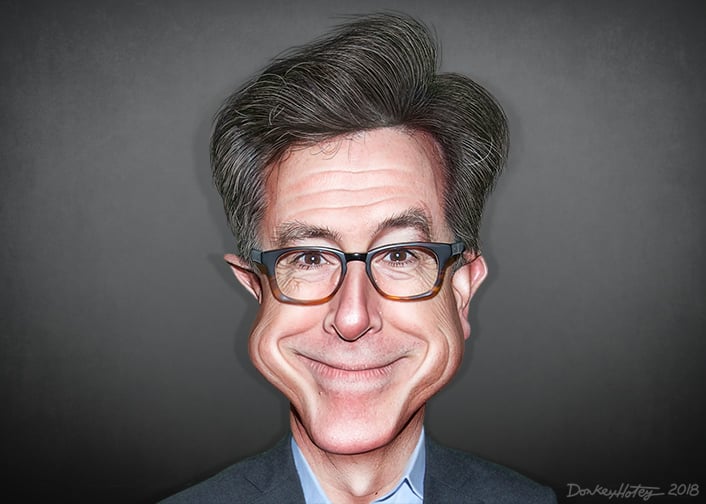
Thanks to my studies, and what they have revealed concerning the ambiguous nature of the soul after death, I have been somewhat surprised by the way Stephen Colbert was criticized for his own simple answer to the question as to what he thinks happens after death. The reason it was not a complete surprise is because I knew that there are some people who like to take what he says or does, and find any way they can criticize him, because they do not like his political affiliations. By doing so, they risk falling for the sin of calumny. What he said in and of itself can be interpreted in many ways; and just like Ecclesiastes, some interpretations can be perfectly orthodox, while others can be very unorthodox. Because we are called to look to the best interpretation of what others say when trying to understand them, it is wrong to demand the worst interpretations possible are what someone means so long as there other, more orthodox ways, their words can be understood. This is true for the way people deal with Colbert, especially if they show their interpretation requires them to engage an argument from silence, condemning him for what he didn’t say, that is, because he didn’t mention the resurrection:
I think of, almost like, it’s more like a feeling, and the feeling is that when we die, I think there is some continuance of some kind. But it’s like a dispersion of the self into some other greater being. And I don’t have any other feelings beyond that.[1]
While Colbert did not mention the resurrection, this does not mean he does not believe in it. Previously, he publicly recited the Nicene Creed on his show, indicating it is what he believed; and so, if we are going to interpret what he said, it is best to include this admission, using that as a hermeneutical key to understand what he meant instead of trying to suggest he denied the resurrection at the end of time. So why didn’t he mention it? While I can’t read his mind, it seemed to me that he was answering a particular question: what happens to us immediately after we die? From the Christian tradition, especially the Catholic tradition, the answer is not “we are resurrected” but that we enter into the intermediary state between our death and the resurrection. If so, then it would be obvious not to mention the general resurrection, as that does not occur until “later” (at least, in a conventional sense, because when talking about time after death, there are many questions which can be raised, and there are many reasons why it might be best to no longer think of that state as being temporal in nature, making any temporal discussions concerning the soul after death to be metaphoric, and not literal, events). What Colbert does do is affirm dogmatic teaching by saying the soul continues after death. He points out, through analogy, what he think the state is like, where it is a “dispersion of the self” into “some greater being.” Since the soul is no longer connected to the body, it is quite possible to think of this “dispersion of the self.” Indeed, it is normative to say, as the soul is meant to be with the body, the soul apart from the body is an imperfect state, one which loses aspects of the self, aspects connected to the body, making it seem like a dispersion. During that “time,” the soul can and will undergo purification (purgatory/toll houses), a purification which will affect our notion of the self. For, to be perfect, we will have to “die to the self,” that is, to overcome our false sense of the self and the attachments which formed from it, so that in our death, if we have not done so during our temporal existence, the false self will be entirely eliminated, allowing the soul, once it is purified, to experience union with God, the “greater being” which is beyond all names (including the name of God). Union with God, and with it, our theosis, is the purpose of our life. Thus, when I read and listen to what Colbert said, I find a perfectly sound way to read it, even when he talks about the dispersion of the self into some greater being.
Since Colbert is not a theologian, nor is he a philosopher, it is not surprising he does not have much to say on the state of the soul after death. But what he does say does not have to be seen as some sort of Gnostic rejection of the resurrection, but merely a presentation of what Christian teaching has always said happened at death: there is a part of us, the soul, which continues in a form of existence independent from its body; while it is good that we do not find ourselves annihilated at death, the state we find ourselves in between death and the resurrection is an imperfect state, as we are meant to be embodied. I think the tension of that imperfection is hinted in Colbert’s words, which is why, what he is talking about is not some Gnostic talk about the soul after death, but a Christian interpretation of that state. It certainly is not Gnostic to talk about union with God. It is basic Christian teaching. Christian theology has consistently struggled to describe the experience of the soul after death, but it has always recognized that whatever that state is like, it is a lesser kind of state than it will have after our resurrection from the dead. Colbert doesn’t mention the resurrection, but that doesn’t mean he denied it; he is silent about it here. To me, it is because he seems to want to talk about what happens at the moment when we die, doing so in a general form which many, not just Christians, can recognize as validating their view, something which good Christian theology always does. Colbert at other places has mentioned his belief in the resurrection. We should read those instances together with what he says here, so that we can recognize he is giving a very simple presentation coming from his Christian faith. I think only those of ill will, those who want to engage calumny, are purposefully making a case for him to be a heretic. In doing so, not only are they causing confusion concerning what Colbert says, but also about Christian theology in general. For, I fear that those who are not well informed about Christian theology and its teachings concerning the soul after death will come to believe Christianity denies both the intermediate state between death and the resurrection, and union with God, when it reality, both are fundamental teachings of the Christian faith.
[1] Quoted from John Brown, “Stephen Colbert prompts accusations of heresy over afterlife view: ‘We become Febreze’” in The Christian Post (5-22-2026).
* This Is Another Post From My Personal (Informal) Reflections And Speculations Series
Stay in touch! Like A Little Bit of Nothing on Facebook.
If you liked what you read, please consider sharing it with your friends and family!
N.B.: While I read comments to moderate them, I rarely respond to them. If I don’t respond to your comment directly, don’t assume I am unthankful for it. I appreciate it. But I want readers to feel free to ask questions, and hopefully, dialogue with each other. I have shared what I wanted to say, though some responses will get a brief reply by me, or, if I find it interesting and something I can engage fully, as the foundation for another post. I have had many posts inspired or improved upon thanks to my readers.










 Ad-Free & Subscriber Log-In