2018-06-11T03:09:24-05:00

After showing how apophatic theology could give some positive understanding about God by the way he established God as the Cause of all, asserting God’s greatness by denying what he was not, Dionysius next continued his theological and contemplative union with God by denying material substance to God. In this fashion, Dionysius wrote:  nor is [He] a body—-nor has [He] shape—-nor form—-nor quality, or quantity, or bulk—-nor is in a place—-nor is seen—-nor has sensible contact—-nor perceives, nor is perceived,... Read more

2023-10-10T05:48:57-05:00

“I am the good shepherd. The good shepherd lays down his life for the sheep” (Jn. 10:11 RSV).  Jesus, the good shepherd, was so concerned with the salvation of our souls, he was willing to lay down his life for our sake. He showed us the way to follow him is to die to the self, to no longer be attached to ourselves but to look upon others with loving compassion, doing what we can to help them: For to... Read more

2018-06-05T10:57:27-05:00

There is something rotten in the state of Germany. It is Richard Grenell. Not to be confused with to be confused with Grendel, he is the United States ambassador to Germany. In an interview on Brietbart, he indicated his new understanding of his position is to make political statements, interfering with foreign elections, by saying that his job is for the sake of collecting and empowering a particular political brand of thought (“conservativism” in the lines of Donald Trump).  After... Read more

2018-06-04T03:08:23-05:00

CAPUT IV. That the pre-eminent Cause of every object of sensible perception is none of the objects of sensible perception.   WE say then- that the Cause of all, which is above all, is neither without being, nor without life—-nor without reason, nor without mind, nor is a body—-nor has shape—-nor form—-nor quality, or quantity, or bulk—-nor is in a place—-nor is seen—-nor has sensible contact—-nor perceives, nor is perceived, by the senses—-nor has disorder and confusion, as being vexed... Read more

2018-06-01T03:08:15-05:00

In a famous episode of Christ’s ministry, Jesus turned fives loaves of bread and two fish into a meal fit for thousands: Lifting up his eyes, then, and seeing that a multitude was coming to him, Jesus said to Philip, “How are we to buy bread, so that these people may eat?”  This he said to test him, for he himself knew what he would do.  Philip answered him, “Two hundred denarii would not buy enough bread for each of... Read more

2018-05-30T06:14:02-05:00

Once, the people of Israel were migrants. They had no land of their own. In Egypt, they experienced the hostility often given to migrants, suffering harshly by the dictates of the Egyptians. In rescuing the people of Israel, making them a holy and chosen nation with a land of their own, God told them to remember what it was like to be hated for being strangers in a land not their own. That way, they would know how and why... Read more

2018-05-28T02:44:09-05:00

Positive theological reflection, kataphatic theology, begins with foundational declarations about God, such as statements which indicate his majesty and power. They are to be given in a form which the audience is expected to understand. Then, after establishing a common foundation for theological discourse, those following the way of kataphatic theology pursue, through discursive logic, the ramifications of its foundations. They seek to derive secondary principles founded upon the first ones with which they began. Finally, they take what has... Read more

2018-05-25T15:36:27-05:00

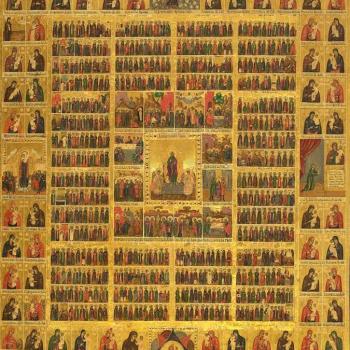
In the Byzantine liturgical tradition, the Sunday after Pentecost is the Feast of All Saints. On it, we celebrate all those who have integrated themselves into the kingdom of God, all those who have fully realized their status as adopted children of God. They are holy and righteous, reflecting the glory of God throughout the world. Saints are holy because God is a holy God who shares his holiness as a gift to those who open their hearts to him.... Read more

2018-05-22T09:29:55-05:00

The prophet Jeremiah has a warning for those willing to exploit labor: “Woe to him who builds his house by unrighteousness, and his upper rooms by injustice; who makes his neighbor serve him for nothing, and does not give him his wage” (Jer. 22:13 RSV). All Workers should earn a just wage. Pope Francis indicated that giving someone less than their fair share, less than a wage which they can live on, is not only exploitation, but a mortal sin.... Read more

2018-05-21T03:32:18-05:00

Dionysius in the Mystical Theology embraced and encouraged the use of both kataphatic and apophatic theology. All doctrinal theological discourse, all that is stated for the sake of others, will have some kataphatic element to it, using a variety of analogies and symbols to discuss God, even if later there is to be an apophatic denial of those same elements. There are many, indeed, an infinite variety of ways kataphatic discourses about God can be had, with each way complementing... Read more

Follow Us!


TAKE THE
Religious Wisdom Quiz

Who saw the "writing on the wall"?

Select your answer to see how you score.


Browse Our Archives