

What did the gospel look like for non-Christians in the ancient world? Prior to Jesus and Paul, the “gospel” in the sense of (good) news (εὐαγγέλιον/euangelion) appears in Greek and Roman classical literature. What passes for good news is different than what we find in the New Testament.
Ancient Examples of the Good News for Pagans
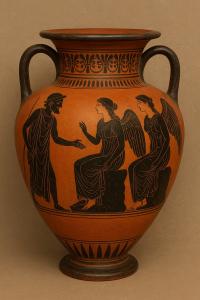
Classical Greek lexicons understand euangelion as a reward or recompense for good news. In Homer’s Odyssey, for instance, the hero Odysseus, disguised as an old vagrant, requests a reward of a cloak and tunic from his swineherd for bringing good tidings. He reports to the unsuspecting herdsman that Odysseus is still alive and will be returning home (Homer, Od. 14.152, 166).*
In military use, the messenger bringing news of victory received a reward, thus, a message of glad tidings (e.g., Plutarch Demetrius 17.6; Appian Civil War 4.113; Heliodorus Aethiopica 19.3). Similarly, regarding political rivalry, soldiers mounted on horses to give good news to Mark Antony regarding his enemy, Cicero, being beheaded (Appian Civil War 4.20). Joy can characterize the use of euangelion, whether with political or private messages. Regarding the latter, for example, there is good news of joy at the death of a bad stepmother! (Heliodorus, Aethiopica 1.14.3–4).
The famous Roman orator and statesman Cicero uses the term to speak of a jury acquittal (Att. [2.]3.1). The Roman emperor’s birthday or inauguration can be called euangelion, whether for Caesar Augustus (OGIS 458 II.40–41), Vespasian (Josephus Jewish War 4.618, 656), or in case of a bad emperor, like Domitian, his assassination (Philostratus Life of Apollonius 8.27.1).
Religious Good News
According to Ulrich Becker, “Such messages are seen as a gift of the gods. When a good message has been received, sacrifices are offered out of gratitude but also in order to hold the gods to their gift” (“Gospel, Evangelize, Evangelist,” NIDNTT 2:107–08). As such, the good news was also associated with presenting sacrifices as thank offerings to the gods for favorable reports.**
Given the aspects of victory, favorable news, and sacrifice related to euangelion, one cannot easily divide “secular” or “religious” uses of the term. I suspect that hardly any good fortune could not be attributed to a god in the Hellenistic world even when a sacrifice was not always present in the texts.
The Gospel Verb
Ancient nuances of the verb, euangelizo (εὐαγγελίζω), are not much different in meaning than the noun. Normally, in the Bible, euangelizo is rendered “proclaim the gospel” (e.g., NRSVue) or “preach the gospel” (e.g., ESV). When proclamation is not clearly involved, or the sense seems broader than mere preaching, perhaps a better alternative comes from the little-known translation of William F. Beck: “bring the good news.” Beck’s rendition is comparable with the choice translation of prominent Greek classical lexicons.***
We find the verb, “to bring the (good) news” used to express a battle victory or war’s end, weddings, a child’s birth, a consul’s election, or even in reference to such things as inexpensive sardines, an opportune death, or a haunted house being exorcized of its spirit!**** The verb at times can be connected with deliverance and good fortune, which seems to be religious in meaning (Lycurgus, Against Leocrates 6.17–18, cf. Demosthenes Or. 18.323; Heliodorus, Aethiopica 10.1–2; Friedrich, TDNT 2:711; Schniewind, Euangelion, 145–151).
The Gospel in the Bible
We see, then, that ancient pagans used gospel terms, too. And sometimes they even used them in religious contexts, though to honor others gods rather than the one true God of Jewish Scripture. Relevant for our purposes, when Paul proclaimed the good news to pagans, they were already familiar with the term. A distinction, however, is that our apostle attributed the gospel to Jesus as Son of God. This had an implication for pagans hearing it: the Roman emperor was not the true king and Son of God, Jesus was.
Notes
* For further lexical use of the term euangelion and its cognates, see my work, B. J. Oropeza, The Gospel According to Paul: Over a Hundred Years of Interpretation.” Religions 15 (2024) 1–45 (3–4; cf. 37–38 notes 2, 8). Often the noun appears in the plural (euangelia) in ancient non-Christian literature.
** For examples, see Aristophanes Equites 656; Aeschines, In Ctesiphtonem [III]160; Xenophon Hellenica 1.6.37; 4.3.14; Isocrates, Areopagiticus 7.10; Plutarch, Agesilaus 17 [I.605c]; Demetrius 17.5[1.896C]; Sertorius 11.4; 26.3; Phocion 23 [I.752b]; Diodorus Siculus 15.74.2. Further, see Moises Silva NIDNTTE, 2:307; Julius Schniewind, Euangelion : Ursprung und erste Gestalt des Begriffs Evangelium, 182; Gerhard Friedrich, TDNT 2:722.
*** e.g., LSJ 705; BrillDAG, ad loc “εὐαγγελίζω,” whether in active or middle voice: e.g., Demosthenes, Orationes 18.323; Polyaenus of Macedonia 5.7.
**** On the first point, see Plutarch Pompey 66.3; Philostratus Lives of Philosophers 5.8; Josephus Antiquities 5.24; 7.245, 205; Jewish War 3.503. On the second, P.Oxy. XLVI.3313.3; Longus, Daphnis and Chloe, 3.33.1; third, Theophrastus, Characters 117.7; Josephus Antiquities 5.277, 282; Jer 20:15; fourth, Plutarch, Marius 22.4, and fifth, respectively, Aristophanes, Equites 642–45, Heliodorus, Aethiopica 2.10.1, and Lucian, Philopseudes 31 (also, Polyaenus, Strategemata 5.7; cf. Spicq/Ernest, TLNT 2.83 n. 10).

















 Ad-Free & Subscriber Log-In