

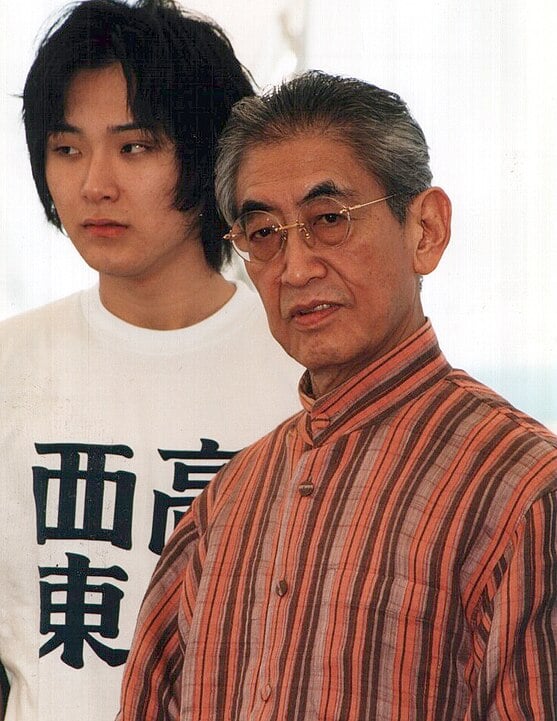
Source: Wikimedia user Rita Molnár
License
Sister Helen Prejean by way of Brecht and Kim Il-Sung, Death by Hanging (1968) is one of those New Wave films that sits uneasily on the line between documentary and fantasy. Nagisa Oshima, the director, culls his material from real life. The case of a Japanese-Korean student who killed two schoolgirls, his correspondence with a North Korea-sympathetic journalist, and the popularity of the death penalty in 1960s Japan form his topics. His form blurs realistic shots and descriptions of the method of execution (hanging) and where it takes place (a Western-style house on prison grounds) with comedic reenactments of repellant sex crimes. You can’t look away because you’re trying to make sense of what you’re looking at.
He takes liberties. While the opening consciously imparts an air of reality—we’re going to learn exactly why pro-death penalty activists are wrong by a sober narration of the process—it rushes into thought experiment. What if, Oshima asks, the executed were not to die after the hanging? What if his heart kept on beating, but when he woke up, he had no memory of his crimes? Would those present—various prison staff, a physician, a prosecutor, and a chaplain—be able to hang him again?
Here, Oshima finds comedy. The useless warden and his men are eminently bureaucratic. You can’t execute someone who is “mentally incapacitated.” What does that mean? No one is exactly sure, but amnesia must qualify. The troupe—one dead serious on making R (Yung-Do Yoon), the Korean youth, dead, one obsessed with forcing him to remember his deeds, others faffing about the execution chamber—fight, scream, and reenact the man’s gruesome crimes in a bid to force his memory. They get a bit too into it, adopting comically “Korean” mannerisms and inventing conversations. R slowly recovers. The jailhouse posse begins to hallucinate, so deep is their commitment to the play of R’s life.
R’s “sister,” a stand-in for a Kim-supportive journalist from the real story, manifests in this bedlam worthy of Peter Weiss’ Marat/Sade (1964). She begs R to discover his inner radical, argues he committed these crimes as a cry for help for his people. The many Koreans devastated by Japanese colonization, forced to migrate to Japan, still divided on the other end of WWII. R, dead eyed and placid, lurches his way from asking “what’s hanging” until he can hold a halfway decent conversation with his “sister.”
R’s background fits the sympathetic crime film stereotype. Growing up in a household full of kids, his father was a drunk and his mother a mute. His many siblings exist to contribute to the squalor. He snapped, the authorities argue, and turned to rape as a means of gratification and control. The trouble, Oshima suggests, is how much they relish reenacting that life. It’s almost, maybe, perhaps, as if they are the ones devoted to dominance and self-gratification.
The Catholic chaplain stands aside, barely daring to look at his charge. And, in a distortion of Catholic theology, argues that R is now not-R, because his soul left during the hanging. The man before them is innocent, not because the death penalty is wrong or because R has amnesia but rather because soul and body have disjoined, said adieu. In his absurd way, he’s the voice of moral clarity. Of course, he gets drunk and tries kissing everyone.
Despite the grave subject matter, Oshima’s unyieldingly comedic tone makes the film more farce than tragedy. The jokes land because the prison lackeys are jokes, petty man devoted, in his view, to a petty institution, one that has power over life and death. As the film winds down, they turn to explicitly nationalist justifications for why he ought to let himself be hanged, whether he is R anymore or not. They play to his “Japanese-ness,” even as he will never be Japanese, not in their eyes.
Above all, Death by Hanging has the good sense to make a laughingstock of its enemies. A sober brow-furrower of a documentary about injustice is one thing. To take a gander at your enemy, see him, know him inside and out, and use his own buffoonery against him—that’s the quintessentially 60s spirit. But the film, to its credit, never lapses into total moral seriousness. We know the issue matters. Show us who benefits and who is crushed.














 Ad-Free & Subscriber Log-In