

Most Pagans are quick to say that our Gods will not be found in a book – especially not in any One Very Special Book. Rather, they will be found in the majesty of Nature.
But too many of us forget that when we find the Gods, they will speak to us.
This is understandable. We live in a society that for all our religious diversity is still dominated by Christianity, and especially Protestant Christianity with its emphasis on sola scriptura. While some Christian denominations believe their God does sometimes speak to people individually, the official canon is closed. This idea of divine silence has made its way into the common culture and from there into Paganism.
Beyond that, if someone says a God is talking to them, some people assume they’re delusional, if not mentally ill. Materialists say that such things not only don’t happen, they can’t happen.
But for most people throughout most of the world throughout most of history, such things were and are simply a part of life. We share this world with a variety of spirits: land spirits, ancestors, Gods, and others persons who are difficult to classify. Mostly they mind their own business.
But sometimes they speak to us.
And occasionally, we hear them.
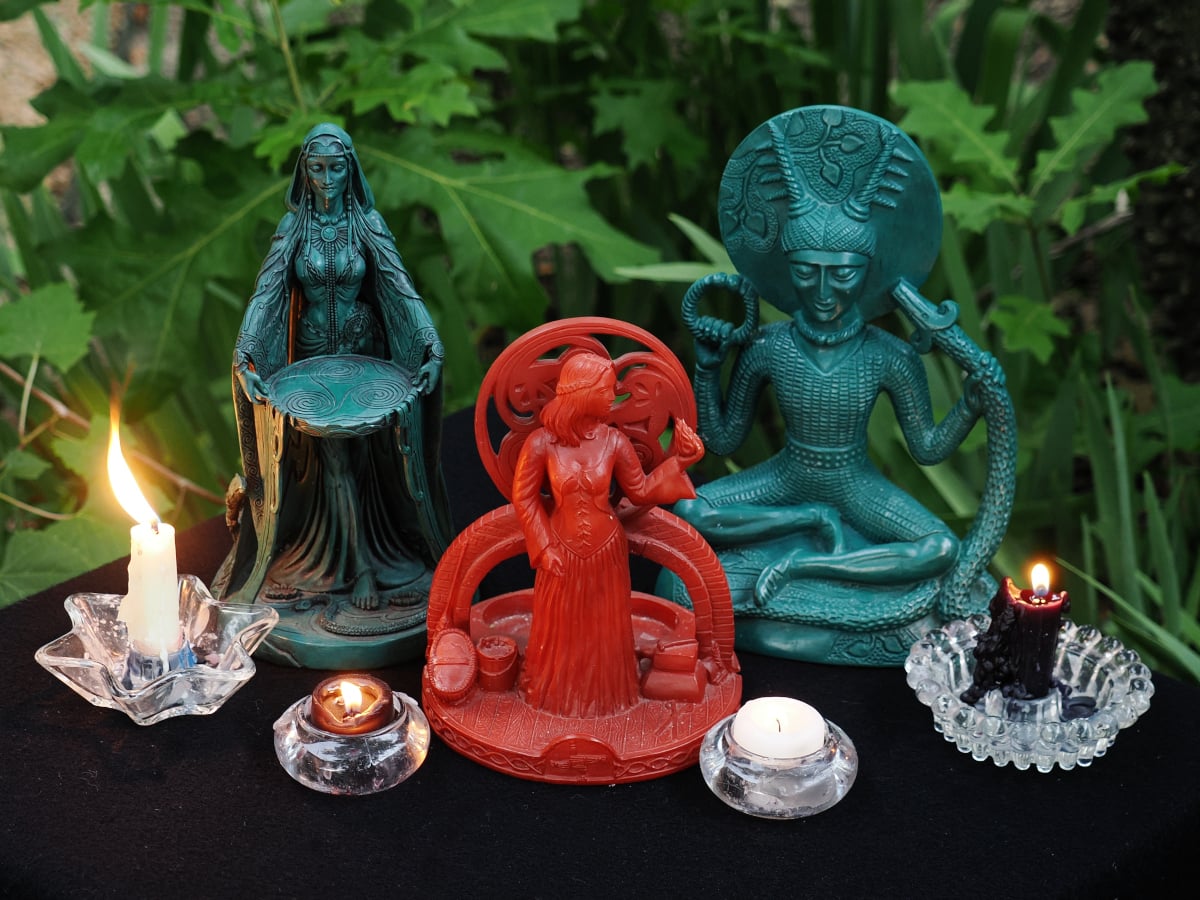
People are hearing from their Gods
It’s been a misconception for centuries: the Old Gods went away with the coming of the One God. But while some went into the Otherworld and others were absorbed into the new religion, Plutarch was wrong: neither Pan nor any of the other Old Gods died. People remembered Zeus and Odin and other Gods of their ancestors. And with the beginning of the Pagan revival in the early modern era, people began actively worshipping them again.
Did this worship persuade the Gods to become more active in the ordinary world again, or did the Gods become more active and so people began experiencing them and worshipping them? My guess is a little of both. However it happened, the Many Gods are very active in our time. They’re showing up in our wider culture and they’re showing up in devotion, including many devotional anthologies. I had a hand in creating one for Cernunnos.
People are hearing from their Gods.
Some people just want to live an ordinary life
I don’t want to imply that everyone should be receiving ecstatic messages on a regular basis. We are humans living in the ordinary world and our primary concern is the ordinary world. Most people simply aren’t interested in living a mystical life, and that’s fine.
But some of us are.
And others are called to it whether they want it or not.
Such things do happen.
The Gods are mighty and the Gods are subtle
Some persons have weak egos that need constant reinforcements, but the Gods know they’re Gods. They don’t need to impress us – and it’s just as well. Zeus himself could appear in the middle of a city throwing lightning bolts and most people would barely look up from their phones. At most they’d mumble “I think it’s going to rain” and then go back to whatever they were doing.
Our Gods do not need spectacle, and they have – in my experience, anyway – no desire to impress those who only want a show. They mostly speak to those who want to hear.
Those of us who have experienced Gods and spirits know that they rarely speak in an audible voice. Most times it’s a thought that isn’t your thought. It’s an idea you never considered that comes out of nowhere. Sometimes it’s a wordless impression that makes you understand the phrase “a picture says a thousand words.” Our earliest primate ancestors did not have the power of language, but they were still able to communicate. Some Gods prefer more primal communication.
The Gods are mighty and awe-inspiring, but when they speak to us, they are usually subtle.
To hear, make a practice of listening
If you want to hear a God, first introduce yourself. Regular prayers, offerings, and other acts of devotion let them know you’re interested in a reciprocal relationship, not a performance and not a series of favors. The more you do and the more you learn about them, the more you learn what to expect – the more you attune yourself to their ways of thinking and being.
If you want to hear the Gods, listen for them. Practice mediation. Not the emptiness of Zen meditation (that practice has benefits, but not for this), but a regular practice of concentration on them and receptiveness to them.
If you would hear a God speak, listen.
Discernment is required
When you hear (see, feel, intuit, experience) something, the next step is discernment. You are a living human – this and all your experiences are filtered through your human brain, which interprets them based on your previous experiences, your expectations, and especially your worldview – your foundational (and often unexamined) assumptions about the world and how it works.
You had an experience – that’s an undeniable fact. Now, what does it mean? Who spoke to you? What were they trying to communicate? What’s the context of the communication? How do you incorporate that into your life? How can you best respond?
Experiences are always real. Our interpretations of those experiences can be more or less true, more or less helpful. If your interpretation tells you everything is fine as it is or that you’re being called to be a Very Important Person, that’s probably not a very true and helpful interpretation. Same thing if you think you’re hearing that you’re worthless and the world is going to hell and there’s nothing that can be done to make it better.
On the other hand, if you hear that things are difficult but there is a path forward, if you hear that you’re not the center of the universe but you do have an important part to play, that’s probably a good interpretation.
Make discernment an active and intentional part of your spiritual practice.
How will you respond?
Sometimes a God will speak to a human to say “you’re doing OK, keep it up.” Sometimes. At the beginning. But Gods are not therapists. Sooner or later they’re going to ask for a response.
Perhaps this is simply a call to live by their virtues and values. Cernunnos wants us to live in harmony with each other, and with all the species with whom we share this planet. The Morrigan wants us to reclaim our sovereignty. Brighid wants us to practice good hospitality. Many of the Gods want us to demonstrate honesty, courage, strength, and perseverance.
We don’t need a world full of priests and mystics. We do need a world where everyone embodies helpful virtues in their ordinary lives.
And some people are called to be priests and mystics, philosophers and theologians, magicians and witches.
What are you being called to do? What do you want to do?
Most importantly, what will do you?
Many Gods, many people, many ways
It’s difficult to establish and enforce orthodoxy in a world where Gods are actively speaking. Different Gods call different people to worship and work for them in many different ways. Plus a plain reading of the stories of our ancestors makes it clear that orthodoxy isn’t very important to some of them.
One might speculate that the reason churches tell their followers that their God doesn’t speak anymore is that if they didn’t, the major divisions (Catholic, Protestant, Orthodox) and the minor divisions (the thousands of denominations and independent churches) would be even more fragmented than they already are.
As a Pagan, it’s not my job to analyze Christian theology and doctrines. And I like order as much as anyone who makes a living as a engineer. But as someone who has experienced the Gods (or rather, a few of them) for myself, I wonder if perhaps the pursuit of orthodoxy is the wrong goal.
Perhaps we were never meant to be united on questions that cannot be answered with any degree of certainty. Perhaps we’re better off uniting around shared values and common interests, and then supporting each other as we pursue the Gods in as many different ways as there are Gods and people.
Appreciate their presence
The loudest voices in our wider society scream that there is only one God and he stopped speaking two thousand years ago. And also, they and only they know exactly what this God wants. That’s another rant for another time.
The second loudest voices in our society scream that there are no Gods and that anyone who thinks otherwise is delusional.
Meanwhile, those of us who have experienced one or more of the Many Gods know that they are alive and they are speaking. We need not – and should not – try to out-scream the others. Pagans don’t proselytize – we need not convert everyone, or anyone. We simply need to listen to our Gods, and to discern the best ways to embody their virtues and values in our lives.
And to appreciate their presence and blessings while we do.









 Ad-Free & Subscriber Log-In