

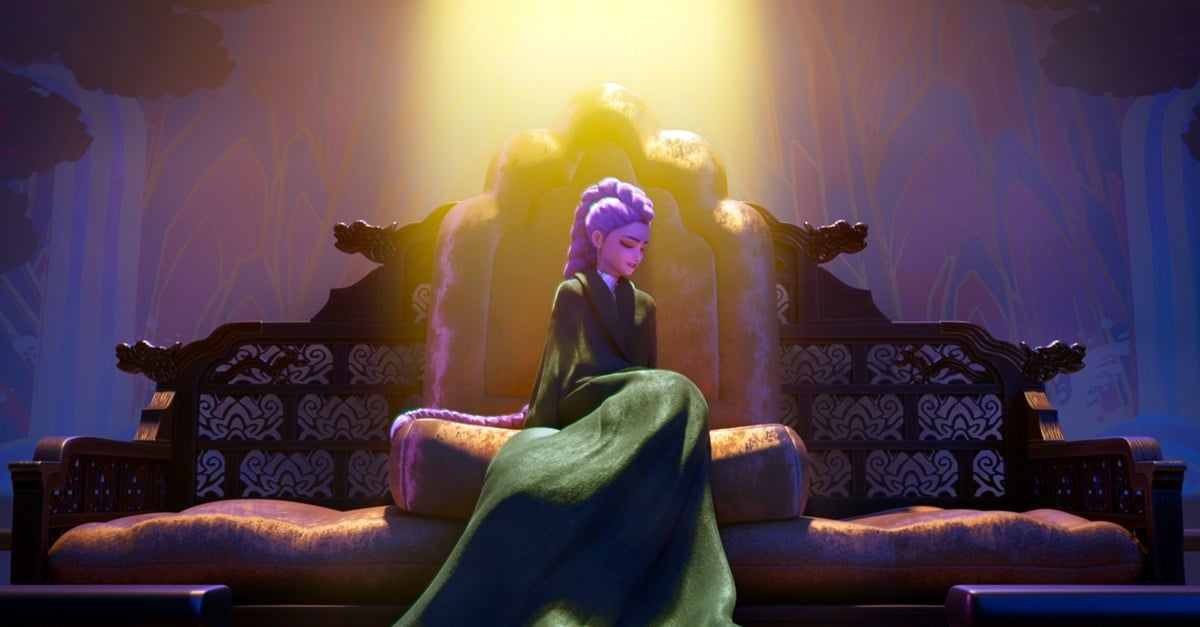
Comparing Netflix’s animated musical KPop Demon Hunters to the hit movie franchise (and J.R.R. Tolkien literary classic) The Lord of the Rings may sound like heresy to some, but the quality of a story doesn’t depend on the medium.
It’s always in the execution … and the mind of the viewer.
Sometimes You See It, Sometimes You Don’t
Those among my friends who love The Lord of the Rings books long told me that it was all about Catholicism. But nothing they told me made me see that.
I did read The Hobbit, and I still didn’t see it. I watched the movies and didn’t see it. I read articles that laid the assertion out in detail — and have even seen the Rosary in it — and while I took them at their words, I still didn’t see it.
At least in the movies, nobody prays. There are no houses of worship, clergy or religious services of any sort. So, how can it be Catholic?
(And some writers refute the claim that LOTR is Christian at all.)
After all, people of many religions — and no religion — love The Lord of the Rings. It’s based on European folklore, specifically, northern European folklore, and yet people from many cultures find meaning in it.
What did Tolkien himself have to say?
I cordially dislike allegory in all its manifestations, and always have done so since I grew old and wary enough to detect its presence.
I much prefer history – true or feigned– with its varied applicability to the thought and experience of readers. I think that many confuse applicability with allegory, but the one resides in the freedom of the reader, and the other in the purposed domination of the author.
So, what’s the answer? It’s because The Lord of the Rings is really good, and it’s done in such a way that it reinforces very definite values (most recognizably Catholic) while couching them in a created worldview that embraces specific cultural elements while expressing universal, deeply human themes.
That sounds not unlike KPop Demon Hunters to me — not an allegory but applicable.
Along the way, the Sony Animation production became an unlikely hit, resurrected storytelling truths that too many have forgotten, and spawned some debate about whether, like LOTR, it’s an example of stealth evangelization.
BTW, if you haven’t seen the movie, stop here and go watch it. I’m going to spoil at will and not explain anything.
Also, the film returns to theaters in singalong form on Halloween weekend — I have my tix.
KPop Demon Hunters Is Exactly What It Sounds Like (see what I did there) … And So Much More
While KPop Demon Hunters is a title that undersells the film’s quality, it’s perfectly accurate. Protagonists Rumi, Mira and Zoey are three Korean pop stars, and they do indeed hunt demons in their offstage time.
But in many ways, it’s a smash hit that shouldn’t be one. Here’s why:
- It’s an entirely original story. Everyone in showbiz knows that only remakes and reboots work these days.
- Most fans have never heard of the producers, writers, directors or most of the voice talent.
- A large chunk of the audience (myself included) has never listened to K-pop music … and it doesn’t matter.
- The film is entirely set in and around Seoul, South Korea, including some of the city’s landmarks. … but people who don’t know Seoul have to figure that out on their own.
- The incredibly detailed production design, sets, cultural touchpoints and costuming draw heavily on Korean customs, folklore and history … but offer no explanation of any of it. Again, that stuff is fun to learn about but not a dealbreaker.
The story both shows a deep appreciation for the phenomenon of K-pop music, while making clear the rigors of it and the perils of music-idol worship, a central feature of the industry.
I get into more detail here about the film’s plot and suitability for Catholics — and here, a Catholic priest also weighs in.
In an irony, EJAE, the artist who provides Rumi’s singing voice and wrote or co-wrote three songs for the hit soundtrack — Golden, Your Idol and How It’s Done — spent 10 years in the K-pop industry before being ultimately rejected for a voice that now wows even music professionals.
What KPop Demon Hunters taught (or reminded) me about storytelling
- Don’t fear the Reaper: In other words, even in a movie that’s bright and fun, don’t be afraid to touch the darkness. The darkness is what gives depth and meaning (as long as it doesn’t win in the end).
- Yearning is better than fulfillment: Rumi and Jinu never kiss. There’s one hug (sorta) and a bit of hand-holding. I’ve watched reaction videos where that reduced people to puddles. Go one inch further, and you lose something precious.
- Specificity can co-exist with universality: Underneath cultural nuances, we’re all human beings. As long as you tap into common human experiences — love, loss, hope, despair, connection, alienation — you can surround your story in a distinct culture and still have broad appeal.
ONE NOTE: I’ve heard story creator and co-director Maggie Kang she wanted even more Korean language in the songs. I respectfully disagree. There is a danger of raising the threshold of entry a bit too much. I think KDH’s balance is perfect.
- Make it beautiful: The animation in this film is STUNNING. You could literally freeze so many frames, stare at them for a half-hour, and then frame them on the wall. So tired of dark, dingy, washed-out films.
- BUT, a beautiful film doesn’t work without a great script. While there is a bit of connective tissue missing in this fast-paced film (not a fatal flaw), it’s so well-written — and a perfect example of how to actually use on-the-nose dialogue. The script structure is impeccable, and the story is emotionally compelling, cohesive, and deeply moving … did I cry? Oh, yes, I did.
- Both Rumi and Jinu deal with the issue of hidden shame but in different ways. Rumi’s secret is not her fault, while Jinu’s is absolutely his fault. One seeks acceptance, and the other, redemption. Meanwhile, Korean-American Zoey struggles with feeling embarrassed by her own quirks while trying to find her place between two worlds; and “black sheep” Mira suffers the shame and pain of her family’s rejection. Exploring similar ideas through different lenses makes powerful, connected storytelling.
- Music and story can be separate but connected: The songs are GORGEOUS, beautifully and professionally crafted pop bangers, but they also advance the narrative. The trillion views on YouTube show that they stand on their own, but they’re even better in context.
- Girlbosses aren’t inevitable: This film has female protagonists who are mighty demon hunters, but they aren’t annoyingly arrogant, dismissive and man-hating. They’re powerful yet girly, love boys but are willing to slay them if they’re demons, and are cool chicks not afraid to burp. LOVE THEM.
- The man gets his due: Jinu goes on a lovely arc from selfishness to self-sacrifice, as he regains his soul and ultimately blocks the demon king’s energy to save the girl he loves (and the world). That’s a MAN right there.
- Scary animals can be cute: I’m living for getting a Funko Pop Derpy Tiger and Sussie the magpie (who has three eyes in a stack, just like a Samsung cameraphone).
- Speaking of which, EASTER EGGS RULE. There are more in this movie than I can name. Here’s one: note Rumi’s four-pointed zipper pull. Then note Jinu’s earring in the climactic scene. ‘Nuff said. So many added toy surprises for the sharp-eyed.
- Protagonists can be likeable: In a world of antiheroes, give me more Huntrix! Flawed, real, human, and warriors for the working day. You go, girls.
Lastly, Is It Christian?
Certainly not overtly, but I don’t know enough about the creative people involved to say whether or not any of them had that intention (see UPDATE below).
This video makes the case that the film is “accidentally” Christian. I guess you could say that.
What’s definitely true is that KPop Demon Hunters‘ themes of forgiveness, redemption, love, friendship and self-sacrifice — while solid traditional values held across many faiths and cultures — resonate with Christians, as does the notion of resisting surface temptation that covers deep evil.
I saw one parent in a reaction video refer to the covertly demonic Saja Boys catchy hit song Soda Pop as deeply selfish — all about what the love object does for the lover … and about the lover consuming the beloved.
Taken another listen in that context.
Dies irae (day of wrath)
Illa (that)
Vos solve in (turns you into)
Favilla (ashes)
Maledictus (cursed)
Erus (you will be)
In flamas (into flames)
Eternum (eternal)
It’s hard to imagine a more damning — and yet danceable — explanation of the perils of worshiping false idols.
The inclusion of Christian references may just be a shorthand to subconsciously connect with fans of Catholic-themed horror films, but it’s effective.
UPDATE: Actually, the Christian references come from songwriter EJAE’s own personal history. From Forbes:
“It’s about the obsession of fans [because the Saja Boys] want them to be obsessed [to control them],” she explains. “That sounds like what an Idol is. I was raised Christian and remembered it’s a sin to idolize something. So, it was like a twist of “I’ll be your Idol.” It was kinda creepy.” …
EJAE was inspired by the choir portion of EXO’s “MAMA” and added her version into the song. She created the harmonies and sounds to evoke a cathedral – a place of worship for the Idols. She reveals the chorus intro to “Your Idol” was “The Huntrix Mantra” in reverse.
“I reversed [the audio] and harmonized that [on the demo],” she shares. “I was like, ‘Whoa, this sounds like a cathedral. [It was] weird. So, I did that and added harmonies to make it sound even creepier and have a kind of old Latin vibe.”
And, That Bit About Self-Acceptance
One last note, and this is important, Rumi has to accept that she is half-demon. After all, what choice does she have? Even after the Honmoon is sealed, the patterns fade but don’t disappear (so, Celine was wrong after all).
But, Rumi doesn’t give over to the demonic, and she doesn’t stop in her mission of fighting the demons or trying to destroy them.
She may be half-demon, through no fault of her own, but it doesn’t become her whole identity or anything she expects to be celebrated.
It’s part of who she is, but she holds onto her belief in the power of light over darkness. I’m sure we’ll learn more about all of this in the planned sequel or sequels.
Don’t miss a thing! Subscribe to my content at Authory.com/KateOHare.











 Ad-Free & Subscriber Log-In