


“This world eats the dead. Everything eaten here has the taste of death. The truth is fed by that which is alive, and those who feed on truth are alive. Jesus came from that place and he gives real food to those who are hungry for it. These will not die.
“God planted trees in a garden, and Humanity lives among those trees. They were not divided when they were told, “Eat from this tree, and do not eat from that tree.”
“The Tree of the Knowledge of Happiness and Unhappiness killed Adam, but the Tree of True Knowledge (the Tree of Life), enlivens humankind.
“The Law is a tree which separates good and evil; happiness and unhappiness, and offers nothing else. When it was said, “Eat this, and do not eat that,” this was the origin of death.” (The Gospel of Philip, vs. 93-94)
Philip’s Gospel continues to examine the symbolism found in the Genesis myth of Adam and Eve in the Garden of Eden, and the two trees God planted there.
“This world eats the dead. Everything eaten here has the taste of death. The truth is fed by that which is alive, and those who feed on truth are alive. Jesus came from that place and he gives real food to those who are hungry for it. These will not die.”
This world is the illusion we are born into. It is not the reality of Oneness, but the dream of separation that deceives us into believing that we are divided from one another, and from God. This is death.
Therefore, “this world eats the dead,” and “everything eaten here has the taste of death,” because the only fruit that this world can produce is death. But, thankfully, we do not have to remain in this world of death, eating the fruit of death, because, as Philip’s Gospel explains: “The truth is fed by that which is alive, and those who feed on truth are alive. Jesus came from that place (of life), and he gives real food to those who are hungry for it. These (who eat of the real food) will not die.”
This passage echoes what Jesus says to his disciples about “real food and drink,” in the Gospel of John:
“Whoever feeds on my flesh and drinks my blood has eternal life, and I will raise him up on the last day. For my flesh is true food, and my blood is true drink. Whoever feeds on my flesh and drinks my blood abides in me, and I in him. As the living Father sent me, and I live because of the Father, so whoever feeds on me, he also will live because of me. This is the bread that came down from heaven, not like the bread the fathers ate, and died. Whoever feeds on this bread will live forever.” (John, 6:54-58, emphasis mine)
The ”real food” that Jesus gives us to eat is symbolized here in John’s Gospel as his very own flesh and blood. But, we understand that this is not literal. We are not encouraged to eat human flesh or to drink human blood. This is another symbolic teaching intended to spark our curiosity and provoke our imagination.
To “feed on this bread” that Jesus offers us, we have to consider the symbolism found in the Eucharist, a sacrament of communion with Christ and with one another. This is not about eating bread or drinking wine (or grape juice) in a religious ceremony. It is about understanding the meaning behind that symbolism and internalizing it until it transforms our way of thinking and being.
The reason the Eucharist (or “The Lord’s Supper”) is commonly referred to as “Communion” is because this is what it symbolizes: Our connection and unity with Christ and with all Humanity. The Incarnation of Christ is literally the fusion of Divinity and Humanity. Our communion with Christ is our communion with all Divinity and all Humanity. We are all One in Christ.
So, when the Gospel of Philip says, “The truth is fed by that which is alive, and those who feed on truth are alive. Jesus…gives real food to those who are hungry for it. These (who eat of the real food) will not die,” this is yet another reference to our communion with Christ and our partaking of the body and blood of Jesus into our own. We are symbolically eating bread and drinking wine, but this ritual points us to a deeper and more profound truth of our Oneness with Christ and with all creation.
Continuing with the Garden of Eden metaphor, Philip’s Gospel says: “God planted trees in a garden, and Humanity lives among those trees. They were not divided when they were told, “Eat from this tree, and do not eat from that tree. The Tree of the Knowledge of Happiness and Unhappiness killed Adam, but the Tree of True Knowledge (the Tree of Life), enlivens humankind.”
In this analogy, the Tree of the Knowledge of Happiness and Unhappiness is the Law of Moses, which is called, “…a tree which separates good and evil; happiness and unhappiness, and offers nothing else.”
In other words, the tree that separates good and evil also separates us from God, and us from each other. Separation is the fruit of that tree. It does not, and cannot, bring us life. It can only bring us death, as Philip concludes: “When it was said, ‘Eat this, and do not eat that,’ this was the origin of death.”
There is only one tree that enlivens us, and that awakens us to reality, and that is the Tree of Life, which is Christ.
Take, eat, and live!
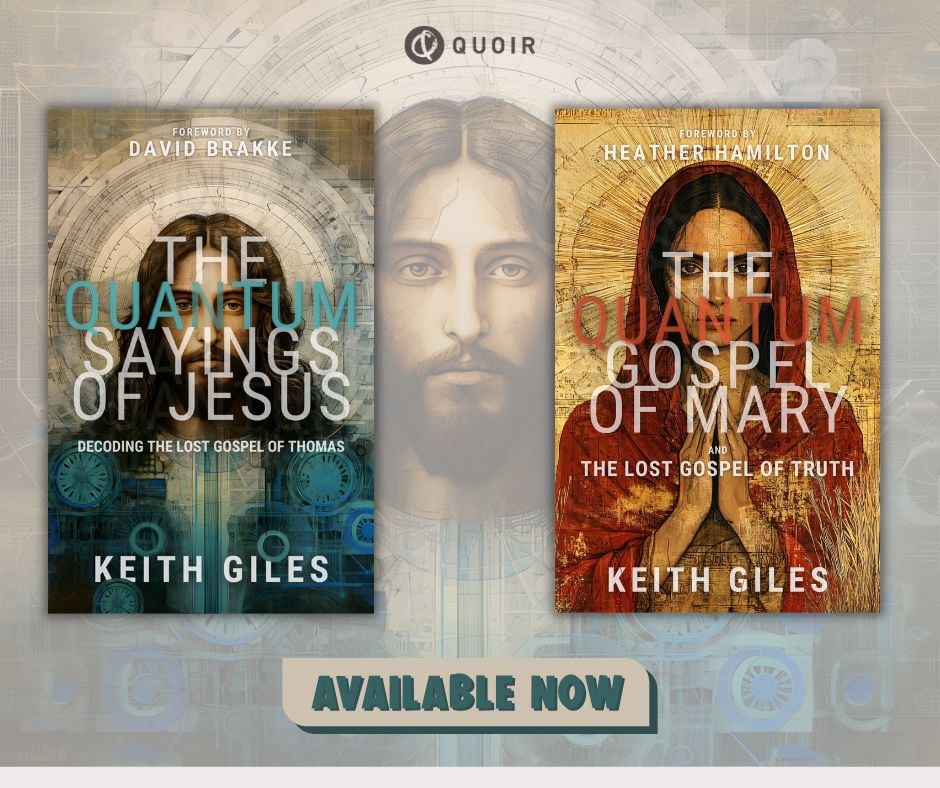
My new book, “The Quantum Gospel of Mary and the Lost Gospel of Truth” is now available on Amazon.
The book from Keith Giles, “The Quantum Sayings of Jesus: Decoding the Lost Gospel of Thomas” is available now on Amazon. Order HERE>





 Ad-Free & Subscriber Log-In