

I Love Jewish People
I have had many Jewish friends. Marty Fleckman was my roommate in college during my senior year and his freshman year. He went on to have some great moments in both college and pro golf on the PGA Tour. Marty first introduced me to eating kosher that included matzo balls and gefilte fish. My favorite caddy on the PGA Tour, besides my children, was my dear Jewish Christian friend Fred Green. He was not a pro Tour caddy, but a friend who caddied for me at occasional tournaments for many years. I first ate a Passover Meal that Fred’s mother served me and my family in her home. And then there are my dear Jewish daughter-in-law and Jewish granddaughter.
Throughout my life, I have gone out of my way to befriend Jews. Why? I am a devout Christian. If it wasn’t for the Jewish people, there wouldn’t be any Christianity! How so? Jesus was a Jew, and all the earliest Christians were Jewish people.
God Chose Jews to Reveal Himself to the World
God chose the nation of Israel to reveal himself to the world. That is why it is true to call Jews “the chosen people.” But that doesn’t mean the God of Israel, the God of creation, favors Jews more than any other ethnic group. Even though Jews are the divinely chosen people, “God shows no partiality” (Acts 10.34; Romans 2.11). God chose Jews to perform the task of revealing himself to the world, whether it is in blessing or otherwise.
So, God chose Abraham to father the nation we call “Israel.” Did God just willy nilly, unconditionally choose Abraham for this task? God forbid! When Abraham was 99 years old and his wife Sarah was beyond childbearing, “The LORD appeared to Abram [later renamed Abraham], and said to him, ‘I am God Almighty; walk before me, and be blameless. And I will make my covenant between me and you, and will make you exceedingly numerous'” (Genesis 17.1-2 NRSV).
Many generations later, when the Hebrew people had greatly multiplied to become a nation, and God used Moses to deliver them as slaves from the Egyptians, God told Moses on Mount Sinai to ask the people if they wanted to keep the covenant he had made with their forebears (Exodus 19.3-6). Moses did that and we read, “The people answered as one: ‘Everything that the LORD has spoken we will do'” (v. 8). So, they thereby affirmed their covenant with God.
God’s Covenant Includes the Ten Commandments
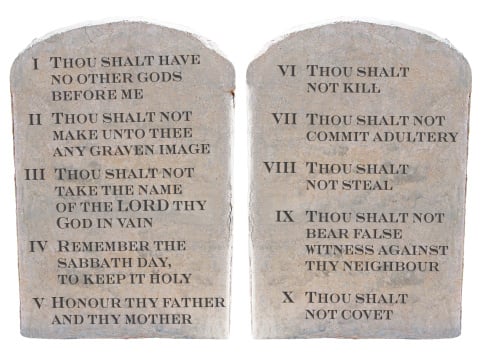
God then gave Moses the Ten Commandments on Mount Sinai (Exodus 20.1-17). And God soon said to Moses, “Before all your people I will perform marvels, such as have not been performed in all the earth or in any nation; and all the people among whom you live shall see the work of the LORD; for it is an awesome thing that I will do with you,” referring to the Hebrew/Jewish people (34.10). Indeed, God clearly has done “an awesome thing” with the Hebrew/Jewish people, and he will continue to do so.
But in considering the plight of the Hebrew/Jewish people in their history, it is important to know that God added to that covenant his law code which involves the Ten Commandments and much elaboration of them in what Jews derive from their scriptures as 613 laws they call mitzvot. And this includes what is called “the blessing and the curse” in Leviticus 26 and Deuteronomy 28. Thus, whether by in divine blessing or cursing, God has revealed himself through the Hebrew/Jewish people, and he will continue to do so, especially during the end times as set forth in Bible prophecy.
God Told Moses He’d Send a Prophet Like Him
God had more than just a covenant and commandments for his chosen people. He was going to send them a Messiah (Hebrew maschiach=anointed one) who would deliver Israel from its Gentile enemies and make it the greatest nation on earth, which the later biblical prophets testify to abundantly. Moses told the people about him, saying, “The LORD your God will raise up for you a prophet like me from among your own people; you shall heed such a prophet” (Deuteronomy 18.15). Moses then recalled what God had said to them at Mount Sinai, “I will raise up for them a prophet like you from among their own people; I will put my words in the mouth of the prophet, who shall speak to them of everything that I command. Anyone who does not heed the words that the prophet shall speak in my name, I myself will hold accountable” (v. 19). That word “accountable” is extremely important. That is, if the people refuse to hear the words of this Moses-like prophet, God will hold them accountable by bringing judgment.
Jesus of Nazareth Was that Prophet Like Moses
And according to Christianity, that is exactly what happened. We Christians believe that Moses-like prophet was Messiah Jesus, also called Jesus Christ, from Nazareth. He came as a carpenter turned itinerant preached, healer, and exorcist to only the tiny nation of Israel. Yet we read, “He came to what was his own, and his own people did not accept him” (John 1.11). Rather, it was Gentiles throughout much of the world who later received him. The result has been that Christianity has been the largest religion in the world for the past 1,600 years or more. Jesus therefore has been the most famous man who ever lived. Yet he was an unknown until he ministered publicly only for two to three years, and then was executed by the Roman state with crucifixion.
Why was that? The Jewish Sanhedrin at Jerusalem had Jesus arrested, interrogated him through the night, condemned him for blasphemy, and brought him to the Roman Governor Pontius Pilate to execute him. But the New Testament gospels relate that Pilate examined Jesus three times in private chambers and came out to declare to Sanhedrin leaders that Jesus was innocent. Luke records that Pilate said the first time, “I find no basis for an accusation against this man” (Luke 23.4). John relates Pilate said likewise, “I find no case against him” (John 18.38). And Pilate said similarly the next two times to both the Sanhedrin leaders the multitude (Luke 23.14, 22; John 19.4, 6).
Jewish Leaders Demanded of Pilate Jesus’ Death
Nevertheless, the Sanhedrin leaders “insisted and said, ‘He stirs up the people by teaching throughout all Judea, from Galilee where he began even to this place'” (Luke 23.5). Now, I ask you, is that evidence of wrongdoing worthy of crucifixion?
Matthew reports concerning Pilate, “He realized that it was out of jealousy that they had handed him over” (Matthew 27.18). Indeed, Moses had predicted in Torah, “I will make them jealous with what is no people, provoke them with a foolish nation,” which has been the true church (Deuteronomy 32.21; cf. Acts 5.17; 13.45; 17.5; Romans 11.11).
Soon after Jesus was crucified, died, raised from the dead, and ascended to heaven, the apostle Peter preached to many thousands on that first Day of Pentecost at the Temple in Jerusalem, “Jesus of Nazareth, a man attested to you by God with deeds of power, wonders, and signs that God did through him among you, as you yourselves know—this man, handed over to you according to the plan and foreknowledge of God, you crucified and killed by the hands of those outside the law” (Acts 2.22-23).
Notice that Peter accused not only Sanhedrin leaders but all of Israel present at Jesus’ examination by Pilate, saying “you crucified and killed” Jesus. This is an important point. It has been popular since WWII to exonerate the multitude of Jews who attended Pilate’s interrogation of Jesus, holding only the Israel’s chief religious leaders, thus the Sanhedrin, “accountable” for Jesus’ death.
But the New Testament gospels often state that it was not only the chief priests, scribes, and Pharisees calling for Jesus to be crucified, but also “the elders.” For example, Matthew reports, “When morning came, all the chief priests and the elders of the people conferred together against Jesus in order bring about his death (Matthew 27.1). These elders were the heads of families, and they also were members of the Sanhedrin, thus involved in ruling Israel. These elders were the representatives of the people. Their representation suggests that all Israel was guilty of calling for Jesus’ death.
Governor Pilate Declared Jesus Was Innocent
Governor Pilate had said three times that Jesus was not at fault. Yet the Jewish crowd, thus not just the Sanhedrin, kept yelling at Pilate, “Crucify him” (Mark 15,13-14; Luke 23.21; John 19.6; cf. Matthew 27.22-23). Matthew then relates, “When Pilate saw that he could do nothing, but rather that a riot was beginning, he took some water and washed his hands before the crowd, saying, ‘I am innocent of this man’s blood; see to it yourselves.’ Then the people as a whole answered, ‘His blood be on us and on our children'” (Matthew 27.24-25). Notice that Matthew said, “the people as a whole.” Thus, it was not only the religious authorities at Jerusalem, such as the Sanhedrin, who were guilty of Jesus’ execution, but also the others present as a multitude calling for him to be crucified.
Despite Pilate trying to exonerate himself of sin for sending Jesus to be crucified, he still was guilty. For, when Pilate asked Jesus, “Are you the King of the Jews?” Jesus answered, “My kingdom is not from this world” (John 18.33, 36). And the apostle John adds that Pilate questioned Jesus further until he said, “You would have no power over me unless it had been given you from above, therefore the one who handed me over to you is guilty of the greater sin” (John 19.11). So, Pilate was still guilty.
But who was “the one who handed” Jesus over to Pilate? That would be Caiaphas, the high priest and head of the 70-member Sanhedrin. During the all-night interrogation of Jesus, he had charged Jesus with blasphemy and called for his death. Thus, he was the most guilty of all. And if anyone says there should be no guilt meted out to any of these characters since the whole thing was God’s plan of salvation, that is a huge misunderstanding of the sovereignty of God.
Jesus’ Apostles Declared Jews Killed Jesus Christ
The apostle Peter continued his allegation against his Jewish people. Days later, after Pentecost, Peter and John were in the Temple when Peter told a lame man from birth, “in the name of Jesus Christ of Nazareth, stand up and walk” (Acts 3.6). The man did so, “Jumping up, he stood and began to walk, and he entered the temple with them, walking and leaping and praising God. All the people saw him walking and praising God, and they recognized him” (vv. 8-9). Peter then preached to the many gathered around, saying this man was healed by “Jesus, whom you handed over and rejected in the presence of Pilate, though he had decided to release him. But you rejected the Holy and Righteous One and asked to have a murderer [Barabbas] given to you, and you killed the Author of life, whom God raised from the dead” (vv. 13-15). Notice again that Peter accused the people of killing Jesus.
The religious authorities at Jerusalem then had Peter and John arrested for this proclamation and interrogated and the next day. Peter then said that lame man had been restored to “good health by the name of Jesus Christ of Nazareth, whom you crucified, whom God raised from the dead” (Acts 4.10). Again, Peter told those leaders they “crucified” Jesus. Of course, they didn’t literally have Jesus crucified. But they were the ones who got it done by pressuring Governor Pilate.
It was the same with the preaching of the apostle Paul. Soon after this Pharisee and trained rabbi was dramatically converted to faith in Jesus, he preached in a synagogue saying of the Jewish religious leaders, “Even though they found no cause for a sentence of death, they asked Pilate to have him killed” (Acts 13.28).
Recall that Moses said in Torah of the prophet like him, who would be Jesus, that God said of him, “Anyone who does not heed the words that the prophet shall speak in my name, I myself will hold accountable.” God did that very thing when, forty years after the Christ event, in 70 A.D. the Roman armies put down a four-year Jewish rebellion by destroying Jerusalem and its Temple. But the Jews rebelled again, in 132 A.D., and three years later the Roman armies annihilated the nation of Israel, expelling Jews from their land. They scattered into Gentile nations, called the Diaspora (Dispersion).
There Jews remained for over 1,700 years until some returned to their ancestral land to reestablish their nation, in 1948. Even religious Jews have said all that time that both Roman destructions of the nation of Israel were the judgment of God even though they did not attribute it to Jews killing Jesus. But, in accordance with what Moses said, it had to be God holding them “accountable” for rejecting the words of the Moses-like prophet—Jesus.
It is important that Gentile Christians love the Jewish people while still remaining faithful to God in believing the scriptures, which for Christians consist of both the Old Testament (Jewish Bible) and the New Testament. And the latter, as we have seen, is full of statements about Jews killing Jesus Christ. Why is it important to say this?
Christians Saying Jews Killed Jesus Are Criticized
We live in a time when anyone who says what I have been saying—that Jews killed Jesus—is very unpopular, in fact, is condemned. It is because of the horrid Holocaust of WWII, in which German Nazis led by Adolf Hitler put 6 million Jews to death. What a shame that the German people have been trying to rid themselves of all the years since.
Yet this present situation has been a total flip flop from the many centuries, especially during medieval times, when professing Christians accused Jews of being “Christ killers” and persecuting them unmercifully for it. It was a terrible blight against Christianity. But I think many people who did that were not really genuine Christians. Instead, even though Christians should be faithful to scripture by regarding Jews’ as accountable to God for the death of Jesus, Christians should still love Jewish people.
The main reason I am saying all of this is that, according to Bible prophecies, including those in the Jewish Bible, Jesus will someday return from heaven to earth with his God-given kingdom of peace that will extend throughout the entire world. And he will make the nation of Israel the head of the nations. Also, Jesus as “King of kings, and Lord of lords” (Revelation 19.16) will have his throne located at Jerusalem.
An End Times Jewish Remnant Will Repent of Jews’ Killing Jesus in Order for Jesus to Return
But all of this will not happen until there is a significant remnant of Jews, both throughout the world and in Israel, who will repent towards God for their forebears’ evil treatment of Jesus of Nazareth. And yes, this indicates that God holds Jews’ accountable to some degree for what is called “inherited guilt.” This is a subject that many dismiss as unfair and thus false. But that is wrong! Daniel’s prayer for his people, in Daniel 9, makes inherited guilt perfectly clear as do other biblical texts.
I will now close this brief essay by proving this from the Jews’ own scriptures. God prophesied through the prophet Zechariah concerning the Jewish people of that end time, “And I will pour out a spirit of compassion and supplication on the house of David and the inhabitants of Jerusalem, so that, when they look on the one whom they have pierced, they shall mourn for him” (Zechariah 12.10 emphasis added). Thus, when Jesus returns in great glory at the end of this age, Jews will see the crucifixion marks in Jesus’ body and mourn for him.
[See also Kermit’s post on March 30, 2022: “Common Jewish Citizens Were Responsible for Jesus’ Death.”]














 Ad-Free & Subscriber Log-In