

A few weeks ago, I found myself asking a simple question:
When did I first sense a nudge from God?
Perhaps there is no better season to ask such a question, than Pentecost, and the season we celebrate God speaking and moving through his Holy Spirit.
As I considered this question, I was not necessarily thinking in terms of an audible voice. Nor was I trying to remember some otherworldly, supernatural, dramatic spiritual experience that defied reality. Rather, I was trying to remember the first sense of a call or a nudge. When was it, and how old was I, when I first sensed that God was speaking to me personally?
The answer to that question surprised me greatly, because it took me much further back than I expected. It took me a nudge I had seemingly forgotten about.
As I reflected on prophetic encouragements, meaningful conversations, dreams, and pivotal moments in my spiritual journey, my mind eventually landed somewhere unexpected.
It took me to early elementary school, in what we called “Junior Church,” sitting midway back in a half dozen of old brown pews. I was sitting when the speaker read a poem. I believe the speaker that morning was a dear old influence on my life by the name of “Miss May.” In my reflection, the older woman named Miss May stood up and read a poem.
At the time, as a small child, I could not have explained why it mattered. I only knew it stayed with me. It has stayed with me, on and off, through many seasons, for more than thirty years.
As that Poem was read, I felt a nudge.
The Voice We Often Forget
In the New Testament, Jesus says that his sheep know his voice (John 10:27). Certainly, Jesus is speaking about those who recognized him as the Messiah and his messianic ministry in his own day. I believe there is also something true here for those who follow him here and now. Those who walk with Jesus learn to recognize his voice through the scriptures, the Holy Spirit, prayer, wise counsel, and the many ways God chooses to guide his people. (See God is Still Speaking: 5 Ways to Hear God’s Guiding Voice).
I believe God still speaks.
The challenge is not always hearing him. Though, truthfully, they are usually more nudges rather than loud voices or mysterious signs and wonders.
Sometimes the biggest challenge is remembering what he has already said.
Many of us spend our lives asking God for fresh direction. Our prayers look like this: “God, give me direction.” We pray for clarity. Praying, “God, if it is your will, give me a sign.” We seek new guidance, perhaps asking, “What do you require of me?” We ask for answers for suffering, struggle, and seasons.
Sometimes God feels silent. We struggle in the waiting. Or we listen in the wrong corners.
I wonder if sometimes God is not withholding direction but rather perhaps in the silence God is inviting us to revisit something he has already spoken.
This theme appears repeatedly throughout Paul’s letters to Timothy. Rather than encouraging Timothy to constantly seek something new, Paul repeatedly calls him to remember and hold fast to what God has already revealed.
Paul reminds Timothy, “Do not neglect the gift you have, which was given you through prophecy when the body of elders laid their hands on you” (1 Timothy 4:14). Later, he writes, “For this reason I remind you to fan into flame the gift of God, which is in you through the laying on of my hands” (2 Timothy 1:6).
Paul also tells him to “follow the pattern of the sound words that you have heard from me” and to “guard the good deposit entrusted to you” (2 Timothy 1:13-14). Even near the end of his life, Paul’s concern is not that Timothy receive some fresh revelation, but that he remain faithful to what has already been entrusted to him.
Timothy is not simply waiting for a new word from God. No, Timothy is being asked to remember, guard, and live out the words he has already received.
I think many of us need that reminder.
We often long for fresh revelation while neglecting old revelation.
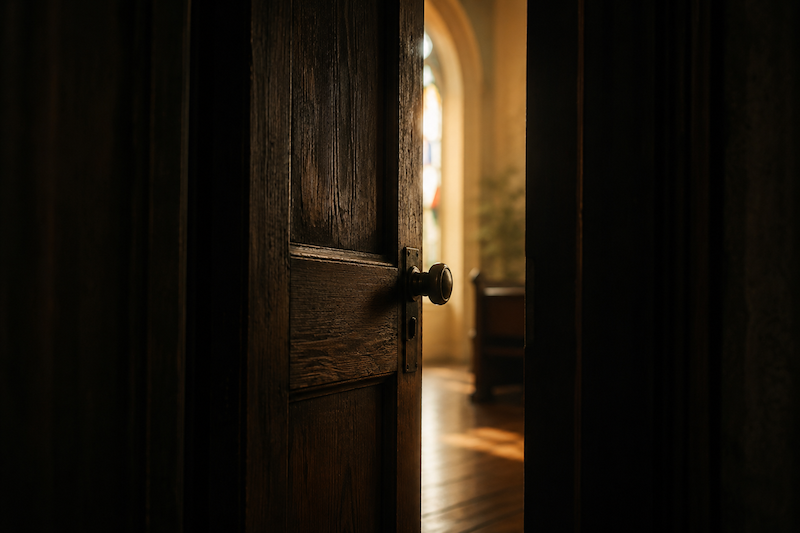
A Poem By the Door
The poem I heard as a child was I Stand by the Door by Sam Shoemaker. I do not think I have heard that poem, nor seen it since I was young. Though I found it again by remembering just a few lines. Lines that lived deep in my psyche across various seasons have reappeared as whispers and nudges.
From what I have learned over the past few weeks, thanks to blogs and Google, Shoemaker was a pastor who ministered in New York City and Pittsburgh and played an important role in influencing some of the spiritual principles that shaped the early days of Alcoholics Anonymous. One blogger suggested that he wrote this poem near the end of his life as something of a personal manifesto, mission statement, or explanation of the life he felt called to live.
The central image of this poem is simple—God’s hospitality.
Shoemaker chooses to stand near the door to practice God’s hospitality to those on a spiritual search. From what I can tell, this is the space he lived his whole life. As I like to say, his theology was lived in the intersections of life. He chose to live a life that stood next to the door of God’s heart, the door through which people find God.
In the poem, Shoemaker does not want to move so far inside that he forgets those who are still searching. Nor does he want to remain so far outside that he loses sight of what is found within. That resonated with me as a young boy, and it still resonates with me profoundly now.
Shoemaker writes about those who inhabit the inner rooms and marvel at God’s wonders. He admires them. They are fully aware of God’s beauty, yet some have become insulated from the struggles of those still searching for the door.
The clean folks on the inside no longer remember the questions.
- The searching.
- The uncertainty.
- The longing.
So Shoemaker chooses to remain near the doorway.
This poem is about extending God’s hospitality to those who seek it. I wonder if Shoemaker wrote it not only to remind himself of God’s call on his life and the nudge in which the Holy Spirit gave him for his life, but also to nudge all of us to be more faithful in missionally extending the hospitality of God’s Kingdom.
This poem is a nudge, encouraging those who are afraid to enter.
It is about welcoming those who wonder if there is a place and purpose for them.
The Words That Stayed
As I looked for the poem, using AI and search engines to find it, I realized I had forgotten most of it. But not all of it. The imagery remained in my mind, and so did two lines.
- “I stand by the door. I neither go too far in, nor stay too far out.”
- “I admire the people who go way in. But I wish they would not forget how it was before they got in. Then they would be able to help.”
Those words somehow lived in my head rent-free for more than three decades. I can remember where I was sitting when they were read. I can picture the room. Even more, I can still feel the affinity and nudge I felt when this poem was read.
Why? Why those lines? Why did they remain when so much else faded?
As I revisited the poem recently, I realized it had become part of how I understood myself. Long before I could articulate a calling, those words had lodged themselves deep within me. In fact, I remember this poem and this understanding of who I was in my teens.
I believe God spoke through these words back then, used them as an undercurrent in my life, and continues to use them to shape how I want to live theology at the intersections of life.
This poem was a God-given message, a nudge, not a dramatic experience.
As I heard them in elementary school, I remember knowing “that’s me,” but that nudge did not come with certainty about every detail of my future.
I sat in that pew, with a simple impression on my heart, soul, and mind:
“That is who you are.”
Rediscovering an Old Whisper
I revisited the poem shortly before leaving for Atlanta. It was emotional. Perhaps I didn’t revisit it but rather rediscovered it, which is the better word. I have felt that I am in a season of discernment. Truthfully, I do not know all I am discerning or what God is leading me towards. However, I am, and I was asking questions. In fact, I was inviting others to pray for me and for the trip. I was seeking clarity about the road ahead.
As I reread the poem, I found myself strangely encouraged.
- I felt reminded to pay attention to conversations in ordinary places.
- To keep my hands open.
- To look for God at the intersections of everyday life.
- To remember that theology is not merely something we study. It is something we live.
The poem felt less like nostalgia and more like affirmation to who God created me to be.
Looking back, I do not see a childhood ambition. I see an early whisper that took decades to understand.
Like the first time I heard it read, I sat in that pew, with a simple nudge on my heart, soul, and mind— “This is who you are.”
It reminded me of something I already knew but had neglected to revisit.
Perhaps that is why God brought it back to mind. If I can be so bold and presumptuous, I believe God often brings us back to things we have forgotten to realign our paths. I believe it is the Quaker Parker J. Palmer who says we spend 40 years of our lives trying on false selves, only to spend the next 40 years rediscovering who God made us and called us to be from the beginning.
As we age, we can too often become so focused on what God might say next that we overlook what he has already said.
Sometimes the whisper we need today is one we first heard years ago.
A Culture of Drifting
Recently, I was reading a book called Coming Up Short about the economic pressures and uncertainties facing many people today. Don’t bother to read it. So far, the book is also coming up short.
However, towards the front of that book, one person summarized their outlook this way:
“So I am floating. Whatever happens next, happens, and I will deal with it when it happens.”
Honestly, I have heard versions of that sentiment from several people recently. As I work for Water Street Mission, and alongside those who are suffering from homelessness, I find a growing sense of drifting and fewer anchors or callings.
This means what is affecting people’s lives is not always necessarily rebellion (though sometimes it is clearly). Sometimes it is exhaustion and detachment in life, because they lack a sense of direction and calling. There is a missing purpose from their lives. We might say that people are floating through life without roots, purpose, long-term vision, or expectation.
While economics and culture certainly play a role, I think something deeper may be happening as well. Many people have become untethered from any sense that God speaks, guides, or calls. Others have never seen such a life modeled. When we lose connection to God’s voice, we drift.
When we forget what he has already spoken, we drift even further.
Spiritual Pilgrims
Psalm 84 has long been one of my favorite psalms.
As I reflected on it recently, I was reminded of a word I once used to describe myself: Pilgrim.
Perhaps that is what we all are. A pilgrim is someone on a journey toward a sacred destination. Someone who knows they have not arrived. Someone who remains open to learning, growing, and seeking.
What struck me is that pilgrims occasionally revisit important landmarks. Not because they live in the past. No, pilgrims revisit holy spots and landmarks because remembering helps them continue forward.
I wonder if followers of Jesus need to become spiritual pilgrims to our earliest whispers and our ever-emerging stories of faith.
To revisit the places where God first met us.
To remember the Scriptures, conversations, prayers, songs, dreams, and moments that shaped us. Those things that nudged us. This is not about memories and stories, but rediscovering signposts we might have forgotten along the way (or worse, ignored).
Three Ways to Revisit What God Has Already Spoken
- Return to Your Earliest Spiritual Memories. Think back to the first moments when you sensed God drawing your attention. Was it a Bible story? A youth leader? A sermon? A conversation? A song? As you remember your earliest encounters and experiences, what remains with you?
- Revisit Forgotten Callings. Journal through what convictions, dreams, or invitations once felt significant. Where have you drifted from them and why? What in your life has become buried beneath responsibility, disappointment, or distraction? Sometimes clarity comes not from discovering something new but from remembering something old.
- Keep Walking in Light of What You Already Know. Faithfulness is not simply hearing God’s voice. It is responding to it. You need to walk it out. So, return and revisit, but “now, walk it out.” If God has already spoken clearly about something, obedience may matter more than additional direction. Often, the next step becomes visible only after we take the one already in front of us.
Now, I’m not suggesting that every childhood dream, desire, or memory is a whisper from God. At various points in my life, I wanted to be a farmer, a rock star, and a marine biologist. Most of us can look back and find dozens of ambitions that came and went.
Yet when I compare those desires with that early impression I received while listening to Shoemaker’s poem, something feels different. That nudge aligned with the heart of Scripture, and it seemed to come from somewhere deeper than my own interests and imagination. In fact, missional evangelism among pilgrims, seekers, and the poor was certainly not on my third-grade bingo card. I had no paradigm for it. No reason to aspire to it. Yet somehow those words lodged themselves in my heart and quietly followed me through the years. I am asking you to find what God planted, and has quietly followed you through your years.
This Is the Way
In hindsight, I wonder where many of us have gotten off course. Not necessarily through rebellion. More often through forgetfulness. We become so focused on hearing a new word from God that we neglect the old one. We ask for fresh direction while overlooking the whispers that first set us on the path.
Perhaps God is still saying what he said years ago. Maybe God is inviting us to return to the place where we first encountered him.
- To remember.
- To listen.
- To trust.
- To walk it out.
As Isaiah writes, “This is the way; walk in it” (Isaiah 30:21).
Maybe the next step in your journey is not discovering something new, but rediscovering something old.
So let me leave you with a question:
- What are the earliest memories you have of sensing God’s presence or hearing his voice?
- Was it a Scripture? A sermon? A conversation? A song? A prayer? A dream? A poem?
- What words, impressions, or moments have stayed with you over the years?
I’d love to hear your stories in the comments. Perhaps there is something there worth revisiting.
If you’re interested in thinking more deeply about how God speaks and guides his people, I highly recommend Alpha’s session How Does God Guide Us? It provides a helpful and balanced introduction to the subject.
If this post resonated, subscribe for future reflections, share it with a friend, or leave a comment. You can learn more about his journey to recover a rooted Christian way of life through the Lord’s Prayer, ancient habits, leading a quiet life, and simple Jesus communities online at JeffMcLain.com, the Lead a Quiet Life blog on Patheos, or the Discovering God Podcast.












 Ad-Free & Subscriber Log-In