2018-03-24T18:48:34+06:00

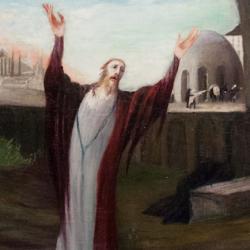
Jesus starts His procession from the Mount of Olives, the mountain just east of Jerusalem across the Kidron Valley. It’s the first time He has come to the Mount of Olives, but it takes on prominence in the last week of Jesus’ life. He begins His triumphal entry from the Mount of Olives. After He leaves the temple for the last time, He goes to the Mount of Olives to prophesy about Jerusalem’s doom (Matthew 24). After the Last Supper,... Read more
2018-03-23T18:03:06+06:00

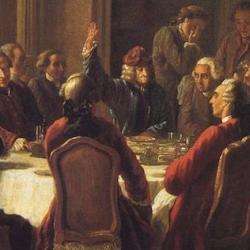
In a review of Steven Pinker’s new book on Enlightenment, Peter Harrison observes that Pinker treats reason “as an unproblematic given, as if we all know what it is and are happy to sign up to Pinker’s version of it.” It’s not so simple, and in fact Pinker’s easy use of the word runs counter to the Enlightenment itself: “Problematizing it and challenging [reason’s] authority turns out to be one of the signal achievements of the Enlightenment.” Harrison offers several... Read more

2018-03-22T20:27:24+06:00

As David Goldman sees, it, last week’s fatal accident involving an Uber self-driving car is emblematic of our techno-Utopianism. “If the brain is merely a machine that white-coated lab techs can measure and manipulate like any other machine, and if machines can programmed to emulate the human brain, then human existence has no purpose. Our destiny is fixed in the same way that the paths of the planets and the orbits of electrons are fixed, and our free will, moral... Read more

2018-03-23T04:44:51+06:00

Eric Cohen puts his finger on one of the glaring flaws of Patrick Deneen’s recent Why Liberalism Failed. Deneen’s is a strangely ahistorical account of liberalism: “Deneen treats American society as if it is simply a Lockean (or Madisonian) abstraction. For a book that celebrates the importance of particular peoples—with histories and heroes, stories and songs, rituals and traditions—it is remarkable how little attention Deneen pays to the real American story. Yes, liberal ideas informed the American founding; and yes,... Read more

2018-03-23T16:43:10+06:00

Ahaz of Judah makes “molten images for the Baals” (2 Chronicles 28:2). He’s the only king in Chronicles to do so. The term massekah is used only twice in Chronicles, once of Ahaz’s making, the other of Josiah’s destruction of molten things (2 Chronicles 34:3-4). The term reaches back to the golden calf incident, when Aaron made a molten image of gold at the foot of mount Sinai (Exodus 32:4, 8, 17). The golden calf was a counterfeit tabernacle: Aaron... Read more

2018-03-22T20:17:16+06:00

Alan Hayward (Creation and Evolution) summarizes some of the evidence for an old earth. Some lines of evidence are fairly powerful. He points to sandwich structures on the ocean floor: A base of hardened sediment with fossils, a layer of large coral reefs, an upper layer of sediment that buried the coral reef (86). If, he argues, the Flood laid down the lower layer of sediment, what caused the upper layer? And how did the coral reef have time to... Read more

2018-03-22T19:36:10+06:00

Lytton Strachey, famed as a member of the “Bloomsbury Group” and for his war against Victorian values, wrote to Leonard (husband of Virginia) Woolf in 1904: “I sometimes feel as if it were not only ourselves who are concerned, but that the destinies of the whole world are somehow involved in ours. We are – oh! in more ways than one –  like the Athenians of the Pericles Age. We are the mysterious priests of a new and amazing civilization.... Read more

2018-03-23T17:37:00+06:00

By the Chronicler’s lights, Ahaz is the worst king Judah ever has. He is the only king of whom it’s explicitly said that he did “not do right” (2 Chronicles 28:1). That not-right is unpacked with six more verbs, making a full seven of wickedness. 1)Did not do right, 28:1. 2) Walked in the ways of the kings of Israel, 28:2a. 3) Made Baals, 28:2b. 4) Burned incense in valley of Ben-hinnom, 28:3a. 5) Burned sons in fire, 28:3b. 6)... Read more

2018-03-22T20:46:55+06:00

Modernity, especially as theorized in modern economics, treats work as “instrumental to the acquisition of goods” (Stephen Marglin, The Dismal Science, 44). Modernity “closes off thinking of hard work as something other than drudgery” (43). As a counterpoint, Marglin calls attention to work in Amish communities: “In physical terms, there is little to distinguish the work that [Amish] women do today from what the hill-country women did in the 1930s, before electricity wrought its miracles. The Amish typically have indoor... Read more

2018-03-23T06:26:32+06:00

“The Father is greater than I,” says Jesus (John 14:28). Eunomius uses this to prove the ontological interiority of the Son. Basil of Caesarea rejects that reading, of course. But his way of rejecting it is worth attending to. He doesn’t claim that Jesus is talking about His inferiority as man, as incarnate Son. He takes it as a statement about the ontological Trinity, and asks in what senses the Father might be greater. He rules out the conclusion that... Read more

Follow Us!


TAKE THE
Religious Wisdom Quiz

What was the name of the blind beggar Jesus healed near Jericho?

Select your answer to see how you score.


Browse Our Archives