

Just in case you didn’t notice, we just flew to the moon!
Growing up, I, along with the rest of the country, was fixated on every Mercury blastoff, every Gemini launch, every Apollo mission. That culminated with human beings actually landing on the moon!
The first moon landing was on July, 1969, 56 years ago! That was followed by six more lunar landings, with the last being in December, 1972, 53 years ago! Then the U.S. space program stopped flying to the moon, focusing instead on orbiting the earth in Space Shuttles and the International Space Station.
Now, after half a century, we headed to the moon again. There seemed to be little attention to the build-up of this astonishing venture, though after the launch and the public realized what was happening, that changed.
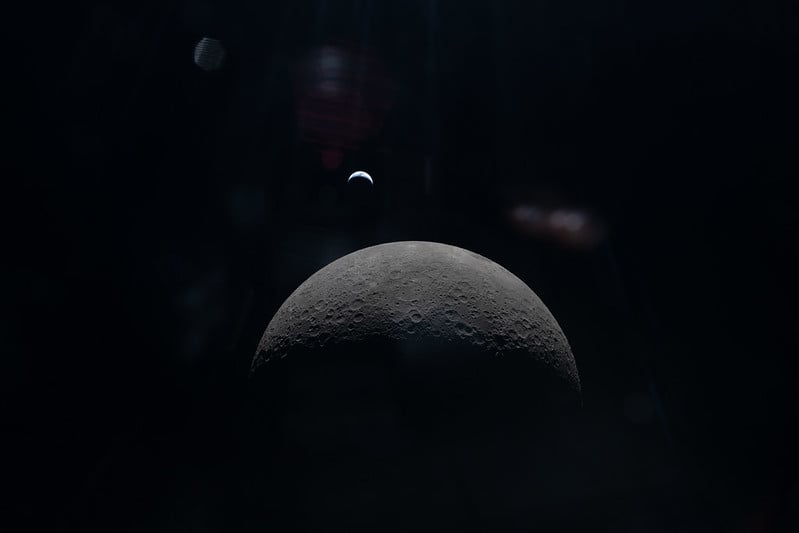
The four astronauts–Commander Reid Wiseman, pilot Victor Glover, Christina Koch, and Canada’s Jeremy Hansen–flew farther away from planet Earth than anyone in history, 252,756 miles. They didn’t land on the moon–that is being planned for later–but they swung around it, peering at the Dark Side of the Moon and sending back awe-inspiring photographs. Then, after nine days in space, they came back home, safely.
Some conservatives looked askance at the four astronauts as if they were picked by a DEI committee, since they were a white man, a black man, a woman, and a Canadian. By all accounts, though, they constituted a good team. And there are many ways to parse diversity. The pilot, Victor Glover, is not only a black man, he is a member of another minority group: he is a devout Christian, who talked openly about his faith in Jesus. Just before they went behind the moon, out of radio contact, he said this to planet Earth:
“As we get close to the nearest point to the moon and farthest point from Earth — as we continue to unlock the mysteries of the cosmos — I would like to remind you of one of the most important mysteries there on Earth,” Glover said.
“And that’s love,” he added. “Christ said in response to what was the greatest command that it was to love God with all that you are. And he also, being a great teacher, said the second is equal to it, and that to is love your neighbor as yourself.
“And so, as we prepare to go out of radio communication, we’re still able to feel your love from Earth. And to all of you down there on Earth and around Earth, we love you from the moon.”
Coming home was the most perilous part of a dangerous mission. When the unmanned Artemis I flew back into Earth’s atmosphere, the heat shield, which had to protect the space ship from temperatures of 5000 degrees, cracked and chunks flew off. This, along with other technological glitches, delayed the manned flight, Artemis II, for two years. But there was no time to completely redesign and test the heat shield, so the manned mission went ahead with the same basic heat shield used a half-century ago. Engineers calculated that if the ship re-entered the Earth’s atmosphere at a different angle, the heat shield would not have to hold off the high temperatures for so long and the astronauts would be OK.
Charlie Camarda, a former astronaut and a senior engineer at NASA, opposed the launch. Describing the re-entry as being inside a fireball for 15 minutes, he told Frannie Block of the Free Press, that the heat shield should have been redesigned. But he still expressed confidence that the astronauts would come home safely. “They’re going to come back safe because we’re going to be praying for them,” he said. “But that doesn’t mean I’m wrong.”
Americans had gotten so used to successful flights that when the space shuttle Challenger exploded on takeoff in 1986 and then the space shuttle Columbia burned up in re-entry in 2003–because of a faulty heat shield–it hit us hard. Over that period, extending into today, it seemed that America’s projects kept going wrong. The optimism of the 1960s and 1970s turned into a broader cynicism.
But this time the math and the physics worked–a testimony to the order of God’s creation–as did Mr. Camarda’s prayers. Speeding into the Earth at 24,661 mph, 33 times the speed of sound, Artemis II came back right on target, splashing into the ocean 40 or so miles west of San Diego, where they were plucked out of the water without incident.
I remember how the early space flights captured my imagination when I was young. This one seems to have captured the imagination of at least some young people. Before the launch, my 8-year-old granddaughter asked me, “Are there aliens on the moon?” I told her that space aliens are in stories and on shows, but we haven’t found any in real life. After the launch, she said that she wanted to be an astronaut. She said that she needed to start saving up her money so she could buy a space ship.
So she raises a good issue. The Artemis program so far has cost $93 billion. That’s quite a bit more than my granddaughter’s allowance. Is it worth it? Hard to say. But, by way of comparison, the federal government spends $88 billion per month to cover the interest on our national debt. The Department of Education, widely considered unnecessary, gets $106 billion per year.
The intangible value of an achievement like this can be seen in a conversation my daughter told me about when she was living in Australia. She said she was complaining about something–she can’t remember what it was–and used the by now familiar formula: “We can put a man on the moon, but we can’t [whatever it was]!” Her Aussie pastor was there, and he replied, “We can’t put a man on the moon. The Americans did that!”
Exactly! Americans–with our pioneering spirit, technical ingenuity, and courageous optimism–did that! No other country, so far, has even tried. We had gotten down on our country and what it is capable of. But we just flew to the moon!
Photo: Crescent Earth Over Lunar Horizon, art002e015231 (April 6, 2026) – The Artemis II crew captures a faint view of a crescent Earth above the horizon on the Moon’s far side. Credit: NASA via Flickr, in accord with NASA Images and Media Guidelines.













 Ad-Free & Subscriber Log-In