

In our post about Owen Barfield, we discussed his prescription for bringing language back from the dead–and, by extension, bringing what we moderns assume to be meaningless reality back from the dead–by attending to the vivid imagery latent in the history of our words. Recognizing the original metaphors that lie behind words that we have turned into dead abstractions, we can see how that ancient imagery connects us to a mindset in which tangible reality is charged with meaning.
This tends to happen, he says, in poetic diction–to use the title of the book in which he discusses all of this–and in imaginative literature more generally. Poetry uses language depicting concrete imagery as a way to convey ideas. It thus connects tangible reality with meaning.
Barfield’s attention to ancient languages, etymology, and the recovery of original meaning also tends to happen in a good Bible study, especially one led by a pastor who brings his training in the original languages to bear on the text. This hit me like a ton of bricks (notice the imagery of my language, cliché though it is) in a recent Sunday morning Bible class led by Concordia Seminary professor Joel Biermann.
A Digression You Can Skip
First, a digression on church politics that non-LCMS members should feel free to skip: I am in the highly unusual position of having both of the top candidates running in the election next month for president of the Lutheran Church Missouri Synod as my pastors. The incumbent, President Matthew Harrison, to keep his hand in parish ministry (more imagery), is our Assistant Pastor. Our vacancy pastor is Professor Biermann.
All of the five men who have been nominated strike me as fine pastors and faithful Christians. Far be it from me to endorse anybody–and since I’m not a convention delegate I have no vote–but just to clarify: Someone in a Facebook chat called Biermann the liberal candidate, but, as I said in that thread, that is far, far from the truth. In months of attending his Bible classes and hearing his sermons, I have never heard anything remotely theologically liberal. I have, however, heard him take the confessional, Biblical position on virtually all of the salient theological issues of our day (e.g., third use of the Law, role of women, against “seeker sensitive worship,” for the inerrancy of Scripture, the efficacy of the Sacraments, the substitutionary atonement, insistent that non-Trinitarians do not worship the Christian God, etc.). He does that so well that I hope he continues as a teacher in the seminary, giving our future pastors a very solid theological grounding, rather than getting bogged down in administrative office. (Note the imagery of my language: standing on solid ground vs. being stuck in the mud of a bog.)
Delving into the Language
To continue to the topic of this post. . . .Here is what Pastor Biermann did in the ongoing study he has been leading on the book of Colossians, treating 3:22-4:1, on the hot-button subject of slaves and masters. Here is the text. (He uses the New American Standard translation because, he says, it is more literal. But only the 1995 edition, since later versions adopt more gender-neutral language. I am bolding the words he delves into.)
22 Slaves, in all things obey those who are your masters on earth, not with external service, as those who merely please men, but with sincerity of heart, fearing the Lord. 23 Whatever you do, do your work heartily, as for the Lord rather than for men, 24 knowing that from the Lord you will receive the reward of the inheritance. It is the Lord Christ whom you serve. 25 For he who does wrong will receive the consequences of the wrong which he has done, and that without partiality.
4: 1 Masters, grant to your slaves justice and fairness, knowing that you too have a Master in heaven. (Colossians 3:22-4:1)
Pastor Biermann didn’t tone down the obedience command, any more than he did “submission” in marriage, but he explained that in the Greco-Roman world as in most societies until the 19th century, most economic activity took place in the house–the oikos, in Greek, which is where we get our word “economy” (oikos + nomos, the laws of the house). Whether you were a farmer, a craftsman, a merchant, a lawyer, or a ruler, you worked at home, with all of your family joining in. Additional labor was provided by slaves, who lived in the house and were part of the “household.” This was not the chattel slavery based on race, as in America in the antebellum south. But slaves, usually originally from conquered lands, were bought and sold–which is bad enough–and they had no social standing or personal rights. But they constituted as much as one-third of the population and at least that percentage, maybe more, in the early church, the one place where slaves and the free interacted as equals. Under the Greco-Roman “economy,” slaves provided much of the labor, not only manual work but also much of the “white collar” work, including medicine, teaching (as in the pedagogue, literally, the leader of children), and what we would describe as “office work.” Thus this ancient text from a very different economy speaks to us today about our work, and the relationship between employees and their employers. And thus it teaches us about vocation.
Note how in teaching about the historical and cultural context of the passage, Pastor Biermann does not leave it as an interesting but irrelevant fact. Rather, he applies it to our own context, thereby making it relevant!
The Greek word for “master” is “kyrios,” which means lord, the same term used for the “Lord God” and the “Lord Jesus” (as in the liturgy’s Kyrie Eleison, “Lord have mercy.”) A more literal translation would say “Slaves, obey your lords.” The ancient world had a high view of authority, which ties into the teaching of Romans 13 that God’s authority is invested in human authorities (Romans 1). But this text goes on to specify “masters on earth”; that is, in a literal translation of the original Greek, “lords according to the flesh.” We have a Lord according to the Spirit, but we also have multiple lords “according to the flesh.” This is much clearer than the more abstract English translation and it keeps the original sense that we have different kinds of lords.
The NASB may be more literal than other translations, but it falls into another abstraction: “external service.” The Greek word is ophthalomodouleiais (eye, as in ophthalmologist, + slave, doulos, the same word used throughout the passage). Other translations get at the meaning, as “not only when their eye is on you” (NIV), with the ESV being more literal with “eye service.” The original is even more vivid: Slave, don’t be an “eye-slave.”
The word rendered here as the relatively abstract “sincerity” is haplotes, meaning literally “unfolded,” in the sense of a piece of a piece of cloth that is laid straight out; hence, used in Greek to mean straightforward, singleness of purpose, so that as here an “unfolded heart” means sincerity. The word “heartily” in 4:3 is, in the Greek , psyche, meaning “soul.” Do your work “from the soul.” “Work heartily” And, in an important bit of word study, what the English translation renders as “fairness” is the Greek word isototes, meaning equality! Lords according to the flesh are told to treat their slaves with justice and equality.
What This Text Teaches Us About Vocation
Notice how plunging into the original concrete senses of the ancient language illuminates the meaning of the text for us today. We can now see Colossians 3:22-4:1 as an important text for the doctrine of vocation, relating particularly to the economic vocations.
Employees should obey their bosses. Not just working when the boss is watching or to get approval, but straightforwardly. Work from the soul. Work as if you are doing it not for your boss but for Christ. When you are serving your boss with productive labor you are serving Christ.
Employers, treat your employees with justice and equality. Remember that you yourself have a boss in Heaven who will hold you accountable for the way you treat your workers.
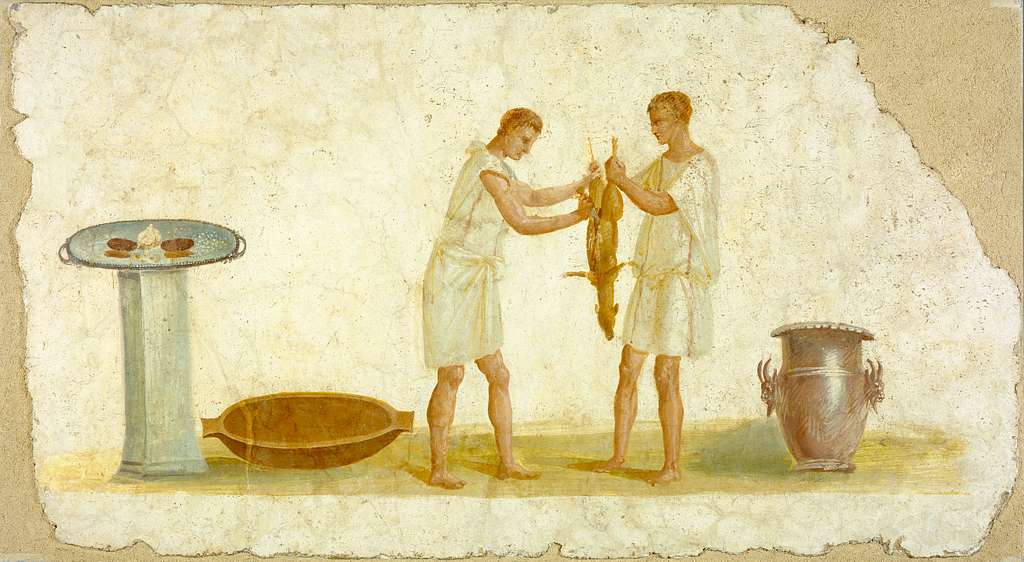
Illustration: Fresco of Roman slaves preparing a meal, Getty Museum, via Picryl, Public Domain. Digital image courtesy of the Getty’s Open Content Program.













 Ad-Free & Subscriber Log-In