

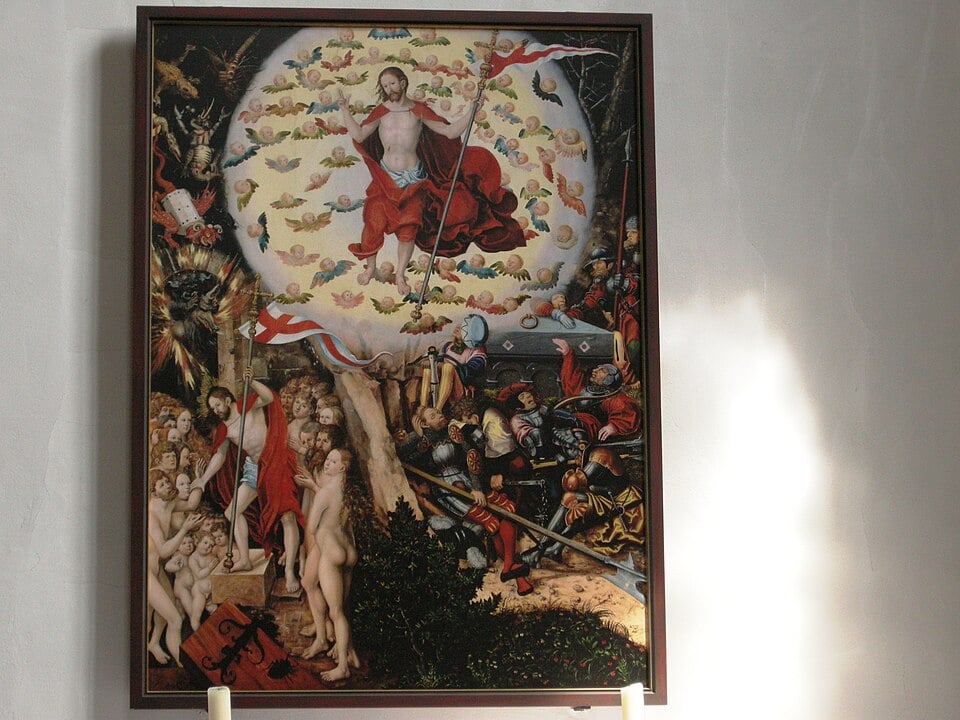
Happy Ascension Day! Always on a Thursday, the 40th day after the Resurrection (counting Easter Day, so the 39th day after that Sunday), reflecting the 40 days that the risen Christ spent with His disciples, whereupon He ascended into Heaven.
Ascension Day has always been a big deal in the historic church, the final and climactic event in the earthly life of Jesus, as celebrated in the church year. It is still a big deal in much of Christendom. Ascension Day is a national holiday, not only in predominantly Catholic countries, but also in predominantly Lutheran countries from Germany to Namibia. Even in the highly secularized Scandinavian nations, workers get Ascension Day off, just as they do for Christmas.
Not so, though, in the English-speaking world. Even though Anglicans tend to follow the church year, it is not a national holiday in the UK, Australia, and Canada, nor is it for the USA, with our predominant Christian tradition being mostly Reformed, which brings us to the topic of today’s post.
One of the most dramatic differences between Lutherans and the Reformed is their understanding of the significance of Christ’s Ascension. They apply it in completely opposite ways! The Reformed say that the Ascension makes it impossible for Christ’s body to be present in Lord’s Supper. Lutherans say that the Ascension is what makes it possible.
For the Reformed, Ascension Day is the day that Jesus left the earth. He is gone. That’s nothing to celebrate. He can be with us in some spiritual sense, but His body is in Heaven. As of the Ascension, for the Reformed, the Incarnation is over.
Lutherans, on the other hand, emphasize what St. Paul says about the Ascension, as he prays that the Christians of Ephesus might know. . .
. . .what is the immeasurable greatness of his power toward us who believe, according to the working of his great might that he worked in Christ when he raised him from the dead and seated him at his right hand in the heavenly places, far above all rule and authority and power and dominion, and above every name that is named, not only in this age but also in the one to come. And he put all things under his feet and gave him as head over all things to the church, which is his body, the fullness of him who fills all in all. (Ephesians 1:19-23)
Having resumed His place in the Trinity, the Son of God now fills all things. In His time on earth, the Son of God was an individual person, occupying a particular place in space and time. But now, as of His Ascension, the Incarnate Christ fills everything.
The Ascension does not mean that Christ is far from us. It means that He is close to us. He isn’t just someone who lived in ancient Judea some 2,000 years ago. Rather, He is with us now, in the most complete and intimate way. Jesus says as much in the prelude to His Ascension as recorded by His disciple Matthew:
And Jesus came and said to them, “All authority in heaven and on earth has been given to me. Go therefore and make disciples of all nations, baptizing them in the name of the Father and of the Son and of the Holy Spirit, teaching them to observe all that I have commanded you. And behold, I am with you always, to the end of the age.” (Matthew 28:18-20)
This is possible because He fills all things. In this context, Jesus brings up the sacraments, putting His full authority behind baptism, connecting it to making disciples. He also clearly reveals the Trinity, that the gospel is not just for the Jews but for “all nations,” and that all of His commandments are to be taught, thus authorizing the writing of the New Testament. In all of this, we have the promise of His presence, not just at that historical moment but “always, to the end of the age.”
That Jesus “fills” all things also helps explain how He is “with” us–the mode of His presence–in the Lord’s Supper. One of the attributes of God is His omnipresence. Contrary to the prevailing social imaginary, God the Father doesn’t just reside in Heaven far above the universe either. He is present everywhere too. So is the Holy Spirit. And, again, so is the Son. The omnipresence of the Deity does not displace the physical realm. Nor does Christ’s presence in Holy Communion displace the physical bread, as Roman Catholics say it does in their doctrine of transubstantiation. “But God’s omnipresence isn’t that of a body,” the Reformed reply. “That’s a spiritual presence.” “Well,” say the Lutherans, “Jesus specifically spoke of His body being present, not His spirit. In His Ascension, He was taken up bodily into Heaven, not just His spirit as happens to us when we die. In Heaven, the Son of God is still incarnate, still bearing both a human and a divine nature. So when He is present, He is present undivided, in both His body and His spirit.
The Reformed come back, “If He is present everywhere in that way, in what you Lutherans call the ‘ubiquity of Christ,’ He must be present in rocks and trees too, so there is nothing special about any such presence in the Lord’s Supper.” Luther had the best comeback to that:
Although he is present in all creatures, and I might find him in stone, in fire, in water, or even in a rope, for he certainly is there, yet he does not wish that I seek him there apart from the Word, and cast myself into the fire or the water, or hang myself on the rope. He is present everywhere, but he does not wish that you grope for him everywhere. Grope rather where the Word is, and there you will lay hold of him in the right way. (LW 36:342)
What makes a sacrament is not just bread and wine in Holy Communion and the water used baptism but the Word of God: specifically, the Word of the gospel that Jesus died for our sins. When we receive that Word that constitutes the sacrament (“this is my body, given for you”), the Holy Spirit creates faith in our hearts. And we receive Christ, who is truly present in a sacramental union in, with, and under the physical bread.
The argument over the meaning of the Ascension and its connection to the question of Christ’s presence in the Lord’s Supper was the main issue in the debate between Luther and Zwingi at Marburg.
For what Luther says about all of this, see Gregory Stackpole’s posts at Into the Clarities:
(1) On The Ubiquity of The Human Body of Jesus as God (Luther against Schwenkfeld)
(2) On The Body of Jesus in The Eucharist (Salkeld’s Summary of Luther Against Zwingli)
(3) On The Body of Jesus in The Eucharist (Against Zwingli, Karlstadt, & Oecolampadius, 1526)
And here is a sermon by Luther on Ascension Day.
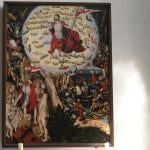
Illustration: Christ’s Ascension by the School of Lucas Cranach (a. 1525), central panel of the Magdalene Altarpiece in the Collegiate Church of St. Peter and Alexander in Aschaffenburg, Germanyt, photo by Lutz Hartmann, CC BY-SA 3.0 <https://creativecommons.org/licenses/by-sa/3.0>, via Wikimedia Commons










 Ad-Free & Subscriber Log-In