

Homer is having a bit of a moment. The controversy around Christopher Nolan’s creative decisions in his forthcoming Odyssey, the recent discovery of an Egyptian mummy buried with some lines from the Iliad, and of course, posts from my esteemed Anxious Bench co-contributors Philip Jenkins, have shown that the ancient poet remains relevant to our culture. Of course, we might ask ourselves why this is the case: is it the power in his words and meter? Is it the complicated characters and narrative arcs?
The early church had a different understanding of why Homer was relevant to their lives, and indeed he was relevant. For them, the bard’s importance had little to do with the man and his writings though. For some early Christians, Homer was relevant because he pointed them towards Christ. Embedded in his stories are truths that might be mined and applied to the Christian life and Christian doctrine.
Perspectives on Homer in Early Christianity
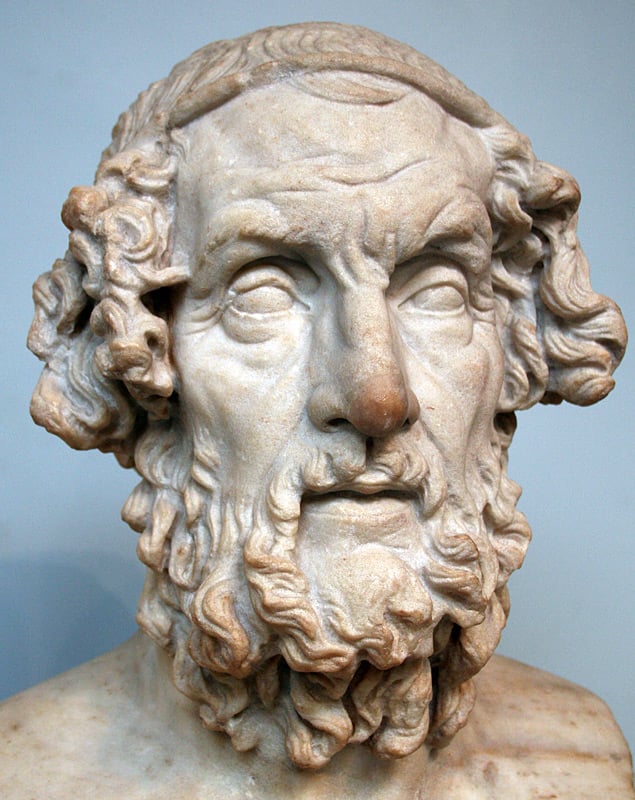
When speaking about Homer in late antiquity, it is important to note his role in society—he was not only a famous poet, but a pillar for learning, culture, and philosophy. In fact, Plato went so far as to say that Homer “educated Greece” (Plato, Republic 10.606e), as young Greek pupils learned their alphabet from Homeric names, used the Odyssey in one of their first reading assignments, and wrote “Homer is a God, not a human being” as one of their first sentences (Sandnes, The Challenge of Homer, 45). And this employment of Homer did not end in youth—many thinkers used him in their philosophical treatises, such as Porphyry of Tyre in his On the Cave of the Nymphs (this work is a wild ride—well worth a read!). A first century commentator named Heraclitus described the situation as follows:
From the earliest age, children beginning their studies are nursed on Homer’s teaching. One might say that while we were still in swathing bands we sucked from his epics as from fresh milk. He assists the beginner and later the adult in his prime. In no stage of life, from boyhood to old age, do we ever cease to drink from him (Heraclitus, Homeric Questions 1.5-6; trans. MacDonald, Christianizing Homer 17).
With the importance of Homer for all things Greek culture, language, and education in late antiquity, it is no wonder that Christians were aware of the poet—though their attitude towards him wasn’t always as positive as that of their non-Christian counterparts.
For many Christians, Homer was looked upon with suspicion or simply rejected. Part of this is the role of the Greek gods in these works, which Homer refers to as daimonia, or ‘demons’. While Homer simply meant ‘divinity’ by this term, it took on a pejorative sense by the time of the New Testament—Early Christians thought Homer was recounting the deeds of malevolent demons of Satan (MacDonald, Christianizing Homer, 20)! Further, some of the moral content of the stories was (rightfully!) concerning, as Homer recounts murder, incest, and other egregious sins. So, some Christians exhorted followers of Christ to reject Homer’s works: “It behooves the young not to be satisfied with those corrupting lessons, and those who are in their prime should carefully avoid listening to the mythologies of the Greeks…” (Pseudo-Clementine Homilies 4.19; trans. ANF 8.255).
Not all Christians completely rejected the bard’s writings though—quite the opposite. Some even composed Christian poetry in his style or created centos from his writings (see: McCashen, “Homer in Irenaeus”). Perhaps this is because many of those writing theology and serving in the church were educated in this system which prioritized Homer. As it was basically impossible to be educated without the poet, many decided to critically appropriate him. As Dennis MacDonald notes, “Since there was no avoiding Homer, the Church decided to tame him” (MacDonald, Christianizing Homer 20). So, what did this look like?
Christianizing Homer
Like most things in early Christianity, there was no one way to approach Homer. Different theologians, regions, and times treated him differently. But we do see some interesting and complementary employments of Homer in Christian discourse in the first several centuries of the church.
First, as the Odyssey and Iliad played an outsized role in education and cultural consciousness, many Christians used elements of the story as a sort of allegory for moral and spiritual ideas. Clement of Alexandria is a great example, here. In one place, he connects baptism to the bathing practices of Telemachus and Penelope (Stromateis 4.22; Odyssey 2.261, 4.750, 760, 17.48, 58), and in other compares Christ to the type of father that Telemachus desired (Protrepticus 9.68; Odyssey 2.47). Most strikingly (and commonly), the famous story of Odysseus being tied to the mast (Odyssey 10.165-200) is used to discuss the cross of Christ by early Christians. In one such case, Hippolytus uses this story in his discussion about Gnostic teachers:
The Sirens sang sweetly and deceived by their music those who sailed past, persuading their hearers by their lovely voice to draw near. Learning this beforehand, they say, Odysseus sealed the ears of his companions with wax, bound himself to the mast, and sailed by the Sirens without danger—though he listened to their song. My advice is that my readers do the same: namely, that they either stuff their ears with wax because they are too weak to sail past heretical teachings (not listening to what could, with its delight, easily convince them like the sweet song of the Sirens), or for them to bind themselves to the cross of Christ, remaining undisturbed because they listen to the Siren song with faith, confident in the cross to which they are lashed, and standing upright. (Refutation of All Heresies 7.13.2-3, trans. Litwa).
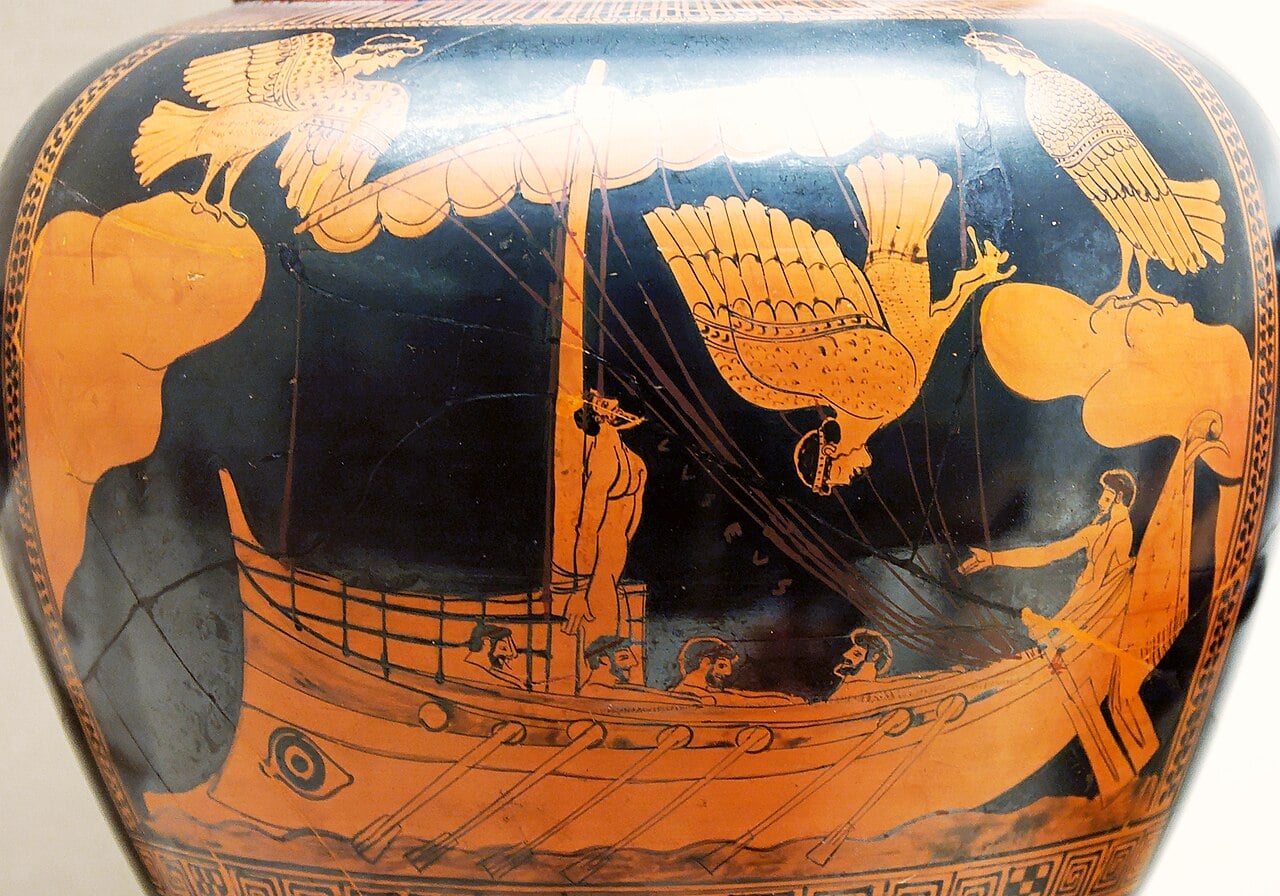
Like Odysseus, we must bind ourselves to the wood, not of the mast but of the cross.
Another way that Homer was used by early Christians was as a source of spiritual edification: reading these stories teaches us about truth, beauty, and virtue. Basil of Caesarea’s famous address On Greek Literature discusses how young students might profit from Greek literature. Importantly, he does not completely embrace Homer’s stories: “you must not follow them wherever they lead and give over once and for all the rudders of your mind, as of a ship, to these men. Rather, you should accept whatever is useful from them and know when it is necessary to disregard something.” (On Greek Literature 2; trans. Hildebrand) So what is ‘useful’? That they teach us of wisdom and virtue. Quoting the Odyssey, he writes:
And almost all [of the authors], who discourse on wisdom, relate praise for virtue, each in his own writings and with more or less force. We must be persuaded by them and attempt to manifest their words in our life, so as to establish indeed the love of wisdom that until now with others [has been only a matter of] words: ‘He alone understands, while [others] glide about like ghosts.’ (On Greek Literature 4).
These texts are not only allegories but sources of spiritual edification and growth.
Finally, educated Christians used Homer to discern spiritual truths: in him, we can learn about God, creation, and judgment. According to Theophilus of Antioch, at times Homer “becoming sober in soul and departing from the demons, made statements in agreement with those of the prophets in order to bear witness to themselves and to all men concerning the rule of God… “ (Ad Autolycum 2.8; trans. Grant). While once again, there was a critical rejection of non-Christian elements to his stories (and they are legion!), other elements of Homer’s writings were compared with the Scriptures and found to be true. And so, the early Christians employed a similar strategy to Homer as they did to Plato: whenever Homer or Plato spoke truth, he is either dependent on Moses or he is dependent on the Logos who spreads truth throughout the world in unlikely places (see: Justin Martyr, First Apology 44).
Seeing Christ in Homer
Origen and Augustine famously speak of how Christian’s might ‘plunder the Egyptians’ on their way to the promise land, taking the best of non-Christian literature and philosophy (Origen, Letter to Gregory 2; Augustine, On Christian Doctrine 2.40.60). And Homer’s writings are, perhaps, the greatest treasures of the Greek poets. Importantly, Christians not only took from the Odyssey and Iliad, but they employed these writings to discuss robust theological ideas, in image and in substance. But this employment is one that necessarily distorts Homer’s own ideas, ripping ideas from their context and intentionally rereading his narratives.
The historian might rightfully bemoan this use of the bard, but of course, the ancients are not beholden to modern historical standards. Indeed, early Christians are not so much concerned with what Homer says, but what Homer can teach us about God and the world. In this, they employ a sort of Logos hermeneutics, that seeks the truth from the text and is willing to dispose of the parts they find immoral or untrue. They are looking through Homer to find truth in his writings, or more specifically, to find Christ.
The relevance of Homer to the early Christian—and perhaps to us—is not only that he writes heroic stories in legendary poetic language and meter, but that his art reveals that truth can be found in surprising places, even if it takes a critical eye to discern it. In fact, we might consider employing this method of engagement with the great treasures of the arts—music, poetry, paintings, etc. That is to say, many in the early church saw the world through the Scriptures, considering how literature, philosophy, and culture might relate to the things of God. Homer is relevant, at least according to these early Christians, because he points us to Christ.










 Ad-Free & Subscriber Log-In