

Anyone who has spent much time in the church has probably heard a bad sermon or two (or three). Today, as we enter into May, I’d like to talk a bit about a very bad sermon from 1517, one that completely missed the point of Easter week and inspired a wave of political violence. It’s also one that has some resonances with our own moment and political debate– so come learn about perhaps the worst May Day celebration ever, sparked at least in part by an inflammatory message from a public platform.
Bad Sermons and Riots, 1517
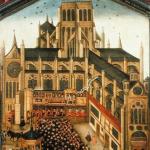
On the Tuesday after Easter, on April 14 of 1517, a preacher stood up to give a sermon in the London church of St. Mary Spitall, in Bishopsgate. This was a recurring yearly Easter sermon series, with two sermons at Paul’s Cross bracketing three sermons at St Mary Spitall. It was a well-attended event and important platform, with outsized influence on London affairs. In the sermon, Dr. Bell laid out a mournful picture, one that had nothing to do with the events of Easter weekend:
“To all you the worshipful lords and masters of this city, that will take compassion over the poor people your neighbors, and also of the great importable hurts, losses, and hindrances, whereof proceed the extreme poverty to all the king’s subjects that inhabit within this city and suburbs of the same, for so it is that the aliens and strangers eat the bread from the poor fatherless children, and take the living from all the artisans, and the business from all merchants, whereby poverty is so much increased.” (as quoted in Hall’s 1548 Chronicle, p. 587; modernization of language my own)
This was certainly not the message Londoners might expect from a pulpit during Easter festivities. It focused not on scripture texts from the gospels or centered on the events of Easter, but instead on a verse from Psalm 115:16: “the highest heavens belong to the Lord, but the earth he has given to mankind.”
In context, this psalm focuses on trust in the Lord rather than in nations, on giving glory to the name of the Lord for his love and faithfulness. It calls the people of Israel to trust not in idols but in God, to praise Him now and forevermore. Dr. Bell expounded none of this, however, for his audience. Instead, he laid out a rather narrow definition of mankind:
“upon this text he entreated, that this land was given to Englishmen, and as birds would defend their nest, so ought Englishmen to cherish and defend themselves, and to hurt and grieve aliens for the common good. And upon this text pugna pro patria [fight for your country], he brought in, how by God’s law it was lawful to fight for their country, and ever he subtly moved the people to rebel against the strangers, and break the king’s peace, nothing regarding the league between princes and the king’s honor. Of this sermon many a light person took courage, and openly spoke against strangers.” (as quoted in Hall’s 1548 Chronicle, p. 588; modernization of language my own)
The second text Dr. Bell pulls in here is not a scripture verse at all: it is a common phrase used in medieval texts, spuriously attributed to Cato and used as a justification for war (see Ch. 4 in Filippo Gianferrari, Dante’s Education: Latin Schoolbooks and Vernacular Poetics).
Whether Dr. Bell’s audience of “light persons” (an early modern insult meaning people of little thought and loose morals) realized that Dr. Bell was pairing scripture with a supposedly Roman saying or not, they seem to have taken his words to heart. They started, as Hall says here, “speaking against strangers”- against London’s immigrant community, a small portion of the population (around 2% of the city’s 50,000 residents). And then, on April 30 into May 1, an evening usually associated with the celebration of artisans and laborers as part of the observation of the feast of St. Joseph the Worker, things turned violent. A group of apprentices and Londoners, dwelling on their grievances, did more than just talk: riots directed against immigrants broke out.
A group of around 1,000 young men gathered in the streets, first storming the city’s largest prison and freeing those imprisoned there for attacking immigrants and foreigners. The newly enlarged mob then rushed the precinct of St. Martin le Grand, in the heart of the city near St. Paul’s cathedral. Here hundreds of Dutch, German, and French artisans lived– and here, the rioters focused on destroying what they saw as property that should be theirs, ransacking immigrants’ shops, destroying their property and houses, and causing chaos through the streets. Somehow, despite the sensational accounts preserved in later ballads, it seems that no one was killed in the riots, although many were injured. Around 300 people were tried for treason after the riots, with 17 ultimately executed.
Public Platforms and Political Violence, Past and Present
Since the 500th anniversary of this so-called “Evil May Day” in 2017, several scholars have written more recent analyzes and accounts of the riots and their aftermath, nicely overviewed in this summary from Historic UK, this article in Smithsonian Magazine, Brodie Waddell’s introduction to his article, and Shannon McSheffrey’s article and analysis of the trials afterwards). These texts tend to focus on the social and political elements of Evil May Day, bringing forward important points to consider and remember. As Shannon McSheffery points out in her 2017 piece on the riot:
“Several aspects of this riot and its handling resonate [in 2017]: London men’s visceral resentment and patriarchal defensiveness in the face of strangers’ alleged stealing of both their livelihoods and their wives; the easy targets that immigrants provided for violent youth; the crackdown of authorities in suppression of protest; and the cooperation of the judiciary in that suppression. There is no side to cheer for in examining Evil May Day . . . Particularly telling for the legal historian was the role of the chief justice in devising an ingenious if legally eccentric strategy of prosecution. We know that law and judicial structures can serve in creative ways as tools in social, economic, and political conflicts. It is worth reflecting, as we think about the 500th anniversary of Evil May Day, how frequently those structures have served to shore up the power of authoritarian regimes.”
True in 2017, these points feel even more important in 2026.
Yet centering the role of bad preaching in Evil May Day perhaps also has some lessons for us to consider. Writing this now, in late April 2026, the day after another attempted political shooting in the U.S. and in the same month as President Trump’s expletive-filled Easter post and Pete Hegseth’s use of a line from a movie in a prayer, it feels worth highlighting a few additional things about May Day 1517 that we’d do well to remember on May Day 2026.
First, it’s notable that in both April 1517 and April 2026, we’re seeing the misuse of supposed scripture verses to justify the idea of nationalism and war. Adam Renberg wrote about the early church’s approach to the idea of “just war”which gives some helpful context for us to consider here. But additionally, it seems important to note a trend that we can see here: to justify the idea of a “just war” based on nationalism, those promoting such a position turned to imaginary scripture verses rather than extant ones.
Secondly (and relatedly), both in April 1517 and April 2026, dishonest exegesis of scripture is a problem, one that quite literally takes the word and name of God in vain to serve earthly goals. Dr. Bell’s sermon starts with a letter of grievances from a fellow Londoner and uses that to read into the psalm what he wants to see, without consideration for what the text itself says. For us, looking back at this over 500 years later, it’s easy to see Dr. Bell’s political motivations and condemn the “theology” they created. Are we paying attention to how political motivations might be shaping public “theology” in our own moment?
Finally, in thinking about bad sermons and political violence, we see here that selective and problematic exegesis from a public platform can easily lead to violence. In April 1517, that was certainly the intended goal. In April 2026, it’s hard not to connect the rise in political violence in the US to the rise of public and dehumanizing declarations about “enemies” and “aliens” both in the U.S. and abroad. It is easy to claim that something is just rhetoric, or just a negotiating tactic– but that doesn’t mean that there aren’t tangible consequences to one’s choice of words. Calls for violence do often lead to violence. The events of 30 April 1517 are known as “Evil May Day” for a reason: to avoid evil May days of our own, we’d be well served to hold our religious and political leaders accountable for what they say and do on public platforms.










 Ad-Free & Subscriber Log-In