

The Adventurous Lectionary – Twenty-fifth Sunday after Pentecost – November 9, 2025
Haggai 1:15b-2:9
Psalm 145:1-5, 17-21
2 Thessalonians 2:1-5, 13-17
Luke 20:27-38
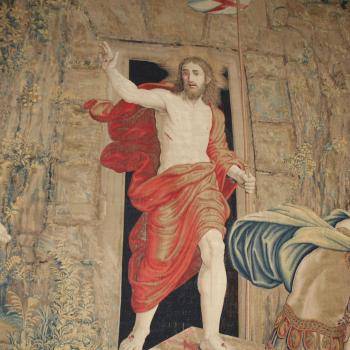
“Now God is God not of the dead, but of the living; for to God all of them are alive,” so ends a cryptic exchange between Jesus and the Sadducees. Resurrection, rebirth, and renewal are at the heart of this week’s lectionary readings. The Sadducees think they have trapped Jesus with a “gothca question,” but Jesus confounds them, asserting that, despite their agnosticism about the afterlife, there is a future and a hope ahead of us, regardless of how low we have sunk spiritually, personally, and institutionally. Where we see death, God sees the possibility of new life. Dry bones can live. Dead spirits can be born again. God is alive, yesterday, today, and tomorrow, and we are in God’s hands, and nothing can separate us from God’s love.
You can’t get a complete systematic theology of survival after death from Jesus’ exchange with the Sadducees. But, you can receive a vision of hope for what lies ahead. Rationalistic in spirit, the Sadducees doubted the concept of resurrection, the restoration of life to the whole person on the last day. Trying to discern Jesus’ theology of the afterlife or rather trap him theologically – and even in the first century, Jewish intellectuals were well aware of the Platonic separation of soul and body and the afterlife adventures of the liberated soul – they ask him a curious question about marriage beyond the grave. Jesus, as often is the case, doesn’t give a definitive answer. He simply places the answer where it belongs, in the context of God’s graceful care for humankind and the cosmos. The dead will live on, God is the God of the living, and we will live on. The details of the afterlife are apparently unimportant; what matters is God’s fidelity and enduring love. God is alive, God is faithful, and it well with our souls.re
This passage may be quite esoteric to many congregants today. Seldom do mainline and progressive preachers talk about the afterlife and conservative Christian visions of heaven or hell lack moral maturity in the separation of saved and unsaved based on a few mumble doctrinal assertions unconnected with concern for the planet or the least of these. Very few progressive Christians have a literal doctrine – or even images – of the resurrection or life after death. Our post-mortem visions constellate on some form of immortality, either in heaven or a journey from life to life, or the accounts of near death experiences. The literal notion of resurrection described in terms of the dead emerging from the ground or being put back together supernaturally if the body has decomposed is the stuff of zombie movies, hardly to be taken seriously. Still, many congregants ponder what will happen at the hour of death, even if they don’t share these questions in church.
While we don’t fully know what Jesus had in mind with his response, his words can be an opportunity to reflect on survival after death and on human hope as it relates to our daily lives and political context. We fear the fate of the earth, the death of our democracy, and the process of dying far more than we fear the reality of death or the afterlife. Few preachers get much traction fanning the flames of hell, even in evangelical congregations. Fear-based and transactional understandings of the afterlife reflect a morally ambiguous vision of God. Yet, if we can consider the possibility of an afterlife, ethics suggest a connection between our actions in this life and our experiences beyond the grave. This need not be couched in terms of heaven or hell, but the reality of unresolved issues and personal identity, not to mention redemption of what has died in us relationally and spiritually in this lifetime.
As I have noted earlier, very few mainline or progressive pastors preach about the afterlife and this allows popular, but often superficial and polarizing, images to dominate their congregants’ visions of life after death. Our concern is this life, but care for this life and the fate of the earth need not preclude healthy and humble reflection on life after death. While no pastor can be definitive about the afterlife, he or she can reflect on various possibilities as they relate to this lifetime and assert that neither Jesus nor healthy Christian theology counsels us to disregard our obligations to care for this lifetime and the world in light of the afterlife. We are here and the world – us and our companions – is saved as much here as in an uncharted beyond. (For more on the afterlife, I suggest my short text, “From Here to Eternity: Preparing for the Next Adventure.”)
The passage from Haggai also gives us an image of hope. The decimated nation will return to its former glory; better than that, injury will be healed, hope restored, forgiveness given, and new beginnings emerge. This will be the work of the faithful and active God visualized by the Psalmist. Thessalonians continues this hopeful vision: the fullness of Christ is on the way, do not be afraid, have faith in God, and all will be well. Our lives are in God’s hands, and so are our deaths, and God is faithful. We may experience cataclysms and threats and we may be apprehensive about the fate of the earth and the survival of US democracy but God is at work silently and persistently to defeat the powers of darkness. God is God and Trump isn’t, and he like Nebuchadnezzar and August will be a page in history, sound and fury signifying nothing in the years ahead. If we stand firm in our trust in God and live faithfully, the future will be filled with hope and not fear. While the author of 2 Thessalonians may have in mind a “second coming,” we can translate this passage to address our own faith in a time in which we experience threat to the predictable order of things and in which the very existence of planetary life is at risk through human folly, war making, and greed. God is not mocked by power hungry and prevaricating politicians and preachers; God will have the final word and that word is Love!
These passages do not counsel us to passivity or to sitting on the sidelines, letting God take care of the future. We are called to be partners with God and agents of our destiny, challenged to live faithfully, to act lovingly, and to care for the earth regardless of what the future brings. Faithfulness is not about a divine rescue operation but about becoming God’s companion through actions to save the world and bring justice and beauty to our companions. Heaven will take care of itself; our task is here on earth, undergirded by the trust that whatever the future brings, we are in God’s hands.
++++
Bruce Epperly is Theologian in Residence at Westmoreland Congregational United Church of Christ, Bethesda, MD (https://www.westmorelanducc.org/) and a professor in theology and spirituality at Wesley Theological Seminary. He is the author of over 80 books including: “Homegrown Mystics: Restoring the Soul of Our Nation through the Healing Wisdom of America’s Mystics” (Amazon.com: Homegrown Mystics: Restoring Our Nation with the Healing Wisdom of America’s Visionaries: 9781625249142: Epperly, Bruce: Books) “Jesus: Mystic, Healer, and Prophet “(Jesus: Mystic, Healer, and Prophet: Epperly, Bruce: 9781625248732: Amazon.com: Books), Saving Progressive Christianity to Save the Planet”( Saving Progressive Christianity to Save the Planet: Epperly, Bruce G: 9781631999215: Amazon.com: Books), and his most recent book, “God of the Growing Edge: Whitehead and Thurman on Theology, Spirituality and Social Change.” (The God of the Growing Edge: Whitehead and Thurman on Theology, Spirituality, and Social Change: Epperly, Bruce G: 9781631999291: Amazon.com: Books The God of the Growing Edge: Whitehead and Thurman on Theology, Spirituality, and Social Change: Epperly, Bruce G: 9781631999291: Amazon.com: Books) His latest books are “A New Pentecost for Progressive Christians.” (A New Pentecost for Progressive Christians: Epperly, Bruce G: 9781631999413: Amazon.com: Books) and “Creation Sings: 40 Days of Spiritual Wisdom from the Non-human World” (Amazon.com: Creation Sings: Forty Days of Spiritual Wisdom from the Non-Human World: 9781625249296: Epperly, Bruce G: Books)











 Ad-Free & Subscriber Log-In