

The Adventurous Lectionary – December 7, 2025 – The Second Sunday in Advent
Isaiah 11:1-10
Psalm 72:1-7, 18-19
Romans 15:4-13
Matthew 3:1-12
Today, we explore radical transformation, guided by God, but brought about by ourselves. I think global history argues against a divine rescue operation. Today’s readings contain both threat and promise, and we might struggle with Isaiah’s vision of God as one who strikes the earth and kills the wicked. God sides with the oppressed and the wicked wealthy will pay. The winnowing of God is on the horizon and the ax will topple trees that fail to bear fruit. We ask, where do we fit in? Will we be pruned and winnowed? Or, shall we begin the process ourselves: simplifying our lives and sacrificing for the greater good and doing our best not to be complicit in continuing the evils we deplore among the powerful. The meek seldom inherit the earth. The wealthy seldom give up power. Despite the realities of injustice, we cannot give up hope for a new heaven and a new earth, and the emergence of a Peaceable Realm in the rubble of our civilization.
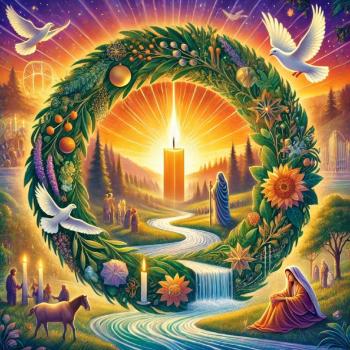
The passages also present a profound image of hope: the Peaceable Realm, the Beloved Community, in which humanity and the non-human world live side by side peacefully and God’s realm supplants the injustice perpetrated by the powerful and privileged. Advent presents an impossible possibility, that the partnership of humanity and divinity will create a new earth. The Season of Advent invites us to wait but also be catalysts for the changes we wish to see.
Isaiah 11 describes the impossible possibility – enemies becoming companions, children safe from harm, wise national leadership, and a world without war. None of this has ever occurred, despite Isaiah’s dream, but Isaiah’s dream still judges world history and serves as a polestar for our endeavors. Indeed, our current political leaders, even those who claim to be Christian, make no pretense about their use of violence to subdue enemies in the Caribbean and traumatize undocumented immigrants in our borders. Still, as unrealistic as Isaiah’s dream may seem, we must strive after God’s Shalom and, perhaps, in the striving after Shalom in our personal lives as well as the body politic create communities that nurture a better humanity and make peace with the non-human world; a world in which poverty, injustice, racism, sexism, and global climate change are a thing of the past and God’s Shalom reigns.
John is a major figure in our Advent Adventures. John presents us with the dream of a new era, but it is clear that to get there we must go through a dark night of purgation. We must prune away the cumber, subtract our wants, and simplify our lives. The realm of God requires a change of heart, a contrite spirit, and a new set of values. God is graceful and initiates this process of creative transformation, but God needs us for God’s dream to be realized in the world. Repentance means turning around and away from everything that imprisons us spiritually and harms our neighbors near and far.
Little is known about the relationship of Jesus and John the Baptist. According to tradition, when Mary the mother of Jesus meets her close relative Elizabeth, John leaps in utero in acknowledgment of the uniqueness of Mary’s son. Beyond that, the early life of John, later John the Baptist, like Jesus’ early life, is shrouded in mystery until adulthood.
As an adult, John comes on the scene as a wild man, proclaiming hard words of transformation and redemption. He comes as a purveyor of bad news first: he doesn’t mince words to the folk who come out to hear him preach, some knowing they need transformation, others for the sheer spectacle of it all. “You brood of vipers,” he shouts, insulting the erudite and affluent. A voice crying in the wilderness, John is a prophet in the tradition of Amos, Hosea, and Micah. Transformation requires pruning, and destruction of old ways of life. Our souls need purification: we must put off injustice and idolatry and spiritual smugness to experience God’s realm in the now. Those who sought new life received baptism as a sign of purification and commitment. But, the cleansing waters of baptism must be preceded by a change of heart and lifestyle. John’s word convicted his listeners and convicts us today.
We must choose life, John says, economically, politically, relationally, and congregationally. Long before Dietrich Bonhoeffer, John the Baptist preached grace but a grace that is costly and not cheap. Forgiveness is at the heart of John’s message but we must live in the spirit of forgiveness to truly experience God’s gifts of love for us and our neighbor.
“Align yourself with God’s coming realm,” such was the message of John. God will come, the gospel narratives state, manifest in the message, hospitality, and healing practices of Jesus of Nazareth. John anticipates Jesus’ ministry not as an abstract figure but as a spiritual companion, first of John himself, and then all of us. The Celts use the term anamcara to describe a deep spiritual relationship of common values and commitments. Perhaps, John and Jesus were anamcara to one another. Our anamcara mirrors our deepest self and enables us to embody the glory of God as persons “fully alive.” In relationship to our soul companion, or anamcara, we experience the better angels of ourselves and others.
Imagine the relationship of John and Jesus for a moment. I believe they were the best of friends who grew into spiritual intimates. The narrative evidence suggests that Mary and Elizabeth were also intimates. Elizabeth was the first relative to hear of Mary’s unusual pregnancy. Perhaps, Mary knew of Elizabeth and Zechariah’s own mystical experiences surrounding John’s birth. I suspect these two women were close enough that Mary expected celebration and affirmation rather than judgment when she shared the news of her pregnancy. I am, as you can see, not worried about the historicity of these stories; there are facts, objectively noted, but beyond facts there are stories that tell us the deeper meaning of life, and invite us to journey beyond the ordinary and controllable world to God’s unexpected and surprising realm of spiritual transformation. (For more on Mary and Elizabeth, see Bruce Epperly, “Three Wise Women: The Twelve Days of Christmas with Mary, Elizabeth, and Anna,” Anamchara Books, 2025).
I can imagine John and Jesus growing up together, playing games with one another, going to religious school together, perhaps speculating on the young women in the community, and dreaming of their future vocations. Both boys were set apart by birth, and I suspect spiritual experience. They might have been sensitive to the seldom-noticed spiritual currents of life. They might even have journeyed together to study among the Essenes, going deeper than other young persons in search of direct experiences of God. As I noted earlier, I believe that Jesus and John were kindred spirits and soul friends.
Given my previous reflections, perhaps, it is no surprise for John when Jesus comes to the Jordan River to be baptized. John protests a bit: after all, they are spiritual friends and colleagues, and John knows the depth of Jesus relationship with God. The child who leaped in the womb followed the unfolding of Jesus’ intimate experiences of God, and we suspect John recognized Jesus’ unique connection with the one they called Father. Jesus’ full humanity – the glory of God, indeed the Incarnation, is a person fully alive – resonated with divine energy, power, and wisdom. John may have recognized that what he spoke about in his sermons Jesus’ fully experienced. John preached of God’s coming and Jesus felt that coming realm in his very marrow; he was the embodiment of the good news that emerges when the flames of prophetic practices refine our spirits. Jesus was the coming presence of God, enlightening and enlivening us to experience God’s transformational presence in our personal and political lives.
John dreamed of the Peaceable Realm and so do we. He never lived to see its full embodiment, but he planted seeds that enabled Jesus to move forward as its messenger and embodiment. John is Advent personified: he embodies the fierce urgency of the now, but not yet. He is impatient with our foolishness and sin, and wants us to be better. As Advent messenger, he knows that salvation occurs through the transformation of one person at a time. This very moment is the right time for us to let go of the past, turn away from our half-heartedness and complicity with injustice, and find a new pathway to God’s peaceable kingdom, one step and one breath at a time.
We are the Advent change we seek; apart from us, there will be no Peaceable Realm.
The uniqueness of John’s message is a good theme for this Sunday’s sermon. His radical vision, preparing the way for Jesus, challenges us to prepare the way for Jesus’ mission in our time. Our preparation is a matter of deeds as well as words. Walking in the way of Jesus involves a commitment to constant transformation and renewal, to changing our ways in response to God’s wondrous gifts of grace. Like John, we are challenged to announce the coming of a world not yet born, critique our own and our community’s hypocrisy, and recognize that Christ’s presence demands a radical reorientation of values so that we might recognize the realm of God already emerging in our midst.
++++
Bruce Epperly is Theologian in Residence at Westmoreland Congregational United Church of Christ, Bethesda, MD (https://www.westmorelanducc.org/) and a professor in theology and spirituality at Wesley Theological Seminary. He is the author of over 80 books including: “Homegrown Mystics: Restoring the Soul of Our Nation through the Healing Wisdom of America’s Mystics” (Amazon.com: Homegrown Mystics: Restoring Our Nation with the Healing Wisdom of America’s Visionaries: 9781625249142: Epperly, Bruce: Books) “Jesus: Mystic, Healer, and Prophet “(Jesus: Mystic, Healer, and Prophet: Epperly, Bruce: 9781625248732: Amazon.com: Books), Saving Progressive Christianity to Save the Planet”( Saving Progressive Christianity to Save the Planet: Epperly, Bruce G: 9781631999215: Amazon.com: Books), and his most recent book, “God of the Growing Edge: Whitehead and Thurman on Theology, Spirituality and Social Change.” (The God of the Growing Edge: Whitehead and Thurman on Theology, Spirituality, and Social Change: Epperly, Bruce G: 9781631999291: Amazon.com: Books The God of the Growing Edge: Whitehead and Thurman on Theology, Spirituality, and Social Change: Epperly, Bruce G: 9781631999291: Amazon.com: Books) His latest books are “A New Pentecost for Progressive Christians.” (A New Pentecost for Progressive Christians: Epperly, Bruce G: 9781631999413: Amazon.com: Books) and “Creation Sings: 40 Days of Spiritual Wisdom from the Non-human World” (Amazon.com: Creation Sings: Forty Days of Spiritual Wisdom from the Non-Human World: 9781625249296: Epperly, Bruce G: Books










 Ad-Free & Subscriber Log-In