

The Adventurous Lectionary – The First Sunday of Advent -November 30, 2025
Isaiah 2:1-5, Psalm 22, Romans 3:11-14, Matthew 24:36-44
This week the theme is “woke spirituality.” “Woke” has a bad name in some circles, where people distrust the quest for diversity and justice, and want to return to a time before affirmative action, Black Lives Matter, LGBTQ+ rights, women’s rights; a time when misogynist and racist humor were acceptable, and white males got more than their fair share. A time when traditional family values kept gays in the closet and women in the kitchen.
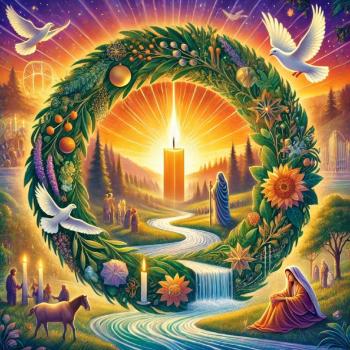
Today’s scriptures proclaim that God is here and that in God’s presence the old ways of war and injustice are overturned, and all God’s children have a place at the banquet table. Advent spirituality dreams of an alternative reality and then works to bring God’s alternative realm to our daily lives and political policies.
Advent is a time for hopes and dreams, for provocative possibilities that take us beyond the world as we know it to the world as it could be – and should be – a place of healing, restoration, justice, and Shalom. Advent joins the personal and the political. The spirit of Advent invites us to examine our values and lifestyle: How shall we experience peace in the onslaught of the Christmas season? How shall our Advent be holy and whole-making? What behaviors do we need to change to be part of the peaceful world Isaiah visualizes? How will the quest for justice, earth care, and peace shape our foreign policy and domestic priorities or our protest against the policies and appointments of the President?
This isn’t so much a matter of holding off on singing Christmas carols till Christmas Eve, but having an attitude of expectation, hopefulness, and prayerful waiting. Advent calls us to be persons who already have one foot in God’s new age and who imagine ourselves as being already the change we want to see in the world.
Let us walk in the light of God, so says the prophet Isaiah. With the darkness of shorter days descending in the Northern hemisphere and fears of darkness politically and globally, these words are good counsel. The dark night – whether in terms of weather or the social order – challenges us to embrace God’s enlightened paths. Open to the light, we can see growth within darkness. We can also find our way through perilous personal, congregational, and political pathways. Just a little light can reveal the moral bankruptcy of prevaricating politicians, pompous patriarchy, and compromised Christianity.
Isaiah proclaims the impossible possibility. Destroyed and despairing, Jerusalem shall become a center of spiritual pilgrimage with seekers coming to create, not destroy. Strangers will find a home in the holy city. Refugees will experience safety once more. The world’s leaders shall beat their swords into plowshares, war will be abolished, and nations will no longer plan on destroying on another. Laughter and joy will fill the city streets. The days of mourning will be a thing of the past as the horizons of God’s future beckon us forward. We wonder about the impossible possibility of ICE melting to make way for welcome to undocumented residents, a return to privileging human rights over patriarchy, and prioritizing care for the planet over profit-making.
The Psalmist also looks toward an era of peace not just in Jerusalem but in the world. “Peace be with you,” is not just a casual greeting but the hope of the nation and the dream of Jerusalem. Wishing another “peace” will transform the spirit of Jerusalem , and our nation as well. We need to get beyond alienation, and experience divine connection, even as we challenge the injustices of our time.
The passage from Romans continues the theme of God’s creative transformation of our world. All time is sacred time, and God’s vision is on the horizon calling us forward. Salvation is nearer than we thought. God’s wholeness is just around the corner – or could it already be here- and we need to be prepared. We need to be mindful of the moment by moment revealing of God’s providence in our lives. Divine omnipresence means that in ways large and small, dramatic and domestic, God is with us in saving ways. The apostle Paul counsels: Don’t miss out on God’s vision embodied in our lives! Act as if God’s realm is here right now, become a citizen of heaven in your everyday life by your commitments, values, and actions. We are, as poet June Jordan asserts, the ones we’ve been waiting for.
Recorded in the Gospel of Matthew, Jesus’ words to his first followers complement the counsel of Romans 13. Although there is an implicit threat in the unexpected coming of God, ultimately this passage is about mindfulness. Stay awake. Holy moments may catch you by surprise. A pivotal life event may be happening right now, and you are too dull-witted to recognize it. Don’t sleep through your life, or through God’s revolution. Don’t miss God moments occurring throughout the day. God is coming to us in every encounter.
We need not wait for a world-transforming catastrophe or Second Coming. As a matter of fact, waiting for a divine rescue operation is the worst thing we can do if we want experience God right now. Don’t pay attention to apocalyptic thinkers and their constantly updated time tables – they have been wrong for two thousand years and there is no reason to believe they will be any more accurate today. Creative transformation – awakening to God and living in God’s realm – is available to us all the time. The future is in our hands as well as God’s and we need to prepare moment by moment to experience God’s vision of Shalom, God’s provocative possibilities embedded in every encounter. (For more on theology of possibility, see Bruce Epperly, “Process Theology: Embracing Adventure with God” and “Process Theology: A Guide for the Perplexed.”)
Jesus’ words challenge us to live faithfully. We are to have a lifestyle of expectancy. We are to live as if God is with us, precisely because God is.
So, stay awake. Walk in the light. Open to your role in the divine adventure. Salvation is here, Christ’s coming is now. Rejoice in the glorious and challenging splendor of this wondrous holy moment.
++++
Bruce Epperly is Theologian in Residence at Westmoreland Congregational United Church of Christ, Bethesda, MD (https://www.westmorelanducc.org/) and a professor in theology and spirituality at Wesley Theological Seminary. He is the author of over 80 books including: “Homegrown Mystics: Restoring the Soul of Our Nation through the Healing Wisdom of America’s Mystics” (Amazon.com: Homegrown Mystics: Restoring Our Nation with the Healing Wisdom of America’s Visionaries: 9781625249142: Epperly, Bruce: Books) “Jesus: Mystic, Healer, and Prophet “(Jesus: Mystic, Healer, and Prophet: Epperly, Bruce: 9781625248732: Amazon.com: Books), Saving Progressive Christianity to Save the Planet”( Saving Progressive Christianity to Save the Planet: Epperly, Bruce G: 9781631999215: Amazon.com: Books), and his most recent book, “God of the Growing Edge: Whitehead and Thurman on Theology, Spirituality and Social Change.” (The God of the Growing Edge: Whitehead and Thurman on Theology, Spirituality, and Social Change: Epperly, Bruce G: 9781631999291: Amazon.com: Books The God of the Growing Edge: Whitehead and Thurman on Theology, Spirituality, and Social Change: Epperly, Bruce G: 9781631999291: Amazon.com: Books) His latest books are “A New Pentecost for Progressive Christians.” (A New Pentecost for Progressive Christians: Epperly, Bruce G: 9781631999413: Amazon.com: Books) and “Creation Sings: 40 Days of Spiritual Wisdom from the Non-human World” (Amazon.com: Creation Sings: Forty Days of Spiritual Wisdom from the Non-Human World: 9781625249296: Epperly, Bruce G: Books)










 Ad-Free & Subscriber Log-In