

The Adventurous Lectionary – The Fourth Sunday of Easter – April 26, 2026
Acts 2:42-47, Psalm 23, I Peter 2:19-25, John 10:1-10
Today’s lectionary highlights one of the best-known passages in scripture. “The Lord is my shepherd, I shall not want,” as the traditional translation relates. God is the Good Shepherd, who cares for God’s flock and who will look for every lost sheep until it is brought home to safety.
Psalm 23 is a spiritual message for our time of chaos, conflict, and confusion, a time in which Christians bow down before a false and fallible idol, revealing the moral bankruptcy of the faith they affirm, and in which our nation’s leader seeks to rule by whim, violence, and destruction.
In its realism, Psalm 23 recognizes the external and internal threat, the enemy that threatens us, and the valley of the shadow of death, but more importantly recognizes that God is with us in this time of national and international chaos, when leaders have lost their reason and embrace death not life in their political policies. God prepares a table for us, anoints us, and guides us. Even when we are sheltering in place, we can experience our cup running over. We can experience a feast of beauty, love, and creativity in the presence of all that threatens us. We can be blessed to be a blessing.
The affirmative message of Psalm 23 complements the Good Shepherd passage from John 10, which contains one of my favorite affirmations. “I have come that you might have life, and have it abundantly.” This was one of Jesus’ mission statements. He is affirming that while there are pathways that lead to destruction, the good shepherd seeks only the best for his sheep. The good shepherd wants all of us to flourish, to live joyfully, and grow into full humanity. Jesus’ mission statement (John 10:10) unmasks bad theology, that is surfacing during this time of war in which militarism is identified as God will and God is seen as the agent of violence, guiding every bullet to its target. The Good Shepherd seeks healing not hurt, love not destruction, peace not violence.
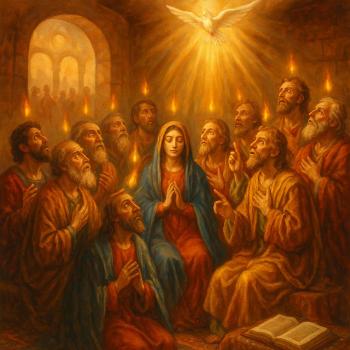
There is a pathway that leads to abundant life, and we catch a glimpse of divine abundance in the words of Acts 2. In this honeymoon time of the church, the Jerusalem community is filled with the spirit and God’s Spirit motivates their life together. Perhaps, the author of Acts is using some hyperbole here but the world he describes presents an ideal human community, the beloved community, the body of Christ, toward which we strive and which is so different from our individualistic, self-interested, win-lose, competitive world. Dare we imagine such a world, such a church, and would we even accept it or join such a community, which saw our personal lives part of a greater story which claimed our time, talent, and treasure. If we imagine less, we will settle for the unsustainable, economically unjust, and ecologically devastating in which we currently live. The current crisis challenges us to acts of generosity and to open rather than close our hearts. We must go from self-interest to world loyalty, greed to generosity, and scarcity to abundance.
In twenty-first century, individualistic America, these words are countercultural even in the church, but we need to address these challenging words, and perhaps struggle with how we can live them out in the free market and in the life of the church. It may even require a new economic vision which places the common good and the least of these ahead of the wealthiest and most privileged. We have enough for everyone’s need, as Gandhi said, but not everyone’s greed.
There are important lessons to be learned from Acts 2. First, the Jerusalem community devoted itself to faith formation, through theological reflection, prayer, and worship. What we believe matters and it’s connected with how we live our lives. The first followers saw God as life-giving, breaking down barriers, and calling us to new life through the resurrection of Jesus and the gifts of the Holy Spirit. Prayer was as real as breathing, and every moment was a call to prayer. They prayed and broke the bread of life together, celebrating Christ’s supper as often as they gathered.
Second, they were filled with awe, expecting great things from God and great things from their community. They believed abundant life was possible for everyone and that God was moving in their lives, giving them power to love, heal, and welcome. This passage along with I Corinthians 12 models a community which joins creativity and initiative with a all-inclusive social safety net.
Third, they shared with one another: while they may not have sold their property in its entirety, they made their largesse available to their neighbor. They saw their well-being connected with the well-being of every member of the community. They were each other’s business, not in a gossipy way, but in terms of promoting one another, knowing another’s success contributed to the health of the body and our health. They sold their possessions to benefit those in need, creating a community in which everyone had what he or she needed.
This is the most radical aspect of this beloved community. Its members were not possessed by their possessions. They saw the well-being of others as important as their own – they took greed off the table; they would not make a profit if it hurt others; they would not accept inequality in community in terms of economics. While some members may have had “more” economically, such as Lydia in the Philippian community, their largesse was not private property to be used as we wish but subject to the needs of others. We rob from God when our wealth indirectly or directly hurts others.
This is clearly an embodied, spiritual and democratic socialism, and while not necessarily big government, certainly a challenge to any free market, amoral system. It certainly argues for caring for vulnerable people by any means necessary, insuring without asking questions or setting minimal requirements that all have food, housing, health care, and the ability to work.
Finally, the Jerusalem community shared meals gratefully with friends and family. They had glad and generous hearts. Their gratitude opened up a world of unexpected possibility. Gratitude is the virtue of relationship and interdependence, reminding us that none of us is self-made, all of us depend on the efforts of others, job creators need workers, and out of this interdependence, our lives are our gifts to God and one another. From the perspective of Acts 2, our success is judged by how much good we do for others, not the size of our bank account, business profits, and ability to compete successfully with others. This is not a call to mediocrity, whether spiritual or economic, but God’s challenge to seek excellence that benefits our neighbors and create businesses that promote employment and ecological well-being as the primary goal, not corporate or individual wealth.
Abundant life involves doing something beautiful for God at every level of our lives, and ensuring that our congregational, business, professional, and economic priorities give something beautiful to God by bringing beauty to our neighbor’s lives.
+++
Bruce Epperly is Theologian in Residence at Westmoreland Congregational United Church of Christ, Bethesda, MD and a professor in theology and spirituality at Wesley Theological Seminary in Washington DC. He is the author of over ninety books, including his Christological trilogy Jesus: Mystic, Healer, and Prophet; Whitehead and Jesus: An Adventure in Spiritual Transformation; and Messy Incarnation: Meditations in Christology in Process and also Creation Sings: Forty Days of Spiritual Wisdom from the Non-Human World; and Homegrown Mystics: Restoring Our Nation with the Healing Wisdom of America’s Visionaries. He is married to Rev. Kate Epperly, D.Min. and lives in Potomac, Maryland.












 Ad-Free & Subscriber Log-In