
 Looking Closer
[Some of this material was previously published in March 2004 at Christianity Today.]
–
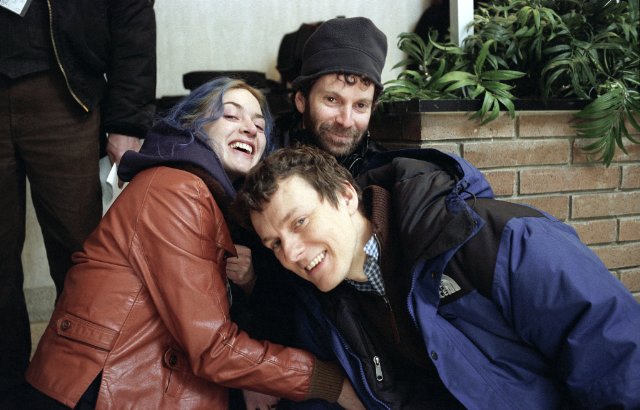
My review of Eternal Sunshine of the Spotless Mind led to an unexpected opportunity: a chance to interview the two creative masterminds of this remarkable film. It was a privilege to meet Charlie Kaufman, writer of Being John Malkovich and Adaptation, and director Michel Gondry, and to ask them why they are so attracted to unconventional stories.
The following conversation does include a discussion of the ending of the film in somewhat vague terms. These comments could be considered “spoilers.” If you have not yet seen the film, you may wish to return and read this at a later date.
–
Eternal Sunshine takes us into a bizarre dream-state. We enter the mind of an unconscious brain surgery patient (Jim Carrey) as he struggles to make sense of his scrambled memories. He has asked the doctor to “delete” all his memories of his girlfriend (Kate Winslet), but is now having second thoughts. So he frantically tries to salvage some of the most precious moments they spent together before the doctors erase them from his mind. The result is something like a love story thrown in the blender.
Kaufman clearly delights in confounding audience expectations. Viewers respond in two ways—some are delighted to experience something new, challenging, and enlightening, while others are disgusted that they did not get the formulaic, easy-to-swallow entertainment or the happy ending they thought they’d get.
However, this writer’s stories can be unsettling for other reasons as well. In Kaufman’s view of the world, people seem depraved, selfish and self-absorbed. Like Flannery O’Connor’s stories, Kaufman’s are like nightmares that compel us toward the truth by showing us the consequences of foolish behavior.
Is Kaufman’s spectacular avoidance of clichés a reaction against Hollywood? Or is it a reflection of obscure filmmaking influences?
“It might be a reaction,” he muses. “Conventional story elements and frothy romantic stories — I have a reaction against that. I don’t have that experience in my life. I’ve always felt left out because of that, so I don’t want to write that stuff. But in terms of figuring out different ways of telling a story, I don’t know whether it’s so much a reaction as just a creative impulse. If something is important to me in telling a story, then I get excited about the challenge of finding a way to do it that serves the story.”
Gondry has a different answer. “It’s not an influence, it’s not a reaction. It’s like you get to construct a toy that you will like to play with. If I get so extremely lucky as to direct a film, I don’t want to spoil it by doing something that I’ve already seen. I would never do a re-make, for instance. They asked me if I wanted to do a re-make of Charlie and the Chocolate Factory, and I said, ‘Why would you want to do a remake? Just watch the movie.’”
The debates and differing interpretations amongst viewers after a Kaufman film seem to delight him. Sometimes you have to wonder if bewilderment might be one of his aims — to divide us in order to get us talking. (Sounds like another famous storyteller who always challenged his audience by refusing to explain his parables.) When I proposed a possible interpretation of this film’s conclusion, Kaufman gave me a perfect poker face and said, “Your interpretation is absolutely valid. But I think the ending is open to interpretation.”
It should come as no surprise that, when this director/writer team is asked about their inspirations and favorites, Kaufman mentions his deep respect for David Lynch (especially the labyrinthine and confounding mystery Mulholland Drive) and Michel Gondry quickly names Groundhog Day as one of his favorites. But you have to be careful with these guys. Gondry also insists that he loves “that Superman movie with Richard Pryor. It’s a masterpiece!”
Gondry also talked a bit about the challenges posed by a screenplay that jumps around in time even as it switches between a half-dream/half-memory state and reality as well.
“Charlie saw the possibilities of exploring a relationship in a deep way. You had this very big problem to solve early on – when Joel is in his memory. There is a part where he is in the memory and a part when he’s commenting on the memory and he’s removed himself. It was a big struggle to figure out how we would show that. We came up with the idea that, when we use the past tense, we would have you see something that would take you out of reality and tell you where you are.
“When you see the story backwards and you see the consequence before the cause… that is anti-dramatic. I remember the scene where he is crying and saying wonderful things bout her and you’re wondering why… it was so hard to organize that. It was hard to use the past tense without indicating that in a technical way.”
Wasn’t it a bit unnerving, casting such a famously hyperactive star as Jim Carrey in such an understated role?
Gondry turns to Kaufman: “When I came to you with the possibility of Jim, you were a little bit concerned. But I was interested in this tension….. Jim has a quality of not being “cool” in a way that most actors are trying to be cool. They have to be in harmony with themselves, and kind of macho, a seducer… and he doesn’t have that.”
Indeed, Carrey’s performance is the most understated and mature of his career. He makes the character of Joel likeable, complicated, and sympathetic, even if he is a loser. We can relate to his failures, though, and we hope to see him find the relationship and love he needs.
Eternal Sunshine offers the audience insights about relationships that suggest we can find more fulfilling relationships when we bear with each others’ failings instead of turning our back on them. I complimented Kaufman on having given us a story that ends on a more upbeat note than the chaos of Being John Malkovich and the feeble glimmer of hope at the end of Adaptation.
He responded, of course, by confounding my expectations yet again. “I’m not sure [the characters] learn so much. When you finish the journey through the memory, you could say that he learned something, and you know that he really loved her. You wish they could start again. But at the end… that’s erased. I think that the ending of the movie is pretty open to interpretation. Your interpretation is absolutely valid. But it is open to interpretation. We know tentatively this sort of tentative decision they’ve made to try again, but we don’t know where that’s going.”
I pressed my point. “Well, it struck me that way because at the beginning of the film, when they encounter a problem, they turn away and run. They do the erasure. At the end, they’ve seen the ugliest and have heard the ugliest thing they could say about each other, but they’re still—”
Kaufman cut in. “In reality, Joel and Clementine have known each other for two days at that point. They’ve learned that they’ve known each other before and that all of these terrible things have happened, but at this point they’re kind of infatuated with each other. I’m not sure that, if you are infatuated with someone, and you’re given this piece of information, you may not incorporate it the way you would after two years of that kind of fighting. There might even be something kind of romantic about learning that you had this big relationship before. If you’re imagining yourself in this future with someone that you just met, the fact that it’s stormy can’t possibly resonate in the way that it would if you’d actually lived it. I think it’s questionable. That being said, I agree that it’s a great moment between them. And I wish them well.”
He adds, “At the end of Adaptation, Charlie has the courage to talk to Amelia, and they love each other. I’d argue that that’s a positive ending.”
Gondry has an entirely different response to offer. “People see fate in things — they go together because they are meant to be together. To me I like to see things in a different way. It’s very slight little event that makes them stay together or destroys them. It could be this one single little thing that could influence the rest of their lives… It’s nice to show these nice little fragile moments. A lot of people say that they are meant to be together—”
Kaufman interrupts again. “And that’s fine. Because that’s built into it also.”
Another reporter asked Kaufman if he thought this film would have broader appeal, and she suggests that his other films went over the heads of most moviegoers.
“This one will appeal to everyone,” he says with a sly smile. “They’re going to love this one.”
Do you really think so? she asks.
“You know what?” he says brusquely, “I don’t care. I feel like I did my part of this movie because I wanted to, and I am pleased with the movie that we made. I’ll be happy if people like it but I’m not going to worry about it.”
I try to change the subject. “Walker Percy talks about how pictures can steal our memories. Our obsession with archiving our memories in images has the unfortunate result of making us focus on the pictures instead of dwelling on our memories. I was thinking about that watching this film and the idea of memory erasure.”
“Are you talking about Message in a Bottle?” he responds, surprised.
“Yes.”
“What a great book. The chapter about the Grand Canyon…”
“That’s it!” I’m surprised that he knows exactly what I’m talking about. “And Sam Phillips has written a song that branches off from that called ‘Taking Pictures.’”
“Oh really?” Kaufman’s wide awake now, perhaps glad to be talking about something besides the movie.
So, of course, I bring it back to the movie with another question. But he moves right past the question to discuss a different idea he’s excited about. “There’s a problem. When you’re writing and you’re trying to envision a scene, it’s best to base it on life. But then so much of what you think about life is based on what you’ve seen in films and television shows.
“I’ll start doing a scene that feels like I know it, but it’s not something that I really know… it’s just something that I’ve seen in a million movies and have sort of incorporated it into… you know… ‘This is the way two people will relate to each other in this moment.’ And that to me is very scary. It’s also very dangerous to what I consider my work. Movies and images… they’re like a virus that takes over who you are. That’s why it’s important to me, when I’m doing this stuff, to be truthful. Truthful, in a sense that it’s truthful to me … because that’s all I can do. If I feel like I’m doing something honest, then I feel like I’m not putting garbage into the world. It’s my experience, and therefore it has some veracity. This is a true moment as I’ve understood it… and then I try to translate it into a scene.”
Gondry jumps in: “I take a lot of film kind of randomly. And then later you look at it, and you’ve captured a moment that is kind of special. You might take a picture of your girlfriend, perhaps, and it will alter the reality and present it in a way that is not correct. Later, when you’ve broken up, you’ll look back at them and you’ll say, ‘Wow. This was such a great relationship.’ But you just see all the best parts.”
Kaufman agrees. “Taking pictures can also be an aggressive act. I know people who will take them to be sort of separate and superior to a situation.
“One day I borrowed a camera. I was very self-conscious, and I was at an airport and I was waiting for the person that I was traveling with. I went around taking pictures, and suddenly I wasn’t self-conscious anymore. And I never take pictures, but I felt like I was in a different position now.”
Gondry’s nodding enthusiastically. “That’s true. Like when you are in a scary situation… I went in a helicopter, and I was hanging out on a harness with a camera, and as long as I was taking pictures I never had any fear. And as soon as the film started running out and I was waiting for them to give the camera back, I was in a panic. It puts you in a different state of mind.”
At this point, I’m hanging onto the conversation in a panic, trying to keep up with them. But my precious, short time with these creative geniuses is up. I express how much I’d like to continue the conversation on the subject of memory and imagery, but I know full well that next time I see them, the subject matter will be something entirely new. And I’m sure it will be fascinating.
UPDATE 2009: I did end up meeting Charlie Kaufman again, on the occasion of the release of Synecdoche, New York. You can read about that at Image journal’s blog Good Letters.














 Ad-Free & Subscriber Log-In