

The Three Most Dangerous, Magical, and Life-Altering Words in the Universe
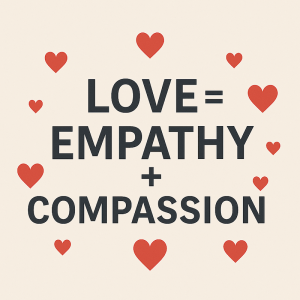
When you hear the phrase “I love you!” what happens in your mind? Maybe your heart races like a teenager at their first school dance. Maybe you cringe because someone weaponized those words in your past—using them to manipulate or control instead of nurture and affirm. Or maybe you feel nothing at all. In a world saturated with greeting cards, romantic comedies, and Instagram captions, those words often feel diluted. That’s because love is more than a feeling; Love equals empathy and compassion.
But don’t mistake overuse for weakness. Strip away the commercialization, clichés, and cheesiness, and “I love you” remains dynamite. The phrase doesn’t just express affection—it declares intent. It heals wounds, rebuilds bridges, and reorients lives. And yes, it terrifies. Saying “I love you” with sincerity requires risk: the risk of rejection, the risk of misunderstanding, the risk of change.
This post isn’t about the surface-level version of love. It’s not about candlelit dinners, diamond rings, or romantic grand gestures (though those have their place). This is about love in its raw, elemental form. Love not owned by religion, tradition, or Hallmark—but love as the force that fuels human connection and the operating system of reality itself. When you practice this kind of love—not just feel it—you unlock nearly everything you’ve ever desired, because everything meaningful sits on the other side of love.
Love: The Common Denominator
Everyone defines love differently, but at its foundation, two elements always remain: empathy and compassion. Without them, love collapses into sentimentality, manipulation, or selfishness dressed up in red and pink.
Think of water. When you break it down into elements, you find hydrogen and oxygen. Put them together in the right proportion, and water sustains life. In the wrong proportion, those same elements turn toxic. Love works the same way. Without empathy and compassion, love loses its ability to nourish. With them, it becomes life-giving.
Empathy means perspective. You step into someone else’s experience—not to agree, but to understand. Think of it as switching camera angles in a film. You remain yourself, but you see the story through another person’s lens. That shift, even temporary, creates the foundation of meaningful human connection. Without empathy, people don’t connect; they simply coexist.
Compassion adds power to empathy. Where empathy says, “I see you,” compassion says, “I care about what I see.” Compassion doesn’t stop at recognition; it moves into action. It insists on rolling up sleeves, lending a hand, and investing in the well-being of others. Together, empathy and compassion fuel love. One changes your perspective; the other changes your behavior.
That’s why love isn’t just an emotion. Emotions fluctuate. Love, rooted in empathy and compassion, becomes a practice—a chosen posture toward others. Without both elements, you may experience infatuation, obsession, or lust, but you won’t experience love.
The Weird Christian Backlash Against Empathy
Here’s where things turn strange. In recent years, more Christians—especially within certain American evangelical circles—have started decrying empathy. That’s right: they’ve labeled empathy “dangerous” and even “sinful.” They argue empathy elevates human feelings above God’s truth, blurs moral boundaries, and leads believers astray.
The irony is glaring. Read the Gospels, and you’ll find Jesus practicing empathy at every turn. He wept at a friend’s grave. He touched people society deemed untouchable. He dined with tax collectors, prostitutes, and outsiders—not because he condoned everything they did, but because he saw them, understood them, and empathized with them.
When Christians condemn empathy, they reject more than a human virtue—they reject the very method of their Messiah. They attempt to worship the name of Jesus while discarding the qualities that made him compelling. That contradiction doesn’t just look inconsistent—it looks hypocritical.
If love requires empathy, and Christians claim “God is love,” then rejecting empathy is like trying to bake bread without flour. You can call it bread, but all you’ve got is an empty plate.
The Hardest Kind of Empathy
Empathy isn’t easy. It’s simple to empathize with a grieving friend or a child afraid of the dark. It’s much harder to empathize with people who refuse to empathize with you.
How do you empathize with someone who mocks your pain? How do you step into the worldview of someone who votes against your rights or works to harm you? How do you show empathy to someone who refuses to extend even basic humanity to you? That’s the real test, and it’s brutal.
Empathy doesn’t excuse harm or tolerate abuse. Boundaries matter, and they protect your well-being. But empathy does invite you to recognize complexity in human stories—even those you dislike. The bigot may have grown up steeped in fear. The cruel boss may carry scars from a neglected childhood. Explanations don’t excuse actions, but they help you understand them—and understanding creates room for compassion.
It’s also worth clarifying the difference between empathy and sympathy, because people often confuse the two. Sympathy says, “I feel sorry for you,” while empathy says, “I feel with you.” Sympathy can create distance, because it places the other person’s pain at arm’s length—almost like pity. Empathy, by contrast, closes the gap. It refuses to stand outside the situation and instead steps inside the other person’s shoes, however uncomfortable. And that’s why empathy, not sympathy, is the foundation of love: it bridges the divide between people rather than reinforcing it.
Sometimes, empathizing with those who refuse to empathize with you becomes the most radical act of love possible. It disrupts cycles of retaliation. It interrupts the endless tit-for-tat that dominates politics, religion, and relationships. Empathy won’t guarantee reconciliation, but it guarantees growth—at least for you, if not for them.
Compassion: Love in Action
If empathy acts as the engine, compassion puts that engine in motion. Empathy without compassion can paralyze—you may feel someone’s pain but never act on it. Compassion takes empathy and turns it into tangible help.
Compassion doesn’t look like pity. Pity says, “That’s sad,” and keeps walking. Compassion says, “That’s sad, and I’m going to help carry it with you.” Compassion joins the story, not just observes it. It shows up with food, a listening ear, or a hand of advocacy. Where empathy transforms perspective, compassion transforms behavior.
Compassion rarely arrives at convenient times. It interrupts schedules, stretches resources, and demands your comfort. That’s why compassion is a discipline. You choose it even when you don’t feel like it. You commit to valuing someone else’s humanity alongside your own.
And here’s the paradox: compassion transforms the giver as much as the receiver. Neuroscience confirms that acts of compassion light up the brain’s reward centers, releasing the same dopamine that achievement brings. Compassion wires your brain for joy. By expending yourself for others, you end up fuller than before. Compassion, far from weakness, reveals itself as one of humanity’s fiercest strengths.
Love equals empathy and compassion.
Love Beyond Religion
Here’s a truth few religious institutions want to admit: you don’t need religion to love. In fact, religion often obstructs love more than it fosters it.
Look at history. Wars, crusades, and inquisitions have been waged in the name of “divine love.” Entire groups—like LGBTQ+ people—have been excluded from churches that claimed “all are welcome.” Religion has justified slavery, colonization, and systemic oppression under the banner of “love.” That version of love is distorted, toxic, and unrecognizable.
Real love doesn’t belong to theology. Love belongs to humanity. It arises from empathy and compassion—capacities that every human carries. You don’t need a creed, holy book, or religious leader to access them. Religion can amplify love when it leans into compassion, but it strangles love when it prioritizes dogma and control.
Love existed before religion. Love will outlive religion. And love thrives best when free from the cages of doctrine and hierarchy.
Love Is the Operating System of Life
When you zoom out far enough, you see that life itself runs on interconnection. Physics calls it energy. Biology calls it ecosystems. Sociology calls it community. Spirituality calls it love. Whatever name you give it, the truth remains: everything connects, and connection sustains existence.
Think of love as the operating system of life. An operating system is the invisible framework that allows everything else to function. On a computer, the OS doesn’t get the glory—it doesn’t design graphics, edit videos, or send emails. But without it, nothing runs. The applications we depend on every day become useless without the silent, ever-present foundation of the operating system. Love works the same way. It isn’t always flashy or visible, but without it, nothing meaningful operates for long.
Military organizations also illustrate this truth. At first glance, you might think armies run on discipline, logistics, or command structure. But peel that back, and you’ll find cohesion—the trust that soldiers have in one another. Without that trust, a military unit collapses, no matter how many weapons it has. Cohesion is their “operating system,” and cohesion itself is a form of love: a willingness to put the group before the self. Remove it, and the entire structure malfunctions.
The same holds true for human beings and groups in everyday life. A person might build a career, chase wealth, or accumulate knowledge, but if they do it without love, the system eventually crashes. Communities can organize around ideology, politics, or economics, but without compassion and empathy binding them, they fall apart. Just as a corrupted OS makes even the most powerful hardware worthless, a lack of love corrodes families, societies, and individuals from the inside out.
This is why love isn’t just a virtue—it’s the hidden software that runs everything. When you align yourself with love, you synchronize with the very code of existence. That’s also why the so-called “law of attraction” makes sense: what you project, you attract. Project fear, bitterness, and resentment, and life mirrors those back to you. Project compassion, generosity, and love, and suddenly possibilities open, relationships deepen, and life organizes itself toward abundance.
In this way, love is not only the operating system of life but also the strategy that ensures life runs smoothly. The more you align with love, the more your inner software updates itself toward wholeness, purpose, and flourishing.
Love as Practice, Not Just Feeling
Love can’t survive as a fleeting feeling. Feelings rise and fall like the weather. Love must resemble climate: intentional, steady, cultivated over time.
At home, love shows up in listening without rebuttals, offering hugs, and choosing kindness even when tired. Science backs this up: hugs release oxytocin, lowering stress and strengthening bonds.
At work, love redefines collaboration. It mentors instead of gatekeeps. It encourages struggling coworkers instead of gossiping about them. Workplaces that prioritize love become humane, and humane workplaces become more productive.
In society, love means more than charity. It demands justice. Charity gives handouts. Justice dismantles the systems that make handouts necessary. Compassion without justice reduces to pity. Compassion with justice becomes love in action. Love equals empathy and compassion.
The Courage to Say I Love You
Saying “I love you” scares most people. It feels like emotional nakedness—exposed to another person’s judgment. What if they don’t say it back? What if they laugh? What if they use it against you?
But courage doesn’t mean absence of fear. It means choosing action despite fear. Every sincere “I love you” prioritizes connection over ego and vulnerability over pride. It signals that the relationship matters more than your comfort zone.
Even if the words go unreciprocated, you’ve shifted the atmosphere. You’ve planted a seed of connection. And seeds grow, often invisibly, into something larger. Silence never plants anything. Love always does.
Love as Resistance
In a polarized, rage-fueled world, love acts as resistance. Choosing love rejects hate, greed, and fear. It refuses division as the default.
Love declares: I won’t reduce you to your politics. I won’t dehumanize you for one mistake. I won’t enter the endless loop of hostility. Love still demands accountability. Love still sets boundaries. But love refuses to surrender its humanity in the process.
Sometimes love protests for the voiceless. Sometimes it sets hard boundaries with toxic people. Sometimes it forgives—not the cheap forgiveness that excuses harm, but the radical forgiveness that frees you from bitterness.
Love resists because it doesn’t let hate dictate the rules. It doesn’t let fear write the script. Systems built on domination fear love precisely because love cannot be controlled.
Everything You Want Is on the Other Side of Love
Here’s the headline: everything you want lives on the other side of love. Not because love acts like magic, but because love organizes your life in your favor.
Want deeper relationships? Practice empathy and compassion. Want inner peace? Choose self-love. Want abundance? Live generously. Want transformation? Lead with love.
Chasing money, fame, or validation without love leaves you hollow. Leading with love turns those things into byproducts rather than goals.
Love isn’t weakness. Love isn’t fluff. Love is the fiercest force in the universe. And you don’t need religion to access it—you need only to practice it.
Call to Action: Practice Love Today
Here’s the challenge: for the next 30 days, make love your default practice. Not conditional love. Not convenient love. Real love—rooted in empathy and compassion.
Tell your people you love them—out loud. Don’t assume they know. Offer empathy to someone unexpected. Break cycles of retaliation with compassion. Trade your inner critic for an inner coach.
Love doesn’t wait for feelings. Love grows through practice. And the longer you practice, the more the world bends toward it.
At the end of everything—beyond politics, ego, and history—only love remains. Always love.
Love equals empathy and compassion.
I wrote this piece because I think that many people misunderstand love—and the concept of empathy seems to be dying. That’s my take—what do you think? Hit me up in the comments; I’d love to dialogue with you!
Derrick Day is the author of multiple books and the host of The Forward Podcast.
Follow him on Facebook, Instagram, TikTok, and YouTube














 Ad-Free & Subscriber Log-In