


The Whitewashing of MLK, America’s Birth Defects, and Why His Legacy Still Makes People Nervous
Every January, America does this adorable little magic trick.
For exactly one day, the country that can’t agree on whether racism is real suddenly becomes spiritually united around Dr. Martin Luther King Jr.—but only the safe version. The version that fits on a poster. The version that doesn’t start fights at Thanksgiving. The version that won’t get your workplace HR department an email from Corporate.
You know the one:
- “Love your neighbor.”
- “Judge people by the content of their character, not the color of their skin.”
- “I have a dream.”
- “Can’t we all just get along?”
And then on Tuesday, America clocks back into its usual personality:
- poverty treated like a personal failure
- racism treated like a “past issue”
- war treated like patriotism
- homelessness treated like a nuisance
- billionaires treated like superheroes
- unions treated like a threat
- public schools treated like a suggestion
That gap—between what we celebrate and what we tolerate—is the whitewashing.
Because whitewashing MLK isn’t just forgetting history.
It’s replacing the real King with a national myth: a harmless, polite, non-threatening man who wanted everyone to be nicer and then go back to business as usual.
But the historically accurate King?
That man would not be invited to most corporate MLK luncheons.
He was a socialist-leaning radical accused of communism.
He was anti-capitalist.
He was anti-militarist.
He supported reparations and economic redistribution.
He worked alongside Bayard Rustin, an openly gay strategist central to the movement.
He defended the dignity of oppressed people irrespective of color.
And the theological King—the preacher King—was light years away from the “conservative Christianity” modern evangelicals like to imagine he’d support.
In short: MLK Day should not be America’s annual Kumbaya performance.
It should be a mirror.
A mirror that forces this nation to confront its birth defects, its unresolved trauma, and its obsession with pretending it’s healed when it’s still bleeding.
The Whitewashed King: How America Turned a Prophet Into a Hallmark Card
Whitewashing King works like a four-step American recipe:
- Quote him.
- Edit him.
- Market him.
- Ignore him.
That’s the formula.
Because a radical King is dangerous.
A sanitized King is profitable.
A real King makes you rethink systems.
A whitewashed King makes you feel good about yourself.
So the country packaged him into a message that doesn’t challenge power:
- “Be peaceful.”
- “Don’t disrupt.”
- “Don’t make things about race.”
- “Don’t talk about wealth.”
- “Don’t talk about war.”
- “Don’t talk about reparations.”
- “Don’t talk about LGBTQ people.”
But King wasn’t trying to make America comfortable.
He was trying to make America just.
And that mission is not the same thing.
America’s Birth Defects: Slavery and Racism Weren’t Bugs—They Were the Foundation
Condoleezza Rice once described slavery and racism as America’s “birth defects.”
Whatever you think of her, the metaphor is brutally accurate.
Birth defects aren’t “oopsies.”
They don’t disappear with positivity.
They require intervention.
And America’s great failure hasn’t been that it had birth defects.
America’s great failure is that it refused to repair them.
Instead of confronting slavery and racism like a life-threatening condition, the country treated them like embarrassing family gossip:
“Don’t bring that up.”
“That was a long time ago.”
“Why are you still talking about it?”
“We already fixed that.”
But racism doesn’t vanish when you stop talking about it.
Racism spreads when you stop repairing it.
It seeps into:
- housing and redlining
- school funding
- healthcare access
- hiring practices
- policing and sentencing
- voting access
- generational wealth
- media narratives
- political power
That’s what happens when you ignore structural damage long enough—it becomes part of the architecture.
My Club Foot Story: You Don’t Heal Birth Defects With Denial
My personal example explains America’s problem better than 50 cable news panels.
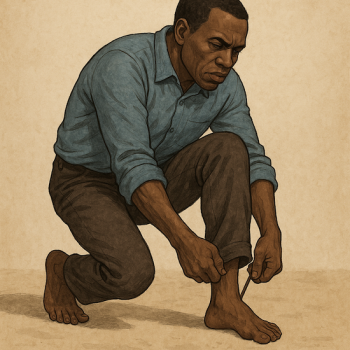
I was born with a club foot.
My parents had two options:
Option A: Ignore it
Pretend it’s no big deal.
Hope it magically resolves.
Try to “positive vibes” it into place.
Option B: Repair it
Do the hard thing early.
Take intervention seriously.
Change your trajectory before limitations compound.
My parents chose repair.
They chose surgery while I was still an infant.
And because of that decision, I gained mobility, opportunity, confidence—and a future not defined by what could’ve been fixed.
Now imagine the alternative.
If my club foot hadn’t been repaired, the consequences would’ve stacked:
- limited movement
- chronic pain
- fewer opportunities
- reduced confidence
- a life shaped by preventable constraints
That’s what America did with slavery and racism.
Instead of repair, we chose denial.
Instead of intervention, we chose mythology.
Instead of rehabilitation, we chose “look how far we’ve come.”
And now we’re shocked racism is still everywhere—like we didn’t leave it untreated for centuries.
Ignoring birth defects doesn’t make you strong.
It makes you permanently limited.
“A Riot Is the Language of the Unheard”: King Understood Unrest Was a Symptom
King wasn’t confused by riots.
He didn’t clutch pearls when the oppressed erupted.
He understood something America still refuses to learn:
Pain ignored long enough becomes noise.
King said:
“A riot is the language of the unheard.”
The Other America (1967)
That quote isn’t a riot endorsement.
It’s an autopsy report.
Riots are what happens when:
- people peacefully protest and get beaten
- people vote and get suppressed
- people work and stay poor
- people beg and get ignored
- people speak and get silenced
America loves order more than justice.
So it funds police, not schools.
It builds prisons, not housing.
It expands surveillance, not healthcare.
Then it acts shocked when the unheard stop whispering.
King didn’t say riots were ideal.
He said riots were predictable.
King on Nonviolence and Self-Defense: He Wasn’t a Cartoon
Modern culture has turned King into a one-dimensional character:
“Nonviolence means you should never defend yourself.”
But King’s actual position was more mature than memes.
He believed nonviolence was morally superior and strategically effective.
He also acknowledged that self-defense is a legitimate right.
King wrote:
“Violence is immoral because it thrives on hatred rather than love. It destroys community and makes brotherhood impossible. But it is a legitimate right of the individual to defend himself against violence.”
—“Nonviolence and Racial Justice” (1957), Christian Century
He also said:
“The Negro has the same right to self-defense as any other American.”
—Interview with Playboy (1965)
And in Stride Toward Freedom:
“I do not condemn violence in all circumstances. I cannot say that a man who is being attacked by a mob and who is being lynched should not defend himself.”
—Stride Toward Freedom (1958)
Then he added:
“The principle of self-defense, even involving weapons and bloodshed, has never been condemned, even by Gandhi.”
—Where Do We Go From Here (1967)
King wasn’t asking oppressed people to be martyrs.
He was building a movement rooted in love without denying survival.
That nuance matters.
King Was a Socialist (and Accused of Communism) Because He Threatened the System
Here’s where the whitewashing gets extra aggressive:
King didn’t just attack racism.
He attacked the economic engine that profits from racism.
And in America, once you threaten capitalism, people start shouting “COMMUNIST!” like it’s a fire alarm.
King was accused of communism because he refused to limit justice to lunch counters and bus seats.
He wanted to address poverty, wealth inequality, labor exploitation, and redistribution.
He was not just fighting for integration.
He was fighting for transformation.
That’s why his popularity dropped later in his life, even among White moderates.
It’s easy to support civil rights when it costs you nothing.
It’s harder when King starts asking you to share power.
King Was Anti-Capitalist—and He Said It Out Loud
The whitewashed King is a dreamer.
The real King is a critic.
He said:
“The evils of capitalism are as real as the evils of militarism and racism. The problems of racial injustice and economic injustice cannot be solved without a radical redistribution of political and economic power.”
—SCLC board, March 30, 1967
That quote is a grenade.
King didn’t say capitalism needed “minor adjustments.”
He called capitalism evil.
Then he said the solution required redistribution of power.
That’s not a brand-friendly message.
That’s why it gets buried.
He also demolished the myth that capitalism is the natural reward for hard work:
“Again we have deluded ourselves into believing the myth that capitalism grew and prospered out of the Protestant ethic of hard work and sacrifices. Capitalism was built on the exploitation of black slaves and continues to thrive on the exploitation of the poor, both black and white, both here and abroad.”
—The Three Evils speech, 1967
King said the quiet part out loud:
American capitalism was built on stolen labor.
And it still thrives on exploitation.
That’s exactly why corporations love quoting MLK while paying poverty wages and calling it “opportunity.”
King Supported Reparations Because Justice Means Repair
Reparations aren’t revenge.
They’re repair.
King understood that oppression has a cost—and somebody always pays it.
The question is whether the cost is paid through justice or paid through chaos.
King wrote:
“We know through painful experience that freedom is never voluntarily given by the oppressor; it must be demanded by the oppressed.”
—Letter from a Birmingham Jail, 1963
(By the way, “Letter from a Birmingham Jail” should be required reading for all Americans.)
That statement applies to every form of justice.
Power doesn’t self-correct out of kindness.
Power changes when pressure is applied.
Reparations are part of that pressure—because you can’t steal wealth for generations and then pretend equal rights automatically equals equal outcomes.
King Opposed Militarism and Called America “Spiritually Dying”
The whitewashed King is “pro-peace.”
The real King was anti-war and anti-empire.
He said:
“A nation that continues year after year to spend more money on military defense than on programs of social uplift is approaching spiritual death.”
—A Time to Break the Silence, April 4, 1967
King wasn’t just making a budget complaint.
He was making a moral diagnosis.
A nation obsessed with violence cannot call itself righteous.
A nation that funds war more than uplift has misplaced its worship.
King understood militarism wasn’t just something happening overseas.
Militarism shapes the entire mindset of a society—turning everything into an enemy, everything into a threat, everything into domination.
King and LGBTQ Liberation: Bayard Rustin Was Essential, Not Optional
Bayard Rustin was openly gay and instrumental to the civil rights movement, including organizing the March on Washington.
King embraced Rustin even though Rustin’s sexuality was used as ammunition by opponents.
That matters.
Because it shows King was committed to liberation more than reputation management.
Later, Coretta Scott King and King’s children became allies of LGBTQ rights, continuing a legacy of widening justice.
King’s movement wasn’t a closed club.
It was a moral revolution.
King’s Theology vs. Conservative Christianity: They Are Not the Same Religion
Now let’s address the elephant in the evangelical room:
A whole lot of conservative Christians talk about King like he’d be one of them.
Like he’d be sitting on Fox News saying, “Now I’m not political, but… let’s ban books and protect billionaires.”
Absolutely not.
King’s theology was rooted in:
- a social gospel tradition
- prophetic justice
- radical love with teeth
- solidarity with the poor
- condemnation of exploitation
- resistance to militarism
- a belief that systems can be sinful—not just individuals
That is light years away from the version of Christianity that:
- worships capitalism as “God’s economy”
- treats poverty like a lack of faith
- treats war like patriotism
- treats oppression like “order”
- weaponizes scripture against LGBTQ people
- and calls justice work “woke” like it’s a demon you can rebuke
King was not preaching “Jesus wants you rich.”
He was preaching that exploitation is evil.
King wasn’t preaching “submit and obey.”
He was preaching resistance to injustice.
King wasn’t preaching “protect the powerful.”
He was preaching uplift for the oppressed.
If conservative Christianity had existed as the dominant public force in King’s time, many of the loudest ones would’ve called him:
- a communist
- a troublemaker
- a divider
- a false teacher
- a threat to America
And some of them did.
MLK Day Should Be a Mirror, Not a Kumbaya Moment
MLK Day has become too soft.
Too clean.
Too nostalgic.
Too convenient.
Instead of being a day of accountability, it often becomes a day of national self-congratulation.
But King’s legacy isn’t a lullaby.
It’s a challenge.
This holiday should force us to ask:
- What birth defects are still untreated?
- What systems still profit from exploitation?
- Who is still unheard and disenfranchised?
- Why does militarism still get unlimited funding?
- Why does economic injustice still map onto race?
- Why do we keep acting shocked at the consequences of neglect?
Mirrors don’t exist to comfort.
Mirrors exist to reveal.
Call to Action: Honor the Real King, Not the Edited One
Want to stop whitewashing MLK?
Start here:
1) Teach the real King
Read his uncomfortable speeches. Quote the parts that cost something.
2) Reject unity without justice
Unity without repair is oppression with choir music.
3) Fight for programs of social uplift
Housing. Education. Healthcare. Living wages. Worker protections.
4) Treat America’s birth defects like your parents treated your club foot
Repair early. Repair honestly. Repair boldly.
5) Make MLK Day about accountability
Not vibes. Not slogans. Not nostalgia.
Action.
Because King didn’t die so America could feel proud once a year.
He lived—and was killed—because America needed transformation.
And it still does.
Final Word: The Dream Was Never Comfort—It Was Liberation
King’s dream wasn’t a feel-good quote.
It was a demand.
A demand for repair.
A demand for redistribution.
A demand for truth.
So this MLK Day, don’t just celebrate.
Reflect.
Repair.
Act.
Because the dream isn’t dead.
But the whitewashing needs to be.
What does MLK’s life and legacy mean to you? What are some of his greatest quotes and lessons? Share them in the comments!
Derrick Day is the author of multiple books and the host of The Forward Podcast.
Follow his website or catch him on Facebook, Instagram, TikTok, and YouTube









 Ad-Free & Subscriber Log-In