

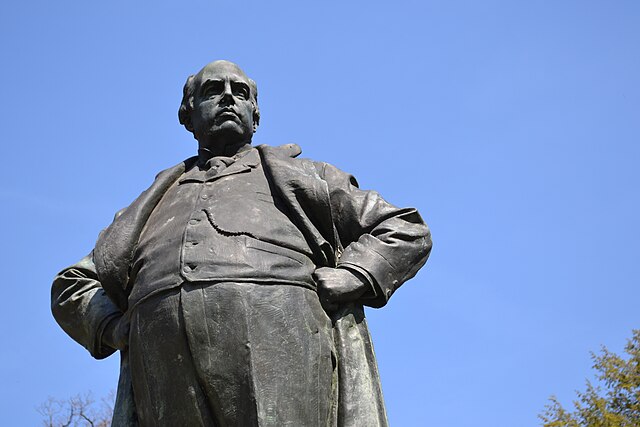
Peoria, Illinois
Robert Ingersoll was born on the 11th of August, 1833.
He is pretty important in the general formation of my spiritual life. And I continue to feel his influence on my more spare Buddhism. So I like to reflect on him and his contributions from time to time. What follows is something I keep working at. I expect to get it right within the next decade or so…
Writer Kimberly Winston wrote of the good colonel, as he was usually styled, that he “was a Victorian-era rock star who packed theaters with people who traveled hundreds of miles to hear his lectures against religion.” He has been called “the Great Agnostic,” and “America’s conscience.”
Colonel Ingersoll died just short of the turn into the twentieth. He was the leading figure in the “Golden Age of Free Thought” that ran through the last quarter of the nineteenth century and well into the second decade of the twentieth.
As I noted at the beginning of this reflection in my childhood I was influenced by Ingersoll. It was through my father who was a fervent devotee of his. My father liked how the colonel raised the plain errors and contradictions of the Bible that he enumerated in his various lectures, which were collected and published in numerous editions over the years. Of my various memories of my father, his citations of these errors and contradictions probably account for ten percent of them all. He really could get into it. And he let the colonel do most of the heavy lifting.
They say if you want to lose your faith make friends with a priest. So perhaps appropriately, Ingersoll was the son of a Congregationalist preacher. But in his case it was the treatment of his father by the congregations he served as well as the denomination which probably first inspired the seeds of doubt. The Reverend Ingersoll was a broadminded liberal, as well as a social justice activist and abolitionist. He was actually tried for his liberalism as heresy, found guilty, and finally defrocked. While the Reverend was eventually restored to the ministry, the events were never forgotten by his son.
Briefly a school teacher, Ingersoll read the law and at twenty-one passed the Illinois bar in 1854. After building a practice he married Eva Amelia Parker in 1862. They would have two daughters.
With the outbreak of the Civil War he raised a regiment, the 11th Illinois volunteers and led it as their colonel. He would be known by that military title for the rest of his life. Colonel Ingersoll saw combat at the battle of Shiloh. After the war he was elected Attorney General for the state, where he began to be noted in Republican circles for his fiery oratory. Ingersoll was encouraged to play down his agnosticism, about which he made no bones, and run for governor. The colonel, however, refused to obfuscate his views on religion.
So, he turned his attention to public speaking in an era when that was a principal form of entertainment. Colonel Ingersoll was interested in and spoke on a wide range of subjects. His political talks were on fire. But as it turned out his celebrations of family and his blunt agnosticism bleeding quickly into atheism, were what gained him fame.
He could turn a phrase. He is remembered for his variation on the golden rule, “Give to every human being every right that you claim for yourself.” Similarly, “Happiness is the only good. The time to be happy is now. The plan to be happy is here. The way to be happy is to make others so.” I hope you notice the threads of interdependence in his various pronouncements. Others include “I am the inferior of any man whose rights I trample under foot.”
Of course, again, it was the colonel’s thoughts on religion that people most responded to. The article on Ingersoll at Wikipedia holds up as an example a line from his lecture “The Great Infidels,” where he declared “All the meanness, all the revenge, all the selfishness, all the cruelty, all the hatred, all the infamy of which the heart of man is capable, grew, blossomed, and bore fruit in this one word – hell.” And, he was blunt about religion, “Every religion in the world has denounced every other religion as a fraud. That proves to me that they all tell the truth – about the others.”
Rejecting the authority of various scriptures, all hierarchies, and the conventions of deities and souls, he came to have a sense of the world and our place in it. In his world, everything passes. “In the presence of eternity, the mountains are as transient as the clouds.” And, he really understood interdependence. The colonel declared, “In nature there are neither rewards nor punishments; there are consequences.” And his response to these insights was for us to take care of each other, to give ourselves over to the power of love.
Not bad sentiments for any of us. And, not far from my liberal or modernist or naturalistic Buddhism.
I can see why he was also called “America’s conscience.”
And the great infidel…








 Ad-Free & Subscriber Log-In