

“The Optimist,” a tender new film about memory, trauma and intergenerational connection releasing March 11, turns the intimate story of one Holocaust survivor into a broader meditation on healing that its producer said she felt compelled to bring to the screen.

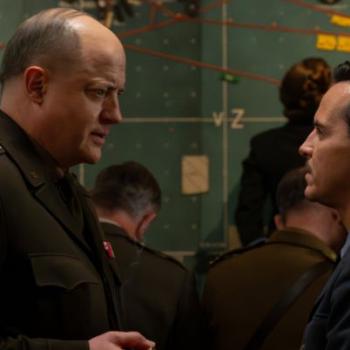
“‘The past is important to remember,’” producer Jeanine Thomas said, explaining why she made the movie after meeting Herbert Heller in 2014. The film follows Heller, played by Stephen Lang, a toy store owner who hid his wartime experiences for more than six decades, and Abbey, a troubled teen portrayed by Elsie Fisher, whose lives intersect and slowly coax each other toward vulnerability and purpose.
Thomas said her relationship with Heller allowed him to speak in ways he didn’t with his family.
“He felt like he could talk to me about things he couldn’t talk to his family about,” she said, adding that Heller “wanted his children to look at him as their dad and not be like, ‘Oh my gosh. He went through this. We’ve got to treat him differently.’”
The film draws on that intimacy and on the producer’s personal connections to war-era trauma. Thomas recounted her own grandfather’s silence after being a prisoner during World War II, and how learning more about the Holocaust reshaped her view of history.
“I learned a lot about the Holocaust I did not know,” she said, noting that the experience put her on “a more faith-based journey” and clarified her purpose as a storyteller.
Thomas also described the moral urgency behind the movie—the necessity to honor both past suffering and contemporary trauma.
“In the present. we have to deal with the trauma that’s happening today, too,” she said. That dual focus is reflected in the film’s structure, which traverses Heller’s harrowing flashbacks and Abbey’s modern struggles set against the redwood forests of Northern California.
The teen storyline, Thomas said, was deliberately crafted to speak to younger audiences dealing with mental health crises. She recounted a real letter a teenager sent Heller after one of his talks.
“One girl did write him a letter. And said, ‘I was planning on writing my parents a suicide note this week, and I heard your story. And if you can make it through what you made it through, I’ve got this.’” Thomas said the story underscored the potential of testimony to save lives.
Thomas framed the film as an effort to create conversations across generations. “Parents, grab your parent, grab your child and see this,” she said, calling the film “intergenerational” in its reach. She said the message resonated palpably when survivors screened the movie.
“We showed, we screened this for Holocaust survivors. I was able to sit off to the side and watch them watching the film. And then once we were done, they’re like, ‘That was my life.’ This is a real thing. Thank you.’”
“The Optimist” also marks the fulfillment of a promise Thomas made to Heller before his death in 2021. “I always made a promise to Herbert,” she said. “I will finish this film and it will be out in the world, worldwide. And your story will affect the world.” That resolve was strengthened by Thomas’ own battle with cancer in 2021, which she said gave her “the strength to make a film and finish it.”
The road to release, she said, required patience as the team sought the right distribution partner.
“We searched for two years for the right distribution,” Thomas said, explaining that timing and the proper home for the film’s sensitive subject matter were critical.
Visceral moments filmed on location helped shape Thomas’ perspective. She described a research trip in 2019 that included Terezin and Auschwitz.
“When I did a crematorium at Terezin, I lost it. I was crying so hard,” she said, noting that the staged veneer of Terezin — a so-called “show camp” when the Red Cross visited — had an especially devastating impact. “It was all such a lie. it hit me.”
The film, anchored by Lang’s portrayal of a man long burdened by silence and Fisher’s portrayal of a young woman at a crossroads, seeks to balance history’s weight with the fragile possibility of redemption. Thomas said that response from survivors affirmed the film’s emotional honesty: “I put this up there with the birth of my children. You know, this is such an amazing — this film works. I’m like, you just gave me validity that this film works.”
Set against a landscape that shifts from forests to intimate interiors, “The Optimist” aims to speak to audiences across generations and beliefs. Thomas emphasized the film’s call to empathy and unity, saying it reflects a desire “to create this beautiful world here, heaven on earth for all, not just this pocket or this pocket… we all have to come together in an interfaith way.”
With its mix of historical flashback and contemporary drama, the film asks viewers to bear witness to survival and to consider how stories can change lives decades after the events occurred. As Thomas put it, witnessing Heller’s impact on younger people made clear why stories like his should be shared widely: “He loved to tell his story.”
“The Optimist,” starring Stephen Lang, Elsie Fisher, and Luke David Blumm, releases in theaters March 11 from Jeanine Thomas Productions, Convoke Media, and Stillking Films.














 Ad-Free & Subscriber Log-In