

In this post I will begin the process of putting into words my reflections about LOST, and will mention and discuss the details of the finale. And so if you have yet to see the finale, and are trying to avoid SPOILERS, then you should probably bookmark this post and come back later.
 It is hard to know whether it is a spoiler to say that everyone dies…eventually. Many are saying that the story is more satisfying emotionally than intellectually. I think I’m inclined to agree. But since the story has always been first and foremost about the characters, this is perhaps to be expected. Ultimately the last quarter of an hour of the show will seem more or less satisfying depending on whether one thinks there can be an afterlife or at least that it is possible to transcend death, even if it involves using an atomic bomb and creating a closed time-like curve. But the more important message is perhaps that life – whether temporary or eternal – means little without the relationships and connections we form. But having LOST end in “Places in the Heart” fashion will probably be frustrating to those who wanted the show to end “realistically” even though a magic island is hardly realistic to begin with. The island was a metaphor, the flash sideways universe was a metaphor, and perhaps most importantly finding one’s constant was a metaphor. And once we start to think about LOST in a non-literalistic way, I think we’ll be able to find it moving and inspiring and touching. And perhaps that is the most important message of LOST: to find a way to connect with the emotional and spiritual and non-literal without sacrificing the intellectual and rational in the process. Would it be true to say that in the end Jack brings faith and reason together in his own person – that he brings balance? Or maybe the answer is Hurley’s approach – forget mysticism, forget science, and focus on being kind and helping others.
 Returning to the plot and the mysteries, it certainly seems to me that, just as Desmond’s exposure to electromagnetism allowed his consciousness to transcend time and space, Eloise Hawking had a similar experience, perhaps as a result of being close at hand when Jughead exploded. And so when she interacted with Desmond in his “flashback” of his life, I think we caught a glimpse of that. She in particular pushed her son to become a physicist, knowing that it was his destiny to die on the island even before he was born as a result of time travel. She pushed him because she knew he couldn’t be prevented from dying but that in a very real sense he could “make time.”
I liked that all the main characters were wrong to some extent at some point in the series. Perhaps the most interesting example in the finale was when Desmond decided he was wrong about this life not mattering after having caught a glimpse of another one. The finale of the show explores the notion of an afterlife, and that parallel universe was missing something until the characters remembered the connections between them. “Live together, die alone” took on new meaning, or at least needs to be reconsidered in light of the ending. And as was also said on IO9, there was something nice about Jack telling Flocke that John Locke had been right about almost everything.
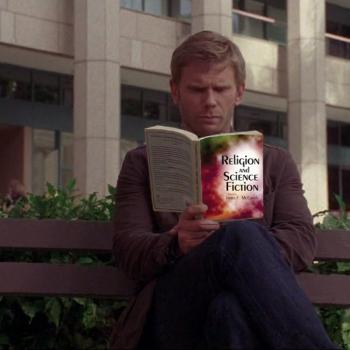
 For a religion professor, there were a lot of striking elements. The interfaith church, for instance, where Christian imagery sits alongside a picture of Krishna and a menorah (among other things and symbols). Pop culture has regularly offered angels and an afterlife with “no religious affiliation.” And given the Hindu components that have been there since season one, I wasn’t too surprised to find a lingam and yoni were the heart of the island. I assume there will be some Freudian exploration of that at some point.
 Star Wars allusions abounded (I loved the quip that Jacob is worse than Yoda). I wonder whether the musical echoes were intentional – there is a motif in the score that is reminiscent of the music from Star Wars Episode III: Revenge of the Sith, which plays during the battle between Anakin and Obi-Wan. Did anyone else notice this?
Jimmy Kimmel live “Aloha to LOST” can be watched online, for those of us who couldn’t stay up to watch it. It is worth watching, not least for the “alternate endings.”
What did you think of it? What will you take away from it? Feel free to discuss, reflect, debate, and simply talk about LOST in the comments section.












 Ad-Free & Subscriber Log-In