

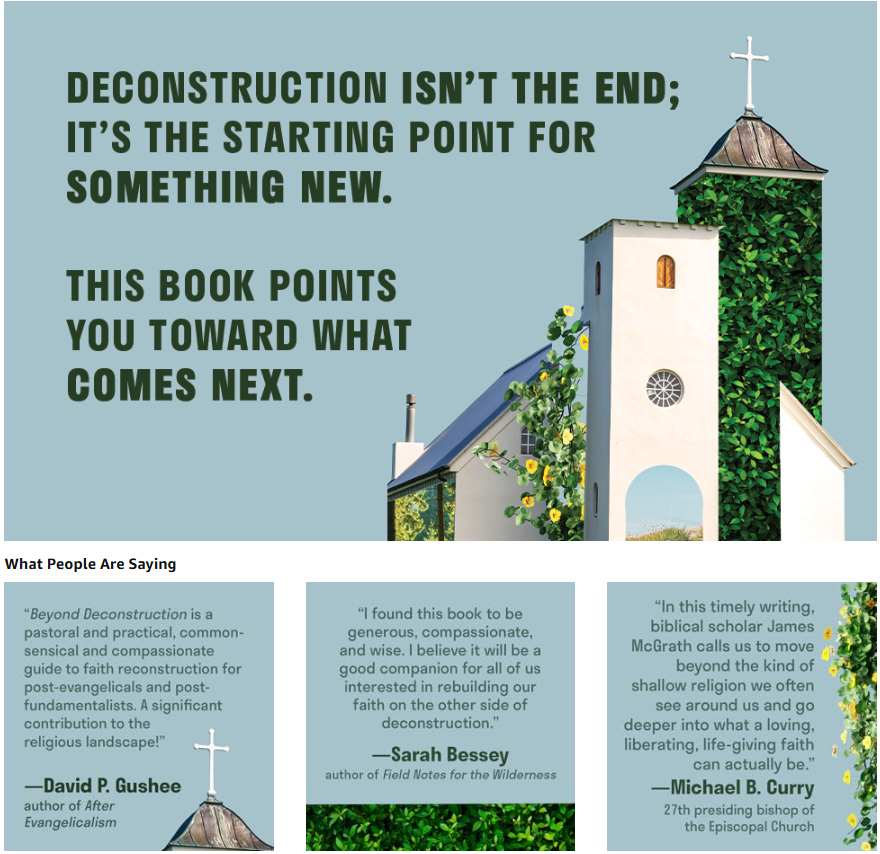
Whenever I have a new book, Jonathan Foye gets in touch and does an interview, and so I thought I would share our recent Beyond Deconstruction interview in its entirety. You can and should read his article, “‘I’m Not That Kind of Christian’ Rebuilding Our Faith after Deconstruction'” published in Insights magazine.
“I’m not that kind of Christian”: Rebuilding our Faith after ‘deconstruction’
However, interviews are always longer than and different from the articles that utilize them, and so I thought this was worth sharing as well. As I start a new year, it is exciting that my most personal book yet, Beyond Deconstruction, will be out soon, and I hope what follows helps you understand why I’m excited about it, and perhaps gets you eagerly looking forward to reading it as well.
Beyond Deconstruction Interview with Jonathan Foye
What is the main premise of the book for those less familiar with the process of reconstructing faith?
The term “deconstruction” in recent years somehow went from being a technical term for a particular approach to literature, to become a buzzword for the process of critically examining your faith. The term hasn’t been clearly defined in that sense, and thus is used to cover a wide array of experiences ranging from carefully rethinking your beliefs to experience a catastrophic collapse of your worldview.
I had the idea to write this book even before the term and the experiences that go with it became widely discussed and popularized. Most people who pursue advanced degrees in biblical studies became interested in the Bible as a result of a faith heritage that they are connected with, whether through upbringing, personal experience, or both. In that context, we are also told things about the Bible that are oversimplified or simply wrong. Thus as a result of studying the Bible closely, the worldview that motivated us to do so gets shaken to its very foundation.
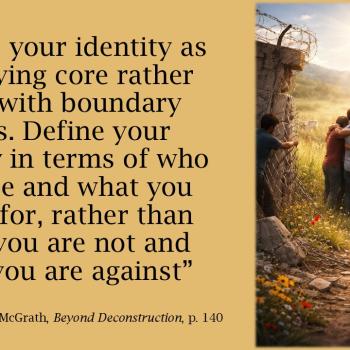
Biblical scholars have thus been “deconstructing” for as long as there has been academic biblical scholarship. I wrote Beyond Deconstruction because I came through the process with a transformed Christian faith, and from conversations I’ve had with others going through the process, sharing the details of that journey has been helpful to them. I wrote the book to share my experience and details of the process and approach, in the hope that they would be useful to others who abandon certain beliefs in light of new evidence, and reach a point where they are ready to stop defining themselves over against what they used to think. Instead of saying “I’m a Christian but…” or “I’m not that kind of Christian,” the book is an invitation to offer a positive articulation of the new worldview you assemble.
Were there any surprising things about deconstruction or the process of putting faith back together that people can look forward to?
For me, I’d say it took me surprisingly long to realize that I didn’t need to apologize for the faith I have now. An important influence on me was Keith Ward’s book What the Bible Really Teaches. He starts off by demonstrating clearly that those who claim to be “Bible-believing Christians” are selective in what they believe. When something is unacceptable to them for whatever reason, they find a way to persuade themselves that the Bible “can’t possibly mean” that thing that they don’t want to believe or do. I passed briefly through a period as a young-earth creationist, having fallen under the influence of some people who persuaded me that being a true Christian included rejecting evolution. My love of science and reading led me to discover that the views of young-earth creationists are lies, and because that wasn’t something I grew up with, I was able to leave it behind. But the experience made me keenly aware of how something that is not part of historic Christianity can become central to the identity of a group.
It took a long while for me to realize what is at the heart of the attraction of views like this. What Jesus calls his followers to do is so hard. Give up what we have, put others first, love our enemies. It is tempting to find something easier to substitute in place of those difficult demands. Not that there isn’t effort involved in being a science-denier. But it is easier than loving your enemies. Indeed, it creates a whole bunch of new enemies (scientists and Christians who embrace the conclusions of science) for you to hate. All the while it feeds your ego, allowing you to think that you know God’s truth and thus can see things about evolution that those clever scientists miss, without ever having to do any actual research. It feeds pride, sows division, distracts from the teaching of Jesus, and misrepresents what the Bible says.
The book will hopefully persuade people that not only can you be a Christian without denying science, you will actually be a better one, not least because you’ll stop spreading lies about science and about the Bible. Young-earth creationism is as dishonest about what the Bible says as it is about science.
Crucially, the book is not aimed at persuading readers to embrace science. Those who have “deconstructed” undoubtedly already do so. If they were previously young-earth creationists, they may feel a nagging guilt or uncertainty, or that accepting science makes them less Christian. The book offers a vision for and guide to fostering a form of faith that doesn’t need to feel threatened by science. And that’s just one of the small snippets of my own experience that I share!
Did you have any favourite experiences of writing this? And finally, how can people get their hands on the book?
I think my favorite moment was sharing my first draft of a chapter with my wife and son. My wife called it one of the best things I’d written, and certainly the most personal. Our son said that I’d now started writing a book that he’d be interested in reading, which hasn’t always been the case. I knew then that I was going to keep working on the book!
The book will be available in Australia as well as in other parts of the English speaking world. I think the two fastest ways to get your hands on a copy are to pre-order the Kindle edition so that it shows up on your phone as soon as it is available, or to go into a local bookstore and tell them you want them to get a copy. It will of course be available on Amazon and other such online booksellers, but in my experience there can be a lag between its US release date and when it is in stock in Australia. Hence my recommendation to let a bookstore know you want it, and have them work on getting it for you.
I hope you enjoyed the above Beyond Deconstruction interview. What other questions do you have about the book, if any? Perhaps one of these videos will answer them:
Don’t miss this previous post about the book, too:












 Ad-Free & Subscriber Log-In