

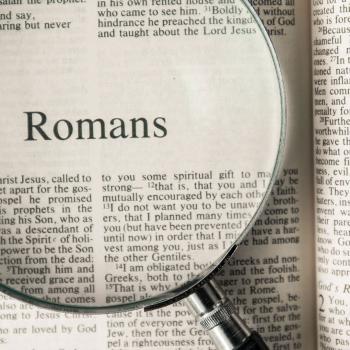
First, I give thanks to my God, through Jesus the appointed king, for all of you, because your faithfulness to God is being reported all over the world. God is my witness, whom I serve in my spirit in the good news concerning his son, as I constantly make mention of you, always asking in my prayers if now, somehow, perhaps, at long last, by God’s will, I will have a clear passage to come to you.
I am longing to see you so that I may impart a spiritual gift to you, so that you may be firmly established. No, wait – that sounds as though I think that it is only I who has something to offer you. What I mean is that I want us to mutually encourage one another in faithfulness, for both your benefit and mine.
I hope you are aware that I have intended on multiple occasions to come to you, and have always been prevented – until now, when I hope that I can finally have an impact in your midst, even as I have among the rest of the nations. I’m indebted to Greeks and barbarians, the wise and the foolish, and hence my eagerness to proclaim good news also among you in Rome.
I’m not ashamed of that good news, I’ll have you know. It is God’s power, at work to accomplish the deliverance of all the faithful – both God’s people first, and also anyone else. In it, God’s very own justice is revealed, from faithfulness to faithfulness, as it is written (in Habbakuk 2:4 – but I’m paraphrasing), “The just shall live from faithfulness.”
__________________________
The only way for Christian readers to grasp the impact of one central theme of Paul’s letter, which is introduced and summed up towards the end of this section, is to place themselves in the passage. Where it says “to Jews first and to Greeks” instead read the following: “God’s power is at work to deliver all the faithful – both Christians first, and also non-Christians.” That gives a sense of how the message sounded in Paul’s time. He was taking the historical identity of God’s chosen people, Israel, and throwing the door open through his adamant claim that it could include others.
It is one of the greatest ironies that most Christian readers think that they embrace Paul’s teaching. And yet they sound more like the view Paul was opposing – an attempt to maintain a special status and salvation for a particular group, as a privilege held by them and not others.














 Ad-Free & Subscriber Log-In