

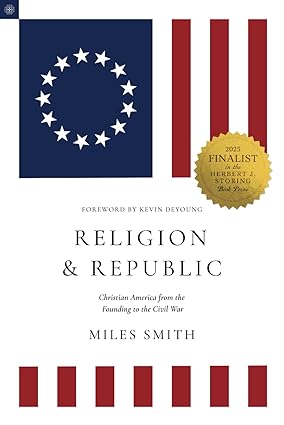
I’m still not committing to blogging through all of Miles Smith’s recent(ish) book Religion & Republic: Christian America from the Founding to the Civil War, but since I did the preface last week and the Introduction this week it’s looking more and more likely this will be a Kuyper-esque series (which I need to get back to–I want to read Pro Rege!) I don’t know that I’ll post about every chapter in the book, but the Preface was intriguing enough I thought it worth a short response here.
In the intro, Smith gives us the formal and explicit thesis of the book:
“What this volume proposes is that the United States Constitution’s disestablishment did not secularize society, nor did it remove institutional Christianity from the civic, state educational, or political spheres.” (31)
Drawing on original sources (including Tocqueville!), Smith argues that the “establishment” Protestant religion was informal, but so broad that it functionally didn’t matter. The Church of England in England and the Roman Catholic Church in France and the Eastern Orthodox Church in Russia never had the cultural punch of First Baptist, Second Presbyterian, and the Grace Methodist churches in small-town America (my examples, not Smith’s).
Even more, Smith argues that the early Americans themselves saw “disestablishment” not as a separation of church from state, but as the ultimate way to defend the established church. Specifically,
“This book posits that the Early Republic United States [1790-1860] in fact remained committed to disestablishment while simultaneously protecting and even perpetuating institutional-usually but not always Protestant-Christianity…” (31)
This is a fairly well-established (but not always well-articulated) principle in Political Science when it comes to free societies. When a citizen body is healthy and virtuously well-behaved, institutional restraints can be relaxed. When we have a people who generally speaks respectfully and decently, we can put a First Amendment in place and trust people to watch what they say without government oversight. (If you want a deeper dive, when the Barons are generally doing a good job, you can have a Magna Carta smacking down the King’s efforts to stick his stupid nose in where it doesn’t belong.) And if you have churches that are broadly influential and politically and socially strong, you don’t need to codify their influence.
In fact, you can de-codify their influence and get a short bump in their influence (at least in the short term). Human beings are more effective when we work together (and even more effective) when we work together voluntarily. When we remove the government rules that force us into certain kinds of action, the result is that other organized bodies step into the void (if it is a genuinely important void). So when government deregulates religion, say by ditching the established church [cheers in Baptist] the result is that the unestablished churches gain more influence, because they’re all that’s left and their membership is entirely voluntary.
Now, to be sure there are other effects as well–the rise of cults being a pretty big one. Still, the point is that Smith is explaining something critical here–and doing it very well. I continue to endorse this book!
Dr. Coyle Neal is co-host of the City of Man Podcast an Amazon Associate (which is linked in this blog), and an Associate Professor of Political Science at Southwest Baptist University in Bolivar, MO











 Ad-Free & Subscriber Log-In