

Dan Sinker, “What I Need You To Understand, Notes from Chicago in Late October”
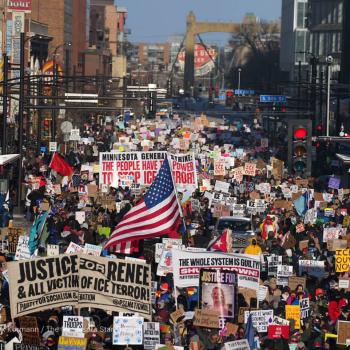
This is how it works: We protect each other, period. These are our neighbors, our friends, our family. We do the things we have to do to ensure that as many of us can make it to tomorrow as possible. Not everyone does. I need you to understand that we tried.
For some, living far away from Chicago, this may sound overwrought. I need you to understand that it’s not. This is every day here. Every day, in any part of the city. As I write this, the onslaught is happening across Lincoln Park, one of the richest parts of Chicago, while yesterday it was in Little Village a working class Mexican neighborhood on the West Side. You never know when it’s going to happen. You only know that it is going to happen. Life is lived on the edge now.
Elizabeth Shakman Hurd, “American Border Religion”
That the border is a zone of legal exception is not a new insight. Rachel St. John notes that as early as the 1920s the border had become a “complicated system of relational space” that “could either be fluid or firm.” In her history of the INS, the predecessor to the US Citizenship and Immigration Service, ICE, and CBP, S. Deborah Kang describes the border as “an impermeable sovereign boundary, a permeable socioeconomic zone, and a vast policing jurisdiction.” Because the INS was exempt from the Administrative Procedures Act (APA) of 1946, Kang notes, the agency was “unconstrained by the procedures stipulated by the APA and judicial review of its administration practices and internal adjudication,” thus becoming “an ‘outlaw’ in American legal culture.” In his autobiographical account, former Border Patrol agent Francisco Cantú describes the US-Mexico border as “a vast zone of exception, a place where laws and rights are applied differently than in any other part of the nation.” The one-hundred-mile aforementioned “Constitution-free” border jurisdiction zone includes roughly one-third of the United States and nearly two-thirds of its population. It includes the entire state of Michigan, which has had the fastest rate of growth of any Border Patrol Sector in the country. …
The exceptions continue. DHS considers itself exempt from the Fourth Amendment, and the government has exempted both CBP and DHS from restrictions on racial profiling that are imposed on other federal departments. One DHS official explained, “We can’t do our job without taking ethnicity into account,” prompting the New York Times to report that “department officials argued that it was impractical to ignore ethnicity when it came to border enforcement.” The organization People Helping People documented a pattern of profiling people of color at Border Patrol interior checkpoints, invoking a long history of white supremacy in the patrol. Founded in 1924 as part of the Immigration Act, the patrol in those days, as described by historian Greg Grandin, was “a frontline instrument of white supremacist power” and “a vanguard of race vigilantism.”
Karen E. Park, “Of Course It Was Shit in Trump’s No Kings AI Video — Calling it ‘Brown Sludge’ Misses the Religious Significance”
In the video, the sovereign himself (he literally wears a crown) becomes the source of pollution and defilement. It is the inversion of holiness, an obscene and grotesque parody. He’s demonstrating that his power is contamination itself.
Christian scripture resorts to the language of excrement only at moments of extreme moral collapse. “I will spread dung on your faces,” God tells corrupt priests in Malachi 2:3, not as metaphor but as judgment. When God commands Ezekiel to bake bread over human dung, He says, “You shall eat it as barley cakes; you shall bake it using human dung as fuel in their sight.” (Ezekiel 4:12) This bizarre command is meant to convey the extreme uncleanness and deprivation Israel will face when the Babylonians besiege the city.
Joseph Margulies, “The Moral Stupefaction of the American Public”
Finally, reducing this controversy to a debate about the law intensifies the ongoing moral stupefaction of the American public. In a theocratic society, disputes are resolved by invoking a holy book; in our society, which claims to worship the rule of law, disputes are resolved by invoking the legal authority to act. The ultimate touchstone of this authority is the Constitution. In the United States, when people wonder whether something is right or just, they are not met with an answer that proves rightness or justice. Instead, they are told that it is legal, or even better, that it is constitutional (or, for some partisans, that it was or would have been approved by “the Founders,” a nebulous group that is treated with God-like reverence and imbued with God-like infallibility). Law-speak thus substitutes for moral judgment.
In other words, we are sold the myth that the language of legality is preferable to the language of morality because it is impartial and fixed. But as this whole dispute makes plain, that is least apt to be true precisely when it matters most. As the voice of bald power, law in this instance has no more legitimacy than any political act. Unfortunately, the longer Americans indulge this mindless preference for the language of the law over morality, the weaker their moral voice becomes. In time, they lose the ability to say, forthrightly and without fear, that what the Trump administration has done is cold-blooded murder for which they and their partisans should be ashamed. They are forced to say, pathetically, that what the Trump administration has done is unlawful, instead of insisting, without hesitation or equivocation, that it is wrong.
Susanne Paola Antonetta, “The Forgotten History of Disabled Children Under Nazism”
T4 set its goal of seventy thousand dead with no obvious means of getting there. Karl Brandt tried injections, but death was slow and could take multiple shots. Himmler had become interested in gas as a quick, cheap method of killing, one less stressful for soldiers, who often broke down psychologically when killing so many by gun. In 1939, Nazi troops received orders to empty asylums in the East, getting rid of “useless eaters” in occupied lands. At first, patients were shot, standing in front of a large pit—some fell forward still in their straitjackets. Reports went to Himmler about badly shaken troops. Guns also used up valuable ammunition.
And so the first gas chamber for the purpose of mass death was built and tested in January of 1940 near Berlin. Attached to the site was the first oven built to dispose of quantities of bodies and bespoke stretchers to convey those bodies without too much handling. These were built in Viktor Brack’s office. The site was an old prison in Brandenburg. T4 administrator Christian Wirth, a cooper’s son, managed the actual construction. Wirth would move on to help run T4 site Grafeneck and then head death camps Sobibor and Treblinka—a man in the Eicke mold whose nickname was “savage Christian.”
Hamden Rice, “Most of you have no idea what Martin Luther King actually did”
It wasn’t that black people had to use a separate drinking fountain or couldn’t sit at lunch counters, or had to sit in the back of the bus.
You really must disabuse yourself of this idea. Lunch counters and buses were crucial symbolic planes of struggle that the civil rights movement used to dramatize the issue, but the main suffering in the south did not come from our inability to drink from the same fountain, ride in the front of the bus or eat lunch at Woolworth’s.
It was that white people, mostly white men, occasionally went berserk, and grabbed random black people, usually men, and lynched them. You all know about lynching. But you may forget or not know that white people also randomly beat black people, and the black people could not fight back, for fear of even worse punishment.
This constant low level dread of atavistic violence is what kept the system running. It made life miserable, stressful and terrifying for black people.










 Ad-Free & Subscriber Log-In