

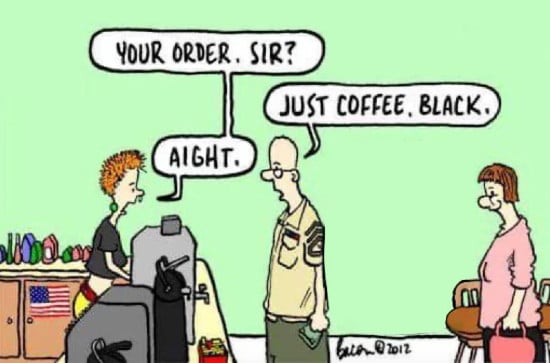
Jason K. Pargin looks at a cartoon that’s been circulating on Facebook for years and makes a case for why it holds the “key to understanding the world today.”
Pargin, author of John Dies at the End and a longtime editor responsible for some terrific work at Cracked, has pivoted to video. You can watch that video here, and I’ll embed it below, but since I want to discuss his comments here without scrambling for the pause button, I’m going to start with a rough transcript:
This boomer comic has been making the rounds on Facebook for at least a decade. It portrays a brave older Marine in a coffee shop, where the barista says, “Can I interest you in a soy latte?” He says, no, “Just coffee. Black.”
“Carmel macchiato?” “Just coffee. Black.”
“Iced peppermint mocha?” “Just coffee. Black.”
“Frappe?”
Now the first thing you’ll notice is that this scenario has never occurred once, anywhere, in the history of the world. And if you say, yeah, well, it’s just a joke, I’m saying the thing that it’s exaggerating has never occurred.
But the perception of a world that motivated the artist to create this, and motivated people to share this millions of times is incredibly important because, in reality, no one ever took his black coffee from him. Every shop like this has black coffee. He can also get it at any gas station, or any McDonald’s drive through, or from home.
All that happened is the range of options for other people expanded and he perceived that as persecution, as his choice having been taken away.
This is not “political.” This is a human nature thing. Most people are not satisfied to simply have the option to live their life the way they want. They also want to feel normal. They want to walk around and see that most other people have made the same choice they made. And if, over time, they see that their personal preference has become less popular and, even worse, is now seen as being basic or unsophisticated, they will perceive the mere existence of those other options as a criticism of them, even if they’ve never heard anybody voice that criticism. …
There is basic psychological comfort in knowing that you’re conforming to what the world wants and in the reassurance that that world is not going to change.
And this is why it doesn’t help to simply tell people, “You can keep doing the thing you were doing. No one’s stopping you from drinking your coffee.” Because it’s not about the coffee. It’s the fear that if everybody else stops drinking coffee the way that I drink it, then I will become an outcast.
And that is scary to someone who suddenly is remembering how they have always treated outcasts.
I appreciate what Pargin means when he describes this as “not political” — meaning that it isn’t political in the sense that it is a product of an explicit partisan ideology or party platform. But beyond that narrow sense of “political,” of course, everything about this is political because it’s all about what is and isn’t “normal” or normative, and who decides that, and how it is or ought to be enforced.
The question of whether or not society’s “range of options” will or should include everyone’s preferences or only a small, normative range is, in fact, the defining political question of 21st-century America. Pluralism vs. exclusivism. Diversity, equality, and inclusion are explicitly partisan matters now. And thus conformity, hierarchy, and exclusion are also one party’s political agenda.
(And that’s “political” without even touching on the warped sexual politics of that cartoon. It portrays a bald man standing between two women who don’t want to have sex with him even though he’s doing absolutely everything he can to perform rugged masculinity the way he was taught and trained to do. He takes his coffee like he imagines John Wayne would — cream and/or sugar would be effeminate — and yet these weird modern women, whether of the age he fantasizes about or closer to his own age, still don’t follow the script and swoon for him like they’re supposed to. I don’t think we can fully understand the resentment and ressentiment and entitlement of our current right-wing politics without accounting for that sexual frustration and sense of emasculation shared among MAGA men who refuse to understand that the women they view as objects are repulsed by them because they view those women as objects, not because of their hairlines or penis size. You cannot begin to understand the right-wing male obsession with mocking “blue-haired baristas” without understanding that they desperately want to sleep with a blue-haired barista and they’re seething with resentment that it’s never gonna happen.)
But anyway, Pargin’s main insights here are very helpful. The cartoon portrays a pervasive fantasy/nightmare that “has never occurred once, anywhere, in the history of the world.”
This is why the circulation of this cartoon led to a rebuttal version of the scene, portraying how this nightmare actually plays out thousands of times a day, every day, here in reality:
Nadine Smith discusses Pargin’s video and describes the impossible, unreal fantasy/nightmare the original cartoon depicts as “anticipatory humiliation”:
Because most of these imagined humiliations never happened, the stories keep their power. They circulate as proof of persecution. The outrage lives on because the incident never did. …
I have witnessed this pattern firsthand. I have had conversations, usually with straight white men who consider themselves tolerant and open-minded, who tell me they are fine with gay people but that “this whole pronoun thing has gone too far.” They start calm, but within minutes they are red-faced and agitated. So I ask what happened. What experience set them off?
The answer is always no one. They have never had the encounter they are angry about. No one they know has either. It is all secondhand, a story absorbed from talk radio, Facebook, or a viral post about someone getting “canceled” for saying “he” instead of “they.” The outrage is real because it feels like something that could happen.
It “feels like something that could happen” to them mainly due to that fear Pargin talks about in that wallop of a final sentence. The fear of “suddenly remembering how they have always treated outcasts.”
The thing about this “anticipatory humiliation” is that what it anticipates — fears, dreads — is something that is not at all “humiliating.” I am a 50-something straight white Christian American male and I have, many, many times, tripped over pronouns (or honorifics or surnames). Here is how that has played out, every single time:
Me: “He …”
Them: “Actually, it’s ‘they.'”
Me: Oh, sorry, my bad.
Them: No worries. Anyway, you were saying …?
That’s not humiliating — unless you decide that it is beneath you to ever say “Sorry, my bad” to anyone, ever. I can’t imagine choosing the constant stress of living in the minefield that would entail, but I guess some people equate occasionally having to say “Sorry, my bad” with red-faced humiliation and enduring shame rather than just recognizing it as a basic, daily part of being human.
People tend to be gracious to anyone with the grace to accept that.
This is what I appreciate most about Pargin’s video — it’s seeking to be gracious, reaching for a way to reach people who are choosing to be beyond our reach. He’s not just dunking on this dumb cartoon and on all the insecure Facebook boomers circulating it. He’s trying to unpack it in a way that would help us figure out how to convince those folks that their imaginary fears and resentments don’t have to rule their lives. (And, thus, don’t have to rule our lives too.)
The biggest obstacle to that is the fear he describes in that last sentence. These folks are scared of religious pluralism, of ethnic pluralism, of anything other than strict conformity to gender roles, And that fear, as he says, is rooted in the fear that others will do unto them as they have done unto others — that, in a sense, the Golden Rule will come back to smack them upside the head.
This has got me thinking again about all the dense theological pondering we Christians do about the relationship between repentance and grace. The latter can only follow the former, but also the former is impossible without the latter. Kindness leads to repentance and all that.
But we needn’t get so deep in the theological weeds here. Basic Mister Rogers stuff remains a good starting point. These insecure, anxious, persecuted hegemons driven by their fears of anticipatory humiliation need, somehow, to learn what they should have learned from Fred Rogers when they were kids: 1. You are special and immeasurably worthy and good, and 2. So is everybody else.
I suspect they’ll always have a problem with that second point because they’ve never quite believed the first one.
Here’s the video:
The title of this post comes from Squeeze’s 1982 hit “Black Coffee in Bed.”
We need to say a word here about how much fun the background vocals at the end of this song are, and how much fun it is to sing along to them with friends who may or may not have been drinking something other than coffee.
The background lyrics are simple, you just need to know how to count to three:
Black [beat, beat] coffee in bed
Black [beat] black coffee in bed
Black black black coffee in bed
(Repeat)
Trust me, if you can arrange a situation where you’re singing that bit with two or three friends — singing along to a jukebox or a boombox or karaoke or a band, whatever — you will feel a bit better about whatever it is that you need to be feeling a bit better about.
Here’s the song, so you can practice. Our part starts at about the 4:48 mark:
The radio edit of this song cuts off the ending, which is unforgivable. If you need a 4-minute version of this song, you should just play the whole thing faster.















 Ad-Free & Subscriber Log-In