

The church I grew up in got quite a surprise one Sunday in 1990 when one of the missionaries we supported stood before the congregation and explained that he hadn't been telling us the whole truth for the past 10 years.
That church had a passion for sending out missionaries. Hydewood Park Baptist Church supported a lot of missionaries, and the people there dug deep into their pockets to provide that support. And we prayed for them a lot too, covering our refrigerators with pictures of these missionary families as a daily reminder to do so.
When our missionaries were stateside on furlough, they would visit the church to report on their work overseas (and, yes, to shore up continued support). They would often give brief remarks in the Sunday morning service, then spend the afternoon sharing a meal in the home of some member of the church before returning to preach in the evening service.
One of the younger missionary couples always came to have dinner at our house. When these missionaries were still in high school they had attended the summer Bible camp where my parents had been counselors years ago. (It's where my parents met.)
These missionaries worked with InterVarsity Christian Fellowship in Austria. You may be familiar with InterVarsity from their work on college campuses across the U.S. (They're like Campus Crusade, except sane.)
All through the 1980s our church supported these missionaries. But for all that time they never really told us what they had been doing. They didn't tell us the real story until they returned on furlough in 1990 and Bob, the husband, came clean.
It seems they weren't really working in Austria. That was just where they were based. That was their cover. They were actually working in Czechoslovakia, Hungary, Bulgaria, Romania, Albania and the former Yugoslavia.
Bob, it turns out, was a missionary James Bond — on his savior's secret service. Like any IVCF worker in the states, he met with groups of college students for prayer, Bible study and fellowship. But the groups Bob worked with lived in places where such meetings were illegal. The students he met with were exercising rights — freedom of conscience, freedom of worship, freedom of assembly — that their governments did not yet recognize.
One of the places where such a group of students gathered was in Timisoara, Romania. You've seen pictures of the church where some of these students attended. You've seen pictures of some of the students Bob worked with, standing with candles in the snow in the December of 1989. (Read more here.)
That was just 15 years ago. A wave of revolution, freedom, democracy and human rights swept across Eastern Europe reaching, by August of 1991, into the very heart of Red Square in Moscow.
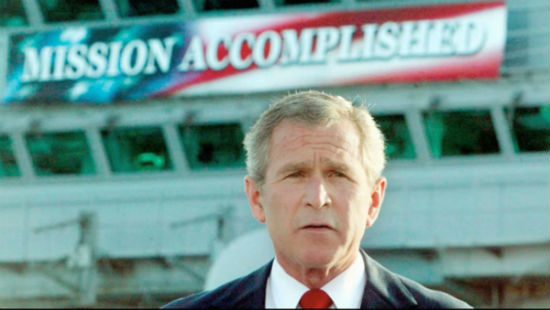
I bring up this story as a counter to the binary accusation of "do-nothingism" that has become the last, desperate accusation leveled in defense of the U.S.-led invasion of Iraq. Those who opposed this invasion are told that if our position had prevailed Saddam Hussein would still be in power today. Perhaps. Perhaps not. The events of 1989 took the world by surprise.
But what strikes me about Bob's work — like the work of so many people throughout the long decades of the Cold War — is the enduring patience and determination. Bob learned the languages. He helped to strengthen the civil society. He was planting trees, trees with roots deep and strong enough to break through concrete.
Contrast that approach with the blundering impatience of the Bay of Pigs. Contrast the difference in outcomes. One worked. The other didn't. And yet the latter has become the model we're now told to embrace lest we be accused of being "objectively pro-Saddam" enemies of freedom.
It seems to me that if we're really serious about "promoting democracy" that we ought to be studying the events of 1989 very carefully. What were the conditions and preconditions in Czechoslovakia that led to the Velvet Revolution? Can those conditions be replicated, translated and recreated elsewhere? What were the differences in the former Yugoslavia that caused it to be the chaotic exception to the triumphs in the rest of the region? Was that situation avoidable?
Many people are studying all of this, of course, but their work is currently out of favor. It's too long-term, too slow. Too hard.
Such patience can no longer be afforded, we are told, because the events of Sept. 11 "changed everything." We now live under the threat of sudden, deadly attack here on American soil. As though that same thing had not been true during every day of the Cold War.
We know what works. We're seeing again what doesn't work. It would be nice if the proponents of what doesn't work would stop accusing the proponents of what does of "do-nothingism."







 Ad-Free & Subscriber Log-In