

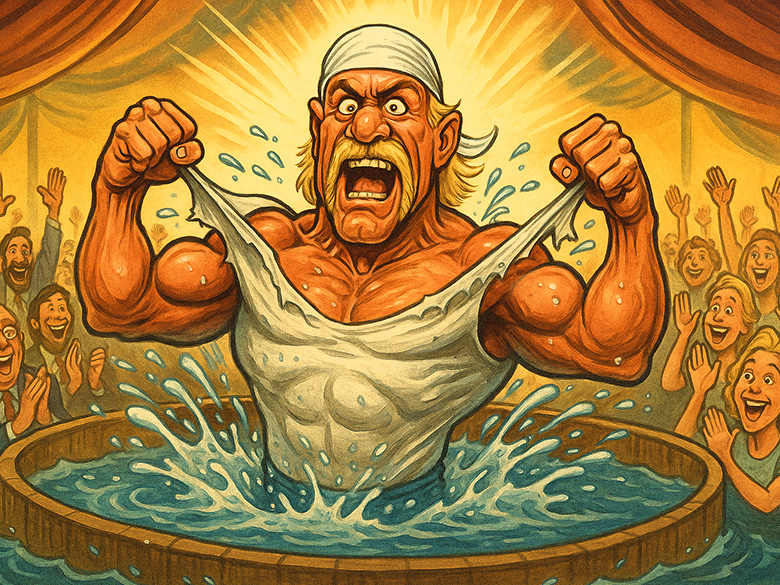
It’s been over a month since Hulk Hogan died, and if your algorithm is anything like mine, you’ve probably seen the same meme a dozen times: Hogan in white, wet from baptism, surrounded by beaming pastors in khaki shorts and polo shirts. The caption? Some variation of “Rest easy, Hulk. You’re finally home.”
Evangelicals ate it up. It’s the perfect send-off: a man with a colorful and problematic past, wrapped up in a splash of holy water and a quote about “total surrender to Jesus.” Instant redemption. Clean ending. Nothing to see here, brother.
Except… there is.
Because what we’re witnessing isn’t faith—it’s marketing. And what they’re selling is the cheap grace of a baptismal stunt double. It’s not about the person being baptized. It’s about how good it makes everyone else feel.
The Salvation Spectacle
I remember being a kid in church when a friend’s dad died. He wasn’t a churchgoer, and the family was quietly devastated—worried about his eternal fate. That is, until someone unearthed an old “commitment card” tucked into the back of his childhood Bible. Cue the tears of joy. Heaven confirmed. Crisis averted.
That card didn’t mean anything. But it meant everything to them.
That’s the game. It’s not about the substance of someone’s life—it’s about giving the faithful some kind of loophole to cling to. One final Hail Mary of certainty in an uncertain world. Redemption on a technicality.
Fast forward to 2024 and Hulk Hogan’s late-in-life baptism checks all the same boxes. It’s packaged, shared, and reposted—not as an intimate spiritual moment but as a moral Band-Aid. No wrestling with legacy. No public accountability. Just vibes. Faith, filtered through a MAGA lens, becomes a ritual of cultural belonging—not transformation.
Enter Russell Brand, Stage Right
We’ve seen this same script play out with Russell Brand.
Brand, whose public persona once leaned heavily on spiritual curiosity and recovery, now spends more time parroting conspiracies, courting right-wing attention, and dodging the wreckage of sexual misconduct allegations.
But somewhere along the way, he too “found Christ.” Not through repentance, not through service, not through silence and accountability—but through YouTube thumbnails and podcast appearances. Like Hogan, Brand’s baptism functioned less as a turning point and more as a narrative reset. It wasn’t grace—it was a rebrand.
To be clear: grace is possible. Repentance is meaningful. But not when it’s used as a smokescreen for influence, applause, and protection.
Baptism Isn’t the Finish Line
We’ve warped the meaning of baptism. In the early church, it was radical—an act of public defiance against empire, ego, and injustice. It marked the beginning of a hard, countercultural journey.
Now? It’s the end credits. A ceremonial absolution that erases everything that came before it. It doesn’t signify change—it signals allegiance. Welcome to the cult. Here’s your MAGA hat and a Bible you won’t read.
When baptism becomes a branding tool, it loses all integrity. It’s not about dying to self. It’s about laundering legacy. It doesn’t confront sin—it hides it behind hashtags and viral testimonials.
Holy Water as Image Control
This is the evangelical formula:
- Public figure sins loudly.
- They go quiet for a bit.
- Someone films them getting baptized.
- The faithful rejoice.
- The sins are never mentioned again.
It’s grace without truth. A gospel of optics. A PR move that comforts the sheep and shields the shepherds.
And in case you’re wondering: no, this isn’t about gatekeeping who gets saved. This is about calling out how we’ve commodified salvation. This is about the false comfort that comes from a sanitized storyline, where all that matters is whether someone said the right thing and got wet—not whether anything changed.
Baptism Is Not a Magic Trick
We’ve mistaken baptism for a magic trick. But water doesn’t erase harm. It doesn’t heal the past. It doesn’t override a life spent in pursuit of self, power, or platform. Baptism is supposed to mark the start of transformation—not be used as the final edit in a legacy highlight reel.
When the church uses baptism to rewrite a public narrative, it isn’t protecting faith—it’s protecting its own fragile mythologies. The myth that Jesus saves your guy, no matter what. The myth that redemption is a spectacle instead of a process. The myth that the right words and right pictures are enough.
Closing Benediction
Maybe Hogan did find something real. Maybe Brand is actually changing. But until we stop turning baptisms into promotional content, I’ll keep calling it what it looks like: a holy-themed press release.
Because if grace doesn’t come with truth, if faith doesn’t demand change, and if redemption doesn’t require anything, then what we’re left with isn’t Christianity.
It’s cosplay.
With better lighting.
And worse theology.
For more Snarky Faith, check out the podcast and more:
- Snarky Faith website
- Snarky Faith on Instagram: @stuartdelony
- Snarky Faith on YouTube: @snarkyfaith
- Snarky Faith on Bluesky: @snarkyfaith.bsky.social
- Snarky Faith Group on Facebook: www.facebook.com/snarkyfaith
- Snarky Faith t-shirts and mugs available here.
















 Ad-Free & Subscriber Log-In