


This shift dulls the Gospel’s social edge in at least two ways. First, by disconnecting Jesus’ death from a public act of resistance to economic injustice, John deemphasizes the political cost of confronting oppressive systems. When the Temple protest is placed at the center of the passion narrative, as in the Synoptic Gospels, it makes clear that Jesus is executed because he threatens entrenched interests that profit from inequality. But in John, that causal link is weakened. The Temple scene becomes symbolic. It is about Jesus “replacing” the Temple as a metaphysical space for accessing the Divine, not Jesus as a flashpoint of social conflict that demands a response from the status quo with the temple serving as the capital of the Temple State.
Welcome Readers! Please subscribe to Social Jesus Here.
This is Part 2 of the series A Story of Hope for our Present Moment
(Read this series from its beginning here.)
Second, the raising of Lazarus introduces a more gnostic dynamic to the story, in the sense that salvation is framed primarily as private, personal, individual access to divine life and revealed knowledge rather than liberation from unjust structures. Eternal life in John is something encountered through belief and recognition of who Jesus is, not through participating with Jesus in the social implications of “the kingdom” on earth as it is in heaven. While John’s theology is profound, it can be abstracted from our material, concrete, socially lived experience. The danger is that injustice becomes secondary, a backdrop to metaphysical revelation rather than a central arena of God’s saving work.
This is not to say that the Gospel of John lacks ethical concern. Its emphasis on love, mutual service, and truth has deep moral and ethical implications. But narratively, the reason Jesus is killed matters. When cosmic, metaphysical reasons for Jesus execution replace the political and economic protest as the decisive cause, the cross risks being interpreted primarily as merely spiritual matter rather than as the predictable outcome of confronting systems that harm the vulnerable and the marginalized.
For Jesus followers committed to justice today, this Johannine reframing invites both caution and critique. John offers a rich theology of life, but by relocating the Temple protest and centering Lazarus, it softens the Gospel’s confrontation with structural injustice. Recovering that sharper and much older edge of the gospel stories requires reading John alongside the Synoptics, allowing the Temple protest to reclaim its place as a warning: challenging unjust systems is not safe, but it is central to following the way of Jesus.
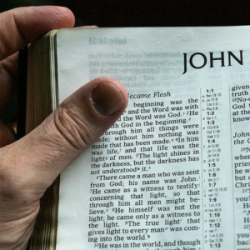
The story of Lazarus of Bethany in the Gospel of John has often been read primarily as a miracle story demonstrating the power of Jesus of Nazareth over death. Yet when read carefully, it could be interpreted with implications for Christian social justice work today.
Lazarus’ death occurs in a community bound together by friendship, grief, and solidarity. When Jesus arrives, he does not stand apart from the suffering of those around him. Instead, he weeps alongside them. This moment reveals a profound truth: divine compassion is not distant from human pain. This gospel’s words ring out, “Jesus wept.” For Christian communities engaged in social justice work, this suggests that faithful action begins with genuine solidarity. Before transforming suffering, one must be willing to feel it and stand with those who experience it.
The command Jesus gives at the tomb in our reading is also significant. We’ll wrap up with that significance in Part 3.
Begin each day being inspired toward love, compassion, justice and action. Free.
Sign up at HERE.















 Ad-Free & Subscriber Log-In