


The command Jesus gives at the tomb in our reading is also significant. Although Jesus calls Lazarus out of the grave, he then tells the surrounding community, “Unbind him, and let him go.” In our reading this week, Lazarus emerges alive, but still wrapped in the burial cloths. It is the community’s task to remove them. The miracle is therefore not completed by Jesus alone but requires communal participation. I can’t help but think of Moses’ words in the Exodus story to Pharaoh: “Let my people go!” These stories, Exodus and John 11, both show we have a work to do of participating in our liberation.
Welcome Readers! Please subscribe to Social Jesus Here.
This is Part 3 of the series A Story of Hope for our Present Moment
(Read this series from its beginning here.)
For Christian social justice movements, our story also offers a powerful lesson for this moment of U.S. imperialism. Systems of injustice built on poverty, racism, exclusion, and violence can function like burial wrappings that keep people bound even after life has returned. Liberation requires more than individual transformation; it calls communities to participate actively in our unbinding.
We can interpret this story of resurrection as as about something much more relevant today than life after death later. In the story of Lazarus, resurrection interrupts grief and despair in the present. It doesn’t ask us to wait for hope in the future. It offers us hope for today. It restores a person to community, relationship, and dignity today, not only as Martha says, “in the resurrection.” Christian social justice work can be understood in similar terms. Ours is the work of participating in life-giving liberation here and now.
Seen this way, the resurrection of Lazarus becomes not only a miracle story but a call. Communities that follow Jesus are invited to help roll away the stones of injustice and participate in the unbinding of those whom death-dealing systems have harmed and wrapped in despair now.
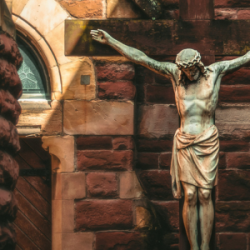
Lastly Lazarus’ resurrection points forward in John’s narrative to Jesus’ resurrection. First, Jesus’ death on the cross can be better understood, not as a divine requirement for atonement, but as the tragic outcome of imperial state violence. In the first century, the Roman Empire used crucifixion was a punishment to publicly terrorize those it considered threats to its political and social order. It was meant to humiliate, silence, and erase dissent. Jesus’ execution fits within this pattern. His message of God’s reign, a vision of justice, shared abundance, and solidarity with the marginalized challenged both imperial power and the systems that benefited from it. The cross, therefore, reveals what oppressive systems often do to those who embody liberation truth-telling: they attempt to destroy them.
Seen in this light, the cross is not salvific suffering that redeems the world or because God required a sacrifice. Instead, it exposes the injustice of the powers that killed Jesus. It is the moment when violence, fear, and domination appear to have the final word. The resurrection decisively reverse their apparent victory. By raising Jesus, God vindicates the life and message that empire attempted to extinguish: the resurrection declares that the violence of the cross does not stand as the ultimate reality. The empire’s verdict of death, shame, and defeat is overturned. Life, justice, and truth endure.
In this way, the resurrection undoes what the cross attempted to accomplish. The cross tried to silence Jesus’ vision of a just world, but the resurrection amplifies it. The cross sought to erase him, but the resurrection restores Jesus as a living witness to God’s solidarity with the oppressed. The cross represents the worst that systems of domination can inflict; the resurrection reveals that such violence cannot ultimately triumph.
Coupled with the previous event in John’s Gospel, Lazarus’ resurrection, it is the opinion of many today, myself included, that Christian hope does not rest in the cross as a mechanism of salvation, but in the resurrection as God’s refusal to allow injustice and death to have the final word. And that is a message much needed at the moment.
Begin each day being inspired toward love, compassion, justice and action. Free.
Sign up at HERE.













 Ad-Free & Subscriber Log-In