

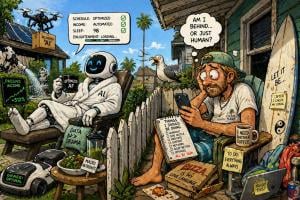
Part II: When Your Neighbor’s Robot Is Holier Than You
There was a time—not that long ago—when “Keeping Up with the Joneses” meant your neighbor got a nicer grill.
You’d notice it.
You’d pretend not to care.
And then, three weeks later, you’d somehow own a slightly better grill like it was your civic duty.
That was manageable.
Now?
Your neighbor has an AI running his calendar, making decisions, optimizing his day before he’s even brushed his teeth. He’s got income streams doing CrossFit while he sleeps. His watch tells him how well he rested, how stressed he is, and—if we’re being honest—probably judges him more honestly than his own pastor.
And somehow… he seems more at peace than you.
Which just feels down right rude.
Welcome to the New Comparison Game
We’re not comparing stuff anymore.
We’re comparing capacity.
Not what you own, but what you can keep up with. Not how you’re doing, but how efficiently you’re doing it. Not whether you’re present, but whether you’re progressing.
Your neighbor isn’t just winning (Charlie Sheen voice).
His tools are.
And that creates a kind of pressure that’s hard to name but impossible to ignore. It hums under everything. It shows up in small moments. You’re sitting there, minding your own business, and suddenly the thought slips in:
“If I don’t keep up… am I falling behind?”
You don’t even know what “behind” means anymore. But you feel it in your weary fucken bones!
The Fear Beneath It All
Let’s not pretend this is neutral.
This isn’t just about innovation or convenience. This is about fear.
The fear of being replaced.
The fear of becoming irrelevant.
The fear that if you’re not constantly improving, you’re quietly disappearing.
We’ve turned life into something that needs to be continuously upgraded. Like you’re an app that needs constant updates or you’ll glitch out and lose value. For me, it’s like do I have to post every accomplishment my kids are doing right in sports to keep them relevant? NO!
And the exhausting part is that there’s no finish line.
There is no moment where you arrive and say, “I’m good. I can stop now.”
Because the system isn’t built for arrival.
It’s built for acceleration.
Jesus Did Not Optimize His Life
And then there’s Jesus.
Who, if we’re honest, would not do well in today’s productivity culture.
He spent thirty years doing… nothing impressive.
No platform. No audience. No personal brand strategy. No carefully curated life plan. No side hustle that turned into a podcast about finding your divine calling in twelve easy steps.
Thirty years of ordinary life.
Working. Eating. showing up. Being present in a place that would never trend.
Today, we’d call that wasted time.
We’d say he wasn’t maximizing his potential.
We’d encourage him to “start sooner.”
Then He Started Walking
And when he finally did step into public life, he didn’t scale it.
He walked.
Everywhere.
Slow enough to be interrupted. Slow enough to notice people. Slow enough to actually see what was in front of him.
It’s almost offensive how inefficient it is.
No shortcuts. No optimization. No attempt to speed up the process.
Just presence, one step at a time.
Interruptions Were Never the Problem
What’s fascinating is that Jesus didn’t treat interruptions like obstacles.
He treated them like the point.
Someone reaches out in desperation and touches his robe. He stops.
A man cries out from the side of the road. He stops.
Children interrupt what feels like an important moment. He welcomes them.
If that was your day, you’d feel behind. You’d feel like everything was getting derailed. You’d feel like you weren’t getting anything done.
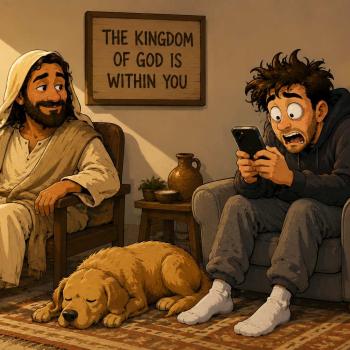
Jesus calls it the Kingdom.
Because what we label as inconvenience, he recognizes as invitation.
What we try to manage, he enters into.
The Tension We Don’t Want to Admit
Here’s where it hits.
We want the peace of Christ.
We just don’t want to slow down to get it.
We want a calm mind, but we don’t want to change our pace. We want presence, but we want it to fit inside a life that’s already moving too fast. We want depth, but without losing momentum.
That combination doesn’t exist.
The peace Jesus embodies isn’t layered on top of a chaotic life.
It comes from a reordered one.
You Can’t Keep Up and Stay Present
At some point, this becomes a choice.
You can keep up with everything, or you can be present to something.
But you cannot do both.
Attention doesn’t work that way. It’s not infinite. Every time you give it to the next thing, you take it away from what’s right in front of you.
And what’s right in front of you is where your life actually is.
Not in the next update. Not in the next breakthrough. Not in whatever everyone else is doing.
Right here.
Which sounds simple until you try to live it.
Presence Feels Like Losing
Let’s be honest about something.
Choosing presence doesn’t feel like winning.
It feels like falling behind.
It feels like you’re missing something important. Like everyone else is moving forward while you’re standing still. Like you’re opting out of a race that everyone else seems committed to winning.
Your ego doesn’t like that.
It wants progress. It wants proof. It wants to know that you’re moving in the right direction.
Jesus rarely offered that kind of reassurance.
Maybe It’s the Wrong Race
What if the problem isn’t that you’re behind?
What if the problem is that you’re measuring your life by a system that was never designed to measure what actually matters?
Because the Kingdom of God doesn’t run on speed.
It doesn’t reward efficiency.
It doesn’t care how optimized your life looks from the outside.
It cares about whether you are present, whether you are awake, whether you are actually living the life in front of you.
That’s a completely different game.
And most of us are still trying to win the old one.
You’re Not a Machine
And this matters more than we think.
You get tired.
You lose focus.
You doubt yourself.
You need rest, connection, silence, meaning.
None of that is a flaw.
It’s the point.
But instead of honoring that, we’ve started treating those things like bugs in the system. Like something to fix, something to eliminate, something to upgrade out of.
And yet the entire story of Christ moves in the opposite direction.
God doesn’t become more efficient.
God becomes human.
Limited. Present. Interruptible.
That’s not a downgrade.
That’s the revelation.
The Quiet Rebellion
So what do you do with all this? I do not know (gasp)…
I don’t think you have to throw your phone away or disappear into the woods.
This isn’t about rejecting the world.
It’s about refusing to measure yourself by it.
Refusing to believe that your value is tied to your pace.
Refusing to let comparison define your worth.
There is a quiet kind of rebellion in that.
Not loud. Not dramatic.
Just a steady refusal to rush past your own life.
You Don’t Have to Keep Up
You don’t have to keep up with the A.I.-s.
You don’t have to match the pace.
You don’t have to prove that you’re still relevant.
Because the life Jesus invites you into isn’t moving that fast.
It’s slower.
Deeper.
More present than you’re comfortable with.
And that’s exactly why it feels like you’re falling behind when you first step into it.
But you’re not.
You’re just finally stepping out of a race that was never going to give you what you were looking for in the first place.
And for the first time in a while…
you might actually be where you are.













 Ad-Free & Subscriber Log-In