


Riffing in an Algorithmic World — Part II
In Part I, I argued that algorithms have basically become our digital prophets — minus the sackcloth, plus push notifications.
Since then, things have escalated.
The other day I started typing a text and my phone’s AI autocomplete finished my sentence before I even knew where I was going with it. Not “close enough.” Not “vaguely accurate.”
Perfect.
Which means somewhere in the cloud, a server now understands my thought patterns better than most people…
And that’s when it hit me:
If the algorithm can finish our sentences… is there still room for God to interrupt them?
Because Part I was about riffing inside the system.
Part II is about what happens when the system starts acting like it knows you better than you know yourself.
Spoiler: it thinks you’re one late-night snack away from buying something you absolutely don’t need.
When Your Personality Becomes a Playlist
Algorithms are incredible at pattern recognition. They track clicks, pauses, scroll speed, the exact moment you stop pretending to read long articles and start watching dog videos.
They know your taste.
They know your mood swings.
They know when you’re procrastinating “productively.”
And slowly, without noticing, you start living inside a version of yourself the algorithm understands.
Same opinions.
Same content.
Same emotional loops.
It’s like spiritual life curated by a DJ who refuses to play anything that might challenge the vibe (spin that “shit”).
Reinforcement Is Not Transformation
Here’s the sneaky thing about personalization: it feels like growth because it feels tailored.
But being understood isn’t the same as being transformed.
Algorithms reinforce who you already are.
God has a habit of turning people into someone new.
Abram becomes Abraham.
Saul becomes Paul.
Fishermen become revolutionaries.
Meanwhile, your feed just becomes… more of your feed.
No burning bushes. Just sponsored posts.
The Echo Chamber of the Holy Me
If we’re honest, a lot of us prefer a God who confirms our worldview. A God who subscribes to our newsletters. A God who would absolutely like our posts.
And in an algorithmic culture, that’s easy to build.
You can curate a faith where every voice agrees with you, every sermon affirms you, and every hot take proves you’re the reasonable one.
But historically, God has not been a fan of comfort zones.
Burning bushes don’t come with content warnings.
Prophets don’t check audience analytics.
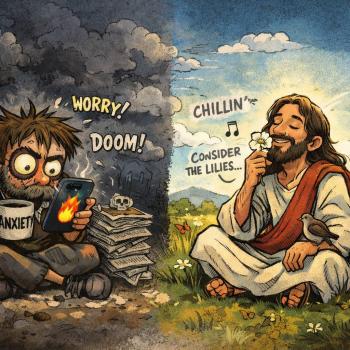
Jesus did not workshop the Sermon on the Mount for engagement metrics.
Divine encounters tend to feel less like affirmation and more like a plot twist.
Optimization Is the New Legalism
We used to measure holiness with rules. Now we measure it with progress.
Morning routines.
Habit trackers.
Prayer streaks.
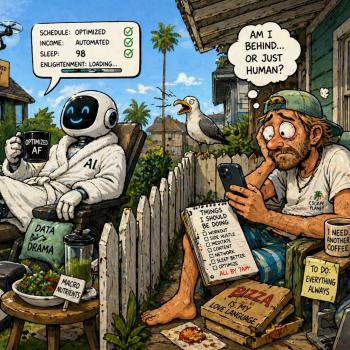
We’ve basically turned spirituality into a Fitbit for the soul.
“How many steps did you take toward enlightenment today?”
But transformation isn’t a productivity hack. You can’t life-optimize your way into grace. The kingdom of God is not a self-improvement podcast.
It’s messy. Disruptive. Frequently inconvenient.
Which is probably why we prefer apps.
God, the Ultimate Wild Card
Here’s what algorithms can’t handle: unpredictability.
They can model behavior, but not grace.
They can forecast choices, but not surrender.
They can predict what you’ll binge, but not what will heal you.
God, meanwhile, specializes in plot twists.
Calling shepherds kings.
Choosing outsiders as insiders.
Resurrection as a strategy.
If God ran on data, half the Bible would’ve been canceled after the pilot episode.
Practicing Holy Chaos (Lightly)
I’m not suggesting you throw your phone into the ocean (though if you do, please film it — irony is important).
But maybe spiritual resistance in an algorithmic world looks like this:
Read something you disagree with without rage-tweeting.
Pray without trying to sound impressive.
Have a conversation where you don’t steer toward your talking points.
Let boredom exist without immediately anesthetizing it.
Basically, create space for something unscripted to happen.
Because that’s usually where God sneaks in.
The Algorithm Doesn’t Know Your Ending
Here’s the good news: you are not a closed system.
You are not your browsing history.
You are not your engagement metrics.
You are not a predictable pattern with a shopping cart.
You are unfinished. Unresolved. Still becoming.
Which means your story is fundamentally incompatible with prediction.
The algorithm might know what you’ll click tonight.
But it has no idea who you’ll become.
Back to the Riff
Part I said transformation happens when we riff inside the algorithm — when we loosen our grip on outcomes and let life get weird.
Part II is the reminder that God is still riffing too.
Not optimizing.
Not scripting.
Not reducing your life to a clean narrative arc.
Improvising.
Inviting.
Interrupting.
We live in a world obsessed with certainty.
But faith has always been a little chaotic — less like a spreadsheet, more like a jam session where you don’t know the next chord until you play it.
So maybe the goal isn’t to escape the algorithm.
Maybe it’s to stay human inside it.
Curious. Interruptible. Slightly unpredictable.
Because the algorithm might know your habits.
But it still has no idea what grace is about to do with your life.
And honestly?
Neither do you.
Which is exactly what makes it good news.











 Ad-Free & Subscriber Log-In